Cookie Banner Fatigue: Why Consent UX Needs a 2026 Reset
Learn why cookie banner fatigue hurts trust, where legal consent differs from analytics choices, and how privacy-first analytics reduces intrusive prompts.
TL;DR
Cookie banner fatigue happens when repeated consent prompts make visitors dismiss, ignore, or distrust privacy notices. The practical fix is not hiding consent, but limiting tracking, making choices clear, and using privacy-first analytics where possible.
Cookie banner fatigue has become a trust problem, not just a pop-up problem. HTTP cookie: a small block of data created by a web server and stored by a browser, often used for sessions, preferences, measurement, or advertising. For SaaS, e-commerce, and growth teams, the 2026 priority is clear consent with fewer intrusive prompts.
Table of Contents
What is cookie banner fatigue?
Cookie banner fatigue is the exhaustion visitors feel after repeatedly facing cookie consent banners, especially when choices are confusing, manipulative, or interrupt the page. The problem sits between privacy law, interface design, and marketing measurement: consent may be required, but poor banner design is a business choice.
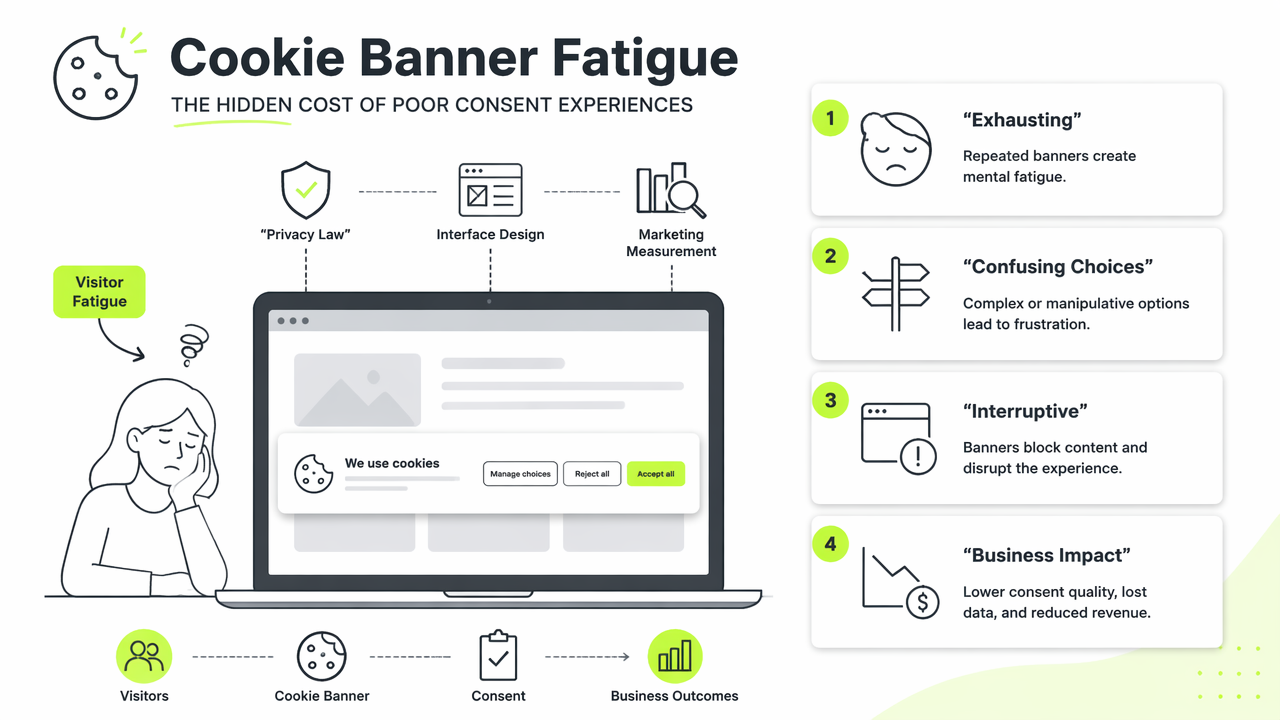
Research by Bongard-Blanchy, Rossi, and Rivas (2021) examined how people perceive dark patterns in digital interfaces. That matters because consent prompts that nudge acceptance can turn privacy control into pressure.
Clear consent should reduce uncertainty, not train visitors to close banners without reading them.
Consent fatigue versus lawful consent choices
The core distinction is simple: law may require permission for certain tracking, but design decides how respectful that request feels.
| Concept | What it means | Better 2026 practice |
|---|---|---|
| Legal consent | Permission for non-essential tracking or storage | Ask only when consent is actually needed |
| Banner design | The interface used to request choices | Use equal, plain-language options |
| Analytics setup | The data model behind measurement | Prefer aggregate, privacy-first reporting |
A clear privacy policy helps explain data practices outside the banner, while terms of service set broader product rules. Neither should replace a consent choice when consent is legally required.
Why intrusive banners damage trust and data quality
Intrusive banners damage trust because they make privacy feel like an obstacle rather than a right. When visitors face repeated overlays, vague labels, or hard-to-find reject buttons, the result is often quick dismissal rather than meaningful choice.
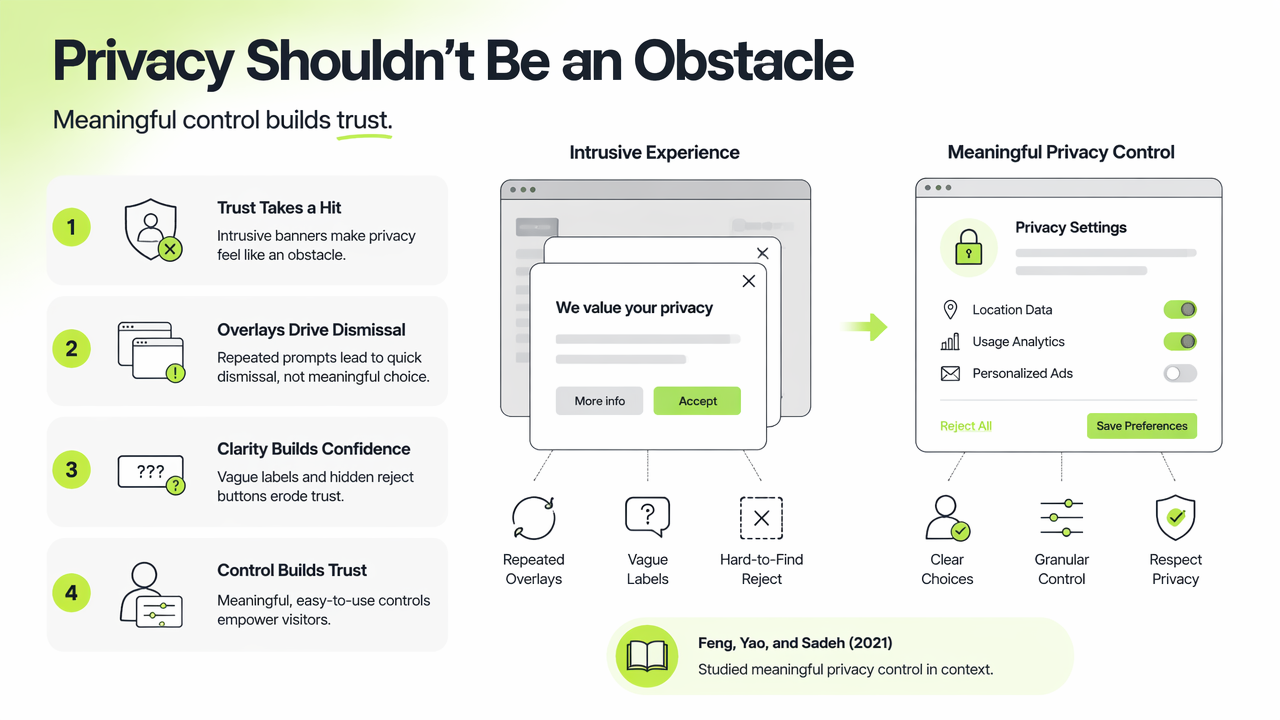
Feng, Yao, and Sadeh (2021) studied meaningful privacy control in connected systems, a useful frame for websites too. Privacy controls work best when choices are understandable, timely, and proportional to the data being collected.
Bad consent experiences also weaken analytics. Acceptance rates may rise through pressure, but the resulting data can reflect banner manipulation rather than real user preference.
Signals that a consent pattern is creating friction
Growth teams can spot consent fatigue without guessing. Common warning signs include:
- High bounce rates on pages with full-screen consent overlays
- Large differences between accept and reject visibility
- Repeated consent prompts after preferences were already saved
- Generic labels such as "partners" without practical explanation
- Analytics dashboards that rely heavily on third-party scripts
A data governance layer matters here. A clear data processing agreement can help business customers understand controller, processor, and vendor responsibilities before measurement tools are added.
How privacy-first analytics reduces banner pressure in 2026
Privacy-first analytics reduces banner pressure by collecting less personal data, avoiding unnecessary third-party tracking, and separating essential measurement from advertising surveillance. That does not remove every consent duty, but it can narrow the number of situations where disruptive prompts are needed.
The Faurya platform is built for teams that want useful website insights without turning every visit into a tracking-heavy exchange. With Faurya, privacy-conscious site owners can align measurement with lean data collection and clearer visitor expectations.
A practical consent-light analytics model
A modern analytics setup should start with data minimization, then add consent only where the use case requires it.
- Map every script, cookie, pixel, and tag on the site.
- Remove tools that duplicate the same measurement job.
- Classify essential, preference, analytics, and advertising purposes.
- Use aggregate reporting where individual-level tracking is unnecessary.
- Keep consent language short, specific, and symmetric.
- Review vendor agreements before adding new tracking.
Faurya fits this model for founders and marketers who need performance signals without excessive collection. For implementation details and product context, visit faurya.com.
Conclusion
Reducing cookie banner fatigue starts with one operational rule: ask for consent when needed, but design analytics so fewer intrusive requests are needed in the first place. Teams should audit scripts, simplify notices, document processing duties, and choose measurement tools that respect visitor attention.
For a practical next step, compare current tracking tags against actual reporting needs, then remove anything that does not support a clear business decision.
Generated by EarlySEO.com