Consentless Analytics: A Practical 2026 Guide
Learn when analytics can run without consent, what architecture lowers privacy risk, and what to review with legal teams before removing banners.

TL;DR
Consentless analytics can reduce banner friction only when measurement avoids cookies, personal profiles, cross-site tracking, and excess data. Site owners should validate the setup with legal or privacy teams before changing consent flows.
Consent banners have become a growth and measurement bottleneck, but removing them is not a copy change. Consentless analytics means website measurement designed to avoid technologies and data uses that normally trigger opt-in consent. Privacy-focused teams can evaluate tools such as Faurya against architecture, not marketing claims.
Table of Contents
What is consentless analytics?
Consentless analytics is web measurement that is intentionally built to avoid cookies, persistent identifiers, personal profiles, and cross-site tracking. The goal is to measure traffic, content performance, and conversions at an aggregate level without storing or reading information from a visitor's device in a way that requires prior consent.
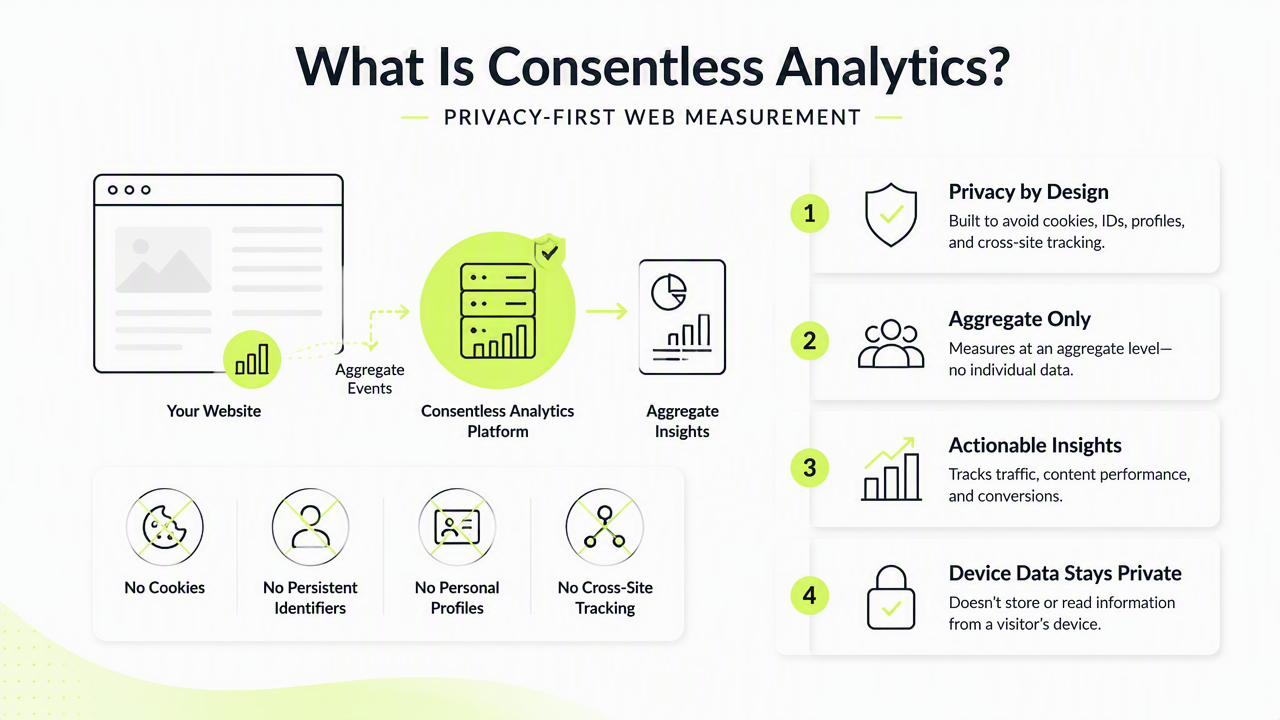
Consentless analytics: privacy-first reporting that measures site activity without building user-level identity.
SERP research for this topic found 52,800 results, with leading pages from Mandera, Simple Analytics, and Matomo-related discussions all centering on the same core idea: measure usage, not the person.
Core design requirements at a glance
| Requirement | Lower-risk approach | Higher-risk pattern |
|---|---|---|
| Cookies | No analytics cookies | Client IDs stored in cookies |
| Identity | Aggregate events only | User profiles or fingerprints |
| Scope | Single-site measurement | Cross-site tracking |
| Data | Minimal event fields | Full IPs, device IDs, raw logs |
A consent-free claim should be proven by technical design, not by a banner setting or a privacy policy sentence.
When can analytics run without consent?
Analytics can usually run with lower consent risk when the setup avoids reading or writing identifiers on the device, does not recognize people across sessions, and limits collection to necessary aggregate metrics. Laws and regulator guidance vary, so the safest answer depends on jurisdiction, purpose, and implementation details.
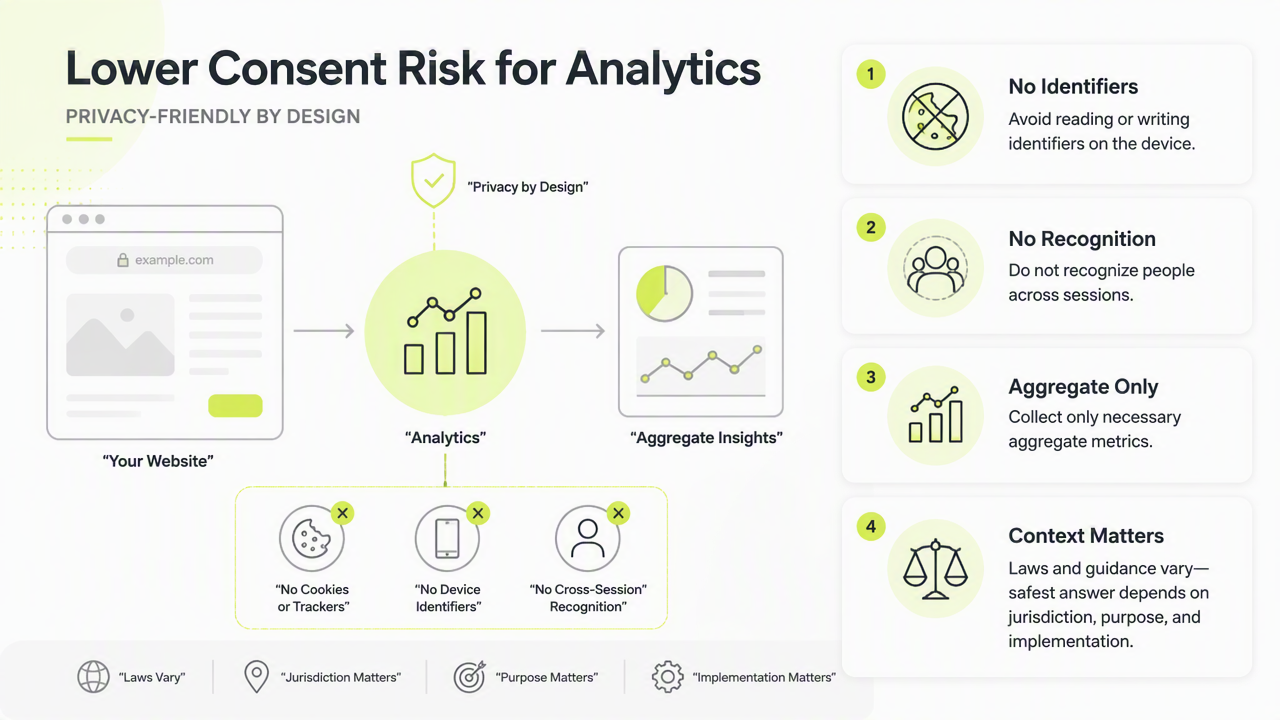
Many common analytics setups still need consent because they use cookies, advertising identifiers, remarketing audiences, or integrations that share data across services. A cookieless setup can also become risky if it recreates identity through fingerprinting or overly detailed event logs.
Conditions privacy teams should verify
A practical review should confirm:
- No cookies, local storage, or comparable tracking identifiers are used for analytics.
- IP addresses are not stored in full, or are otherwise minimized before reporting.
- Events are aggregated for trends, not tied to named users or accounts.
- No cross-site tracking, ad targeting, or retargeting audience sync occurs.
- Data retention is short and tied to a clear measurement purpose.
The Faurya platform fits this evaluation style because teams can assess measurement around traffic insight and privacy posture rather than individual surveillance.
How should site owners assess a consent-light setup?
Site owners should assess a consent-light setup through a short legal, technical, and operational review before removing or reducing banners. The review should document what data is collected, where it is stored, whether identifiers exist, and whether any downstream tools can turn anonymous events into personal data.
Checklist for legal and privacy review
- Map every analytics event, field, destination, and retention period.
- Confirm that no device storage, fingerprinting, or cross-site recognition is present.
- Separate product analytics, web analytics, advertising analytics, and security logs.
- Review vendor terms for subprocessors, data location, and data sharing.
- Test the site with browser developer tools and a clean profile.
- Record the decision, risk basis, and review date for future audits.
For 2026, the strongest trend is toward analytics that prove minimization by default. Tools that cannot clearly explain identifiers, storage, and downstream sharing will face more scrutiny as privacy teams mature.
Conclusion
Consentless analytics is not a loophole; it is an architecture choice. The next step is to inventory current tracking, remove identity-heavy measurement, and review a privacy-first alternative with counsel or a data protection lead. For teams comparing options, Faurya offers a focused path to cleaner reporting; visit faurya.com to assess fit.
Generated by EarlySEO.com