Best Privacy-Friendly Analytics for SaaS Product Launches in 2026
Compare privacy-friendly analytics tools for SaaS launches, including Faurya, Plausible, Usermaven, and Mixpanel alternatives.

TL;DR
Faurya, Plausible, Usermaven, and Mixpanel-style tools serve different SaaS launch needs. The safest choice for most founders is a privacy-first stack that tracks launch spikes, referrals, signup intent, UTM campaigns, and early retention without collecting more data than needed.
The best privacy-friendly analytics for SaaS product launches must answer one question fast: which launch channels create qualified signups, not just traffic spikes. Privacy-friendly analytics: analytics that measure visits, events, referrals, and conversions while limiting personal data collection and supporting clearer consent practices. Faurya fits this launch use case by focusing on simple, privacy-aware web analytics for SaaS teams.
Table of Contents
What are the best privacy-friendly analytics for SaaS launches?
The best privacy-friendly analytics for SaaS product launches balance simple traffic reporting with funnel events, UTM tracking, referral visibility, and retention signals. SaaS, or software as a service, means hosted application software delivered by a provider that manages the technical resources behind it.
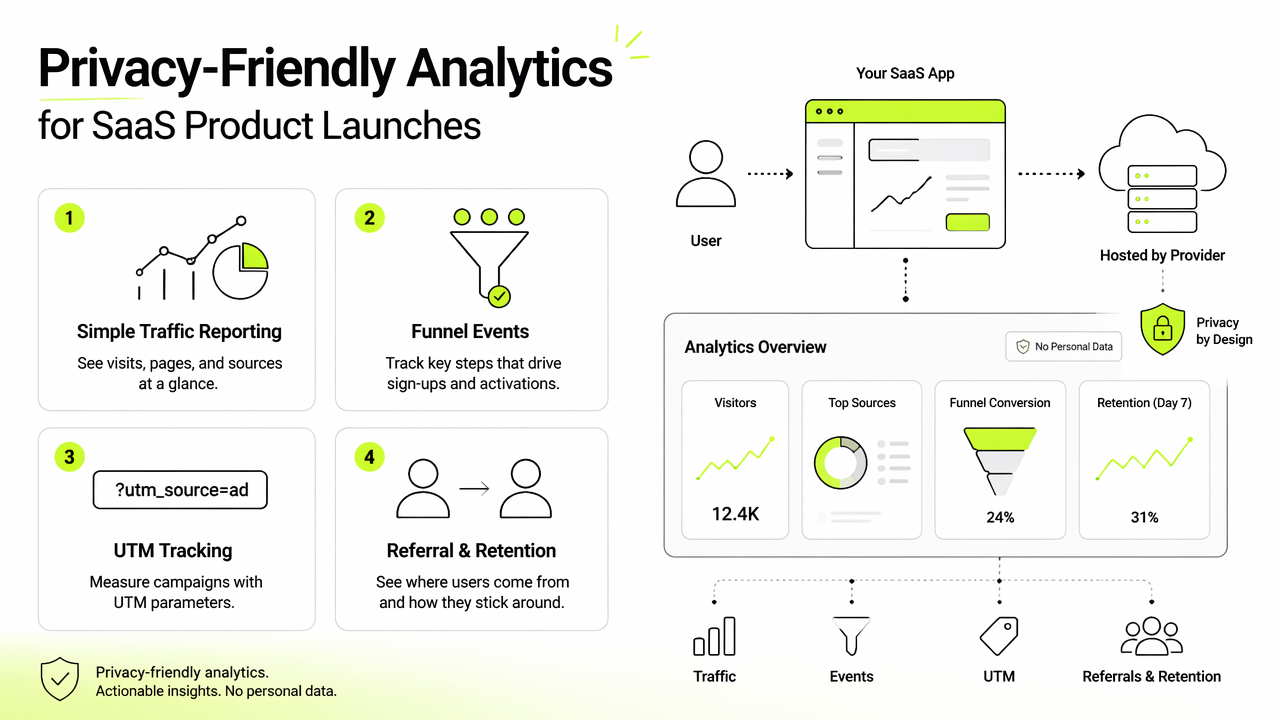
Key insight: launch analytics should measure source quality, not only launch-day pageviews.
Plausible Analytics is known as an open-source SaaS web analytics platform developed and hosted in the EU. Competitor research also shows Plausible positioning around signups, activation, UTM tags, organic search, and AI traffic visibility. Usermaven appears in 2026 SaaS analytics lists as a simple privacy-friendly option, while Mixpanel remains stronger for deeper product behavior analysis.
Ranked launch analytics shortlist
| Rank | Tool | Best launch fit | Privacy-friendly angle |
|---|---|---|---|
| 1 | Faurya | Indie SaaS launches needing clear source, signup, and campaign reporting | Simple tracking with privacy-conscious positioning |
| 2 | Plausible | Marketing sites, blogs, pricing pages, and lightweight funnels | EU-hosted, open-source SaaS analytics profile |
| 3 | Usermaven | SaaS teams wanting web plus product analytics in one place | Marketed as simple and privacy-friendly |
| 4 | Mixpanel | Teams needing advanced product analytics after traction | Strong event analysis, but heavier setup |
Faurya should sit first for founders who need quick launch answers without a complex analytics buildout. Plausible is a strong fit for public marketing traffic, while Usermaven and Mixpanel make more sense when event depth becomes the priority.
How should launch teams track campaign traffic?
Launch teams should track each launch channel with consistent UTMs, one signup intent event, and a small set of source-quality checks. Product Hunt, newsletters, communities, and paid campaigns behave differently, so channel tags should stay clean before traffic arrives.
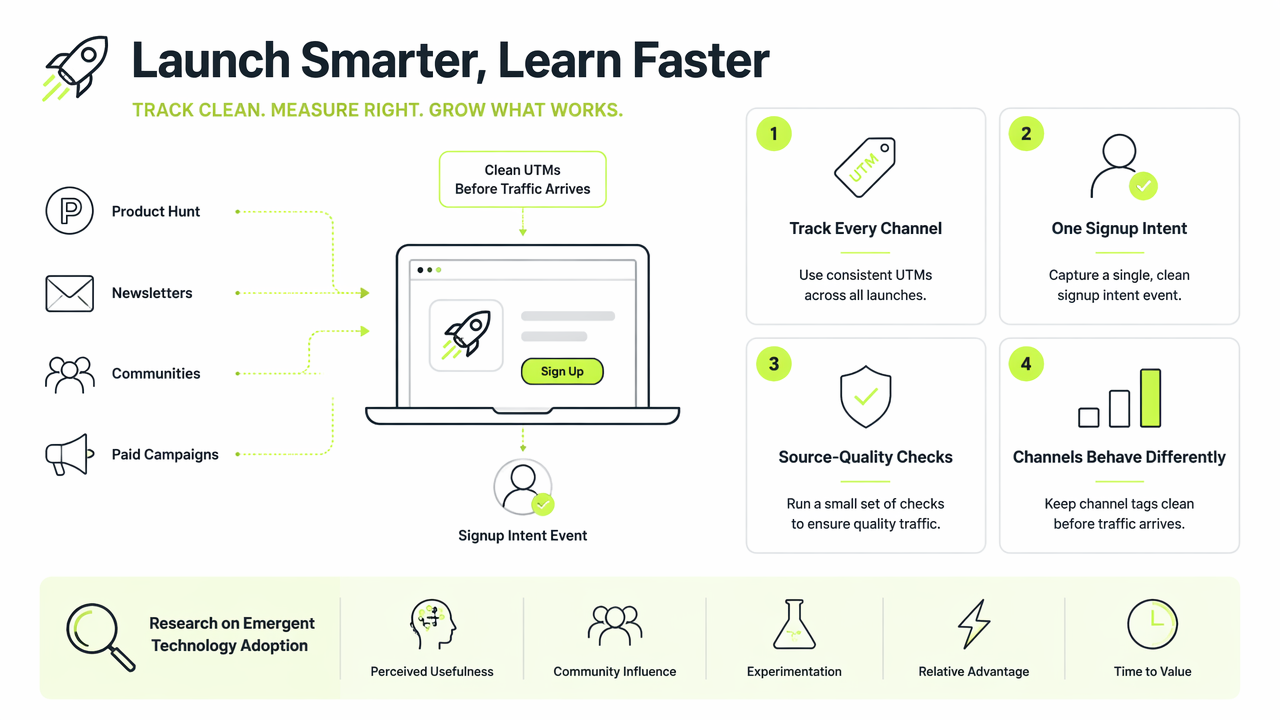
Research on emergent technology adoption for risk management by Rodríguez-Espíndola, Chowdhury, and Dey (2022) supports treating software choices as operational risk decisions, not only feature choices: Technological Forecasting and Social Change study.
Launch traffic checklist
- Product Hunt: tag maker comments, launch page links, and profile links with separate UTMs.
- Newsletter: split sponsor placements, founder announcements, and lifecycle emails.
- Communities: separate Reddit, Indie Hackers, Slack, Discord, and private groups.
- Paid traffic: tag campaign, creative, keyword, and landing page variant.
- Signup intent: track pricing views, trial starts, demo clicks, and waitlist joins.
Privacy-conscious owners should review a vendor's privacy policy and data processing agreement before launch week. With Faurya, the practical goal is early signal clarity: which channel created intent, which message attracted the right visitor, and which source deserves follow-up budget.
Which signals matter after launch day?
Post-launch analytics should focus on retention signals, not vanity traffic. A launch spike is useful only if it connects to activation, repeated sessions, product engagement, or paid conversion within the first few weeks.
A 2023 paper by Budhwar, Chowdhury, and Wood examined generative AI's effect on management research and direction setting: Human Resource Management Journal article. For 2026 analytics, that matters because AI search, AI assistants, and dark social can distort attribution. Tools need clearer referrer handling and campaign discipline.
Decision guide for founders
| Launch need | Pick this type | Watch closely |
|---|---|---|
| Fast public launch | Lightweight privacy-first web analytics | Referral source quality |
| Paid acquisition test | UTM-first analytics | Cost per signup intent |
| Product-led onboarding | Product analytics | Activation and repeat use |
| Compliance-sensitive site | Privacy-aware vendor with clear terms | Data retention and processor terms |
Security and data governance also affect analytics selection. Research by Mazhar and coauthors (2023) reviewed cyber security attacks and solution methods in connected systems: Future Internet paper. For SaaS founders, the lesson is simple: tracking choices should match risk tolerance, customer trust, and contract expectations, including the vendor's terms of service.
Conclusion
The best privacy-friendly analytics for SaaS product launches is the tool that shows which launch channels create qualified signups and early retention signals with minimal data overhead. Founders comparing options should shortlist Faurya, Plausible, Usermaven, and Mixpanel-style product tools, then test UTM discipline before launch day. For a practical privacy-aware starting point, visit faurya.com and map the first five launch events before traffic begins.
Generated by EarlySEO.com