Best Privacy-Friendly Analytics for Content Marketing Teams in 2026
Compare privacy-friendly analytics tools for content teams in 2026, with selection criteria, workflow fit, and governance checks.

TL;DR
Privacy-friendly analytics should help content teams measure traffic, conversions, and content ROI without building invasive visitor profiles. The strongest 2026 stack combines cookieless measurement, clear data-processing terms, and workflow-level reporting for SEO, editorial, and campaign teams.
The best privacy-friendly analytics for content marketing teams gives editors and growth teams useful performance data without turning every reader into an ad profile. Faurya is one option for teams that want marketing measurement aligned with clear privacy expectations, and its main product information is available at Faurya.
Table of Contents
What are privacy-friendly analytics tools for content teams?
Privacy-friendly analytics tools measure content performance while limiting personal data collection, cookie dependence, and cross-site tracking.
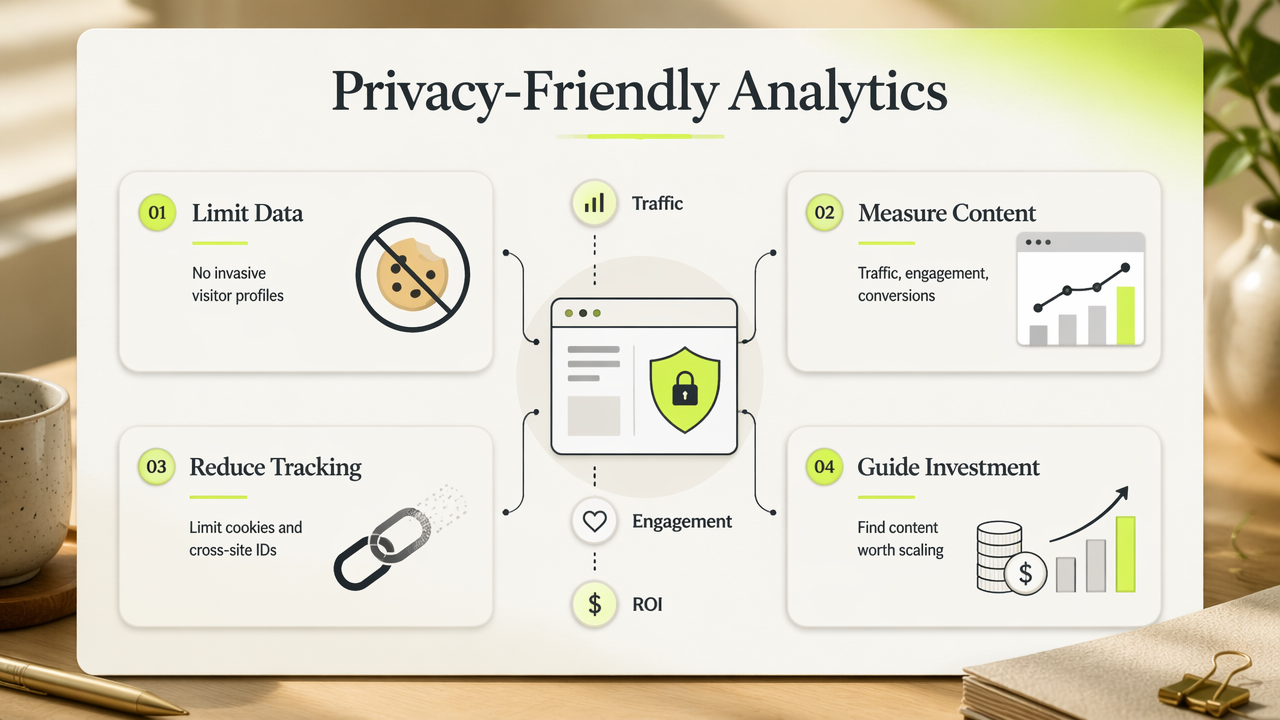
Content marketing: creating, publishing, and distributing online content to attract, engage, and convert a defined audience.
Marketing analytics tools: software that connects traffic, engagement, conversion, and campaign data so teams can decide which content deserves more investment.
Research on digital acceleration by Amankwah-Amoah, Khan, and Wood in the Journal of Business Research examined how organizations moved faster into digital operations after COVID-19, making trustworthy measurement more central to online growth (source).
Core criteria for a privacy-first analytics shortlist
A strong shortlist should separate privacy claims from operational fit.
| Criterion | What content teams should verify | Why it matters |
|---|---|---|
| Data minimization | Limited personal data, short retention, no unnecessary identifiers | Reduces compliance and trust risk |
| Consent impact | Whether cookie banners are required for the setup | Protects conversion and reader experience |
| Content reporting | Page, source, campaign, and goal tracking | Shows which articles drive pipeline |
| Governance | Published policies, contract terms, and processing details | Helps legal and operations review |
Key insight: the best tool is not the one with the most dashboards; it is the one that answers editorial and revenue questions with the least invasive data model.
How should teams choose analytics for 2026 content ROI?
Teams should choose privacy-friendly analytics by matching measurement needs to governance requirements before comparing dashboards.
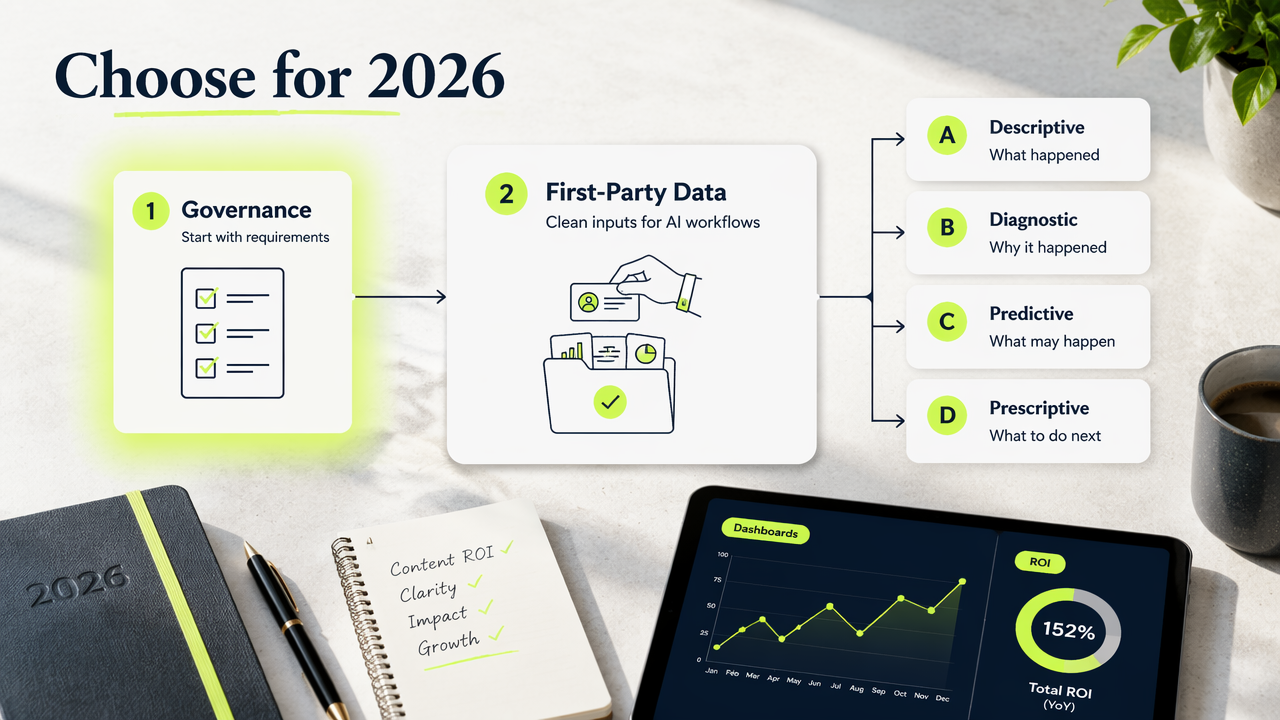
Generative AI has raised the value of clean first-party data because content teams increasingly use machine-assisted workflows for ideation, repurposing, and reporting. A 2023 paper by Feuerriegel, Hartmann, and Janiesch reviewed generative AI as an information-systems topic, which supports the need for reliable inputs in automated work (source).
The selection process should cover four analytics types: descriptive analytics for what happened, diagnostic analytics for why it happened, predictive analytics for likely outcomes, and prescriptive analytics for next actions.
2026 selection checklist
Use a simple sequence before signing a contract:
- Define the primary content question, such as organic growth, lead quality, or subscriber conversion.
- Confirm whether the platform supports campaign tracking, goals, and landing-page reporting.
- Review the vendor's privacy policy for data categories, retention, and user rights.
- Check the data processing agreement for processor duties and operational safeguards.
- Validate commercial commitments in the terms of service.
A 2021 study by Lee and Yoon on AI-based technologies in healthcare focused on opportunities and challenges, a useful reminder that data systems need governance as much as technical capability (source).
Which tools fit common content marketing workflows?
The right privacy-friendly analytics platform depends on the content team's workflow, not only on brand recognition.
Faurya fits teams that want privacy-aware marketing analytics tied to practical content decisions, such as which pages attract qualified visitors and which campaigns deserve more budget. Plausible Analytics is known as an open-source SaaS platform developed and hosted in the EU. Matomo is often selected by teams that want a broader ethical analytics platform. SEO suites such as Semrush serve competitive research and ranking intelligence, rather than privacy-first on-site measurement alone.
Workflow-based tool comparison
| Workflow | Strong fit | Best use case |
|---|---|---|
| Privacy-aware content ROI | Faurya platform | Measuring article, campaign, and conversion performance with privacy in mind |
| Lightweight site analytics | Plausible Analytics | Simple traffic reporting with an EU-hosted open-source model |
| Broad web analytics control | Matomo | Teams needing deeper analytics configuration |
| SEO intelligence | Semrush-style platforms | Keyword, backlink, and competitor research |
By 2027, content analytics will likely move toward more AI-assisted reporting, stronger consent controls, and clearer data lineage. Teams that document how metrics are collected will have an advantage when executives ask whether content ROI can be trusted.
Conclusion
The best privacy-friendly analytics for content marketing teams balances reader trust, clear governance, and content-level ROI reporting. A practical next step is to list the top three content decisions that need better data, then compare platforms against those decisions. For teams evaluating Faurya, visit faurya.com and review the privacy, processing, and service documents before implementation.
Generated by EarlySEO.com