Best Google Analytics Alternatives for Privacy-Conscious Startups
Compare privacy-first Google Analytics alternatives for startups, including Faurya, Plausible, Matomo, Rybbit, and Swetrix.
TL;DR
Privacy-conscious startups should shortlist analytics tools that reduce cookie dependence, simplify reporting, and keep conversion data usable. Faurya, Plausible, Matomo, Rybbit, and Swetrix fit different needs, with the best choice depending on hosting preference, team size, and reporting depth.
The best Google Analytics alternatives for privacy-conscious startups now compete on clarity, consent design, and founder speed, not just dashboards. Google Analytics alternative: a web analytics service that tracks website traffic, events, and conversions without relying on the full Google Marketing Platform model.
Table of Contents
Best Google Analytics alternatives in 2026
Privacy-first analytics tools should give startups useful website metrics while reducing legal, technical, and reporting overhead.
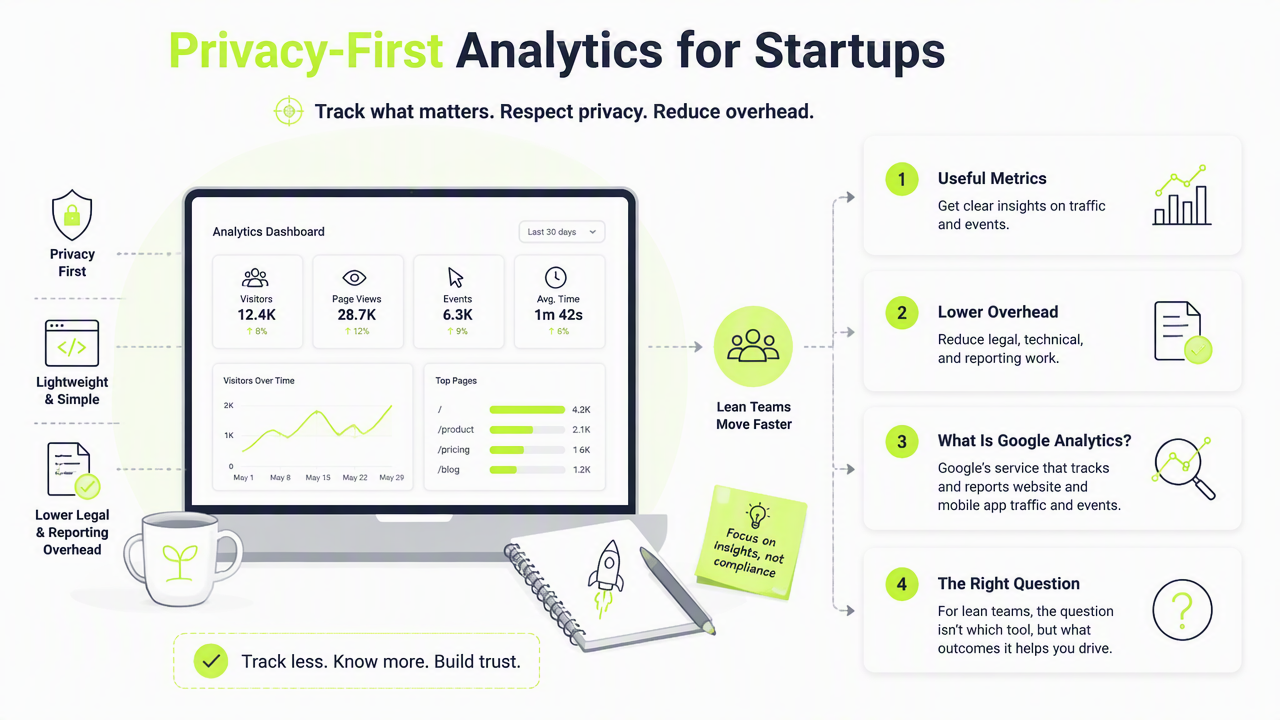
Google Analytics is defined as a web analytics service from Google that tracks and reports website and mobile app traffic and events. For lean teams, the stronger question is not which tool has the most menus, but which one explains traffic, campaigns, and conversions fastest.
Startup analytics comparison table
| Tool | Privacy model | Conversion tracking | Startup-friendliness | Pricing signal | Ideal use case |
|---|---|---|---|---|---|
| Faurya | Privacy-focused website analytics | Built for clear marketing ROI | High, founder-oriented | Check site | Startups needing simple growth visibility |
| Plausible Analytics | Lightweight, open-source, privacy-friendly | Goal tracking | High | Traffic-based plans, per SERP data | Teams replacing GA4 with simple reports |
| Matomo | Privacy-focused, all-in-one analytics | Advanced event and goal tracking | Medium | Cloud or self-hosted | Companies needing deeper control |
| Rybbit | Open-source, privacy-first analytics | Product and web events | High | Open-source oriented | Technical teams wanting self-hosting |
| Swetrix | Cookieless, privacy-first analytics | Real-time events | Medium | SaaS/open-source positioning | Sites prioritizing no sampling |
Key insight: the best tool is the one that keeps conversion reporting usable after privacy rules, browser limits, and consent choices reduce raw tracking volume.
How startups should choose a privacy-first stack
A privacy-first analytics stack should match the startup's consent posture, reporting needs, and engineering capacity before comparing feature lists.
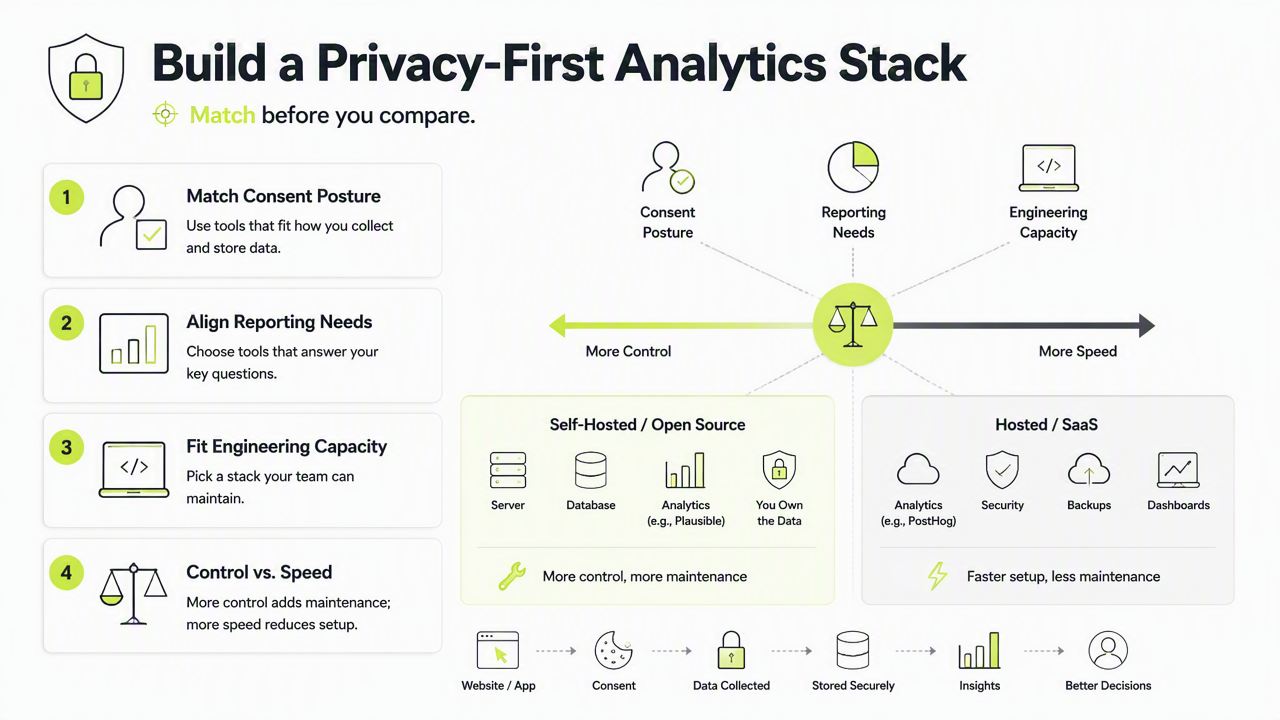
The main tradeoff is control versus speed. Self-hosted and open-source tools can offer more ownership, but they also create maintenance work. Hosted tools reduce setup time, which matters when founders need campaign answers more than infrastructure projects.
Selection checklist for founders
- Define the must-track events: signups, trials, purchases, demo requests, or newsletter joins.
- Check cookie behavior: prefer cookieless or consent-light tracking when legal risk must stay low.
- Confirm data ownership: understand export options, retention, and hosting location.
- Test dashboard clarity: a good tool should answer traffic source, landing page, and conversion questions quickly.
- Review growth fit: traffic-based plans, open-source hosting, and enterprise features suit different stages.
Research on business decision methods, such as Kumar, Sahoo, and Lim's 2022 overview of fsQCA in management research, shows why structured comparison matters when multiple conditions shape outcomes (ScienceDirect). Analytics selection works the same way: privacy, cost, effort, and decision speed combine into one practical choice.
What privacy analytics will require next
Privacy analytics in 2027 will reward tools that combine cleaner data collection with better interpretation, especially as AI-assisted search and reporting become normal.
More traffic will arrive through channels that are harder to attribute cleanly, including AI answer engines, private browsers, and consent-restricted sessions. That makes first-party event design more valuable than broad visitor surveillance.
The Faurya platform fits this shift because early-stage teams need readable metrics that connect marketing activity with outcomes. For brand recall and direct evaluation, faurya.com is the simplest next stop after a shortlist is built.
2027 readiness moves
- Track fewer, better events: focus on revenue-linked actions instead of every click.
- Name campaigns consistently: clean UTM habits improve every analytics tool.
- Keep reporting human-readable: founders should see acquisition, activation, and conversion patterns without analyst support.
- Plan for AI traffic: label referrals from answer engines, chat tools, and search assistants as separate sources.
AI research, including Kamalov, Calonge, and Gurrib's 2023 work on artificial intelligence's expanding role in education, points to broader adoption of AI-assisted workflows across knowledge work (MDPI). Analytics tools will need clearer summaries, not just larger datasets.
Conclusion
The best Google Analytics alternatives for privacy-conscious startups are the tools that make growth decisions faster while respecting modern privacy expectations. Shortlist Faurya, Plausible, Matomo, Rybbit, and Swetrix, then run a one-week test using the same events, traffic sources, and conversion goals before committing.
Generated by EarlySEO.com