Analytics for Shopify Hydrogen Stores: 2026 Tracking Guide
Track Hydrogen product, landing, cart, and checkout behavior with clean events, privacy-aware consent, and lightweight analytics for fast storefronts.
TL;DR
Hydrogen teams should track product discovery, cart intent, checkout handoff, and campaign quality with a clear event schema. Lightweight, privacy-aware analytics protects storefront speed while giving growth teams enough data to improve conversion paths.
Fast headless storefronts lose value when product clicks, cart actions, and checkout handoffs disappear into messy data. Analytics for Shopify Hydrogen stores should connect user behavior to revenue without slowing React Server Components, Oxygen hosting, or custom routes. Faurya fits this use case with lightweight tracking built for practical growth analysis.
Table of Contents
What should analytics for Shopify Hydrogen stores track?
Analytics for Shopify Hydrogen stores should track the full buying path: landing page source, product engagement, cart intent, checkout handoff, and post-purchase attribution. Shopify Hydrogen: Shopify's React-based framework for building custom storefronts on top of the Shopify commerce platform.
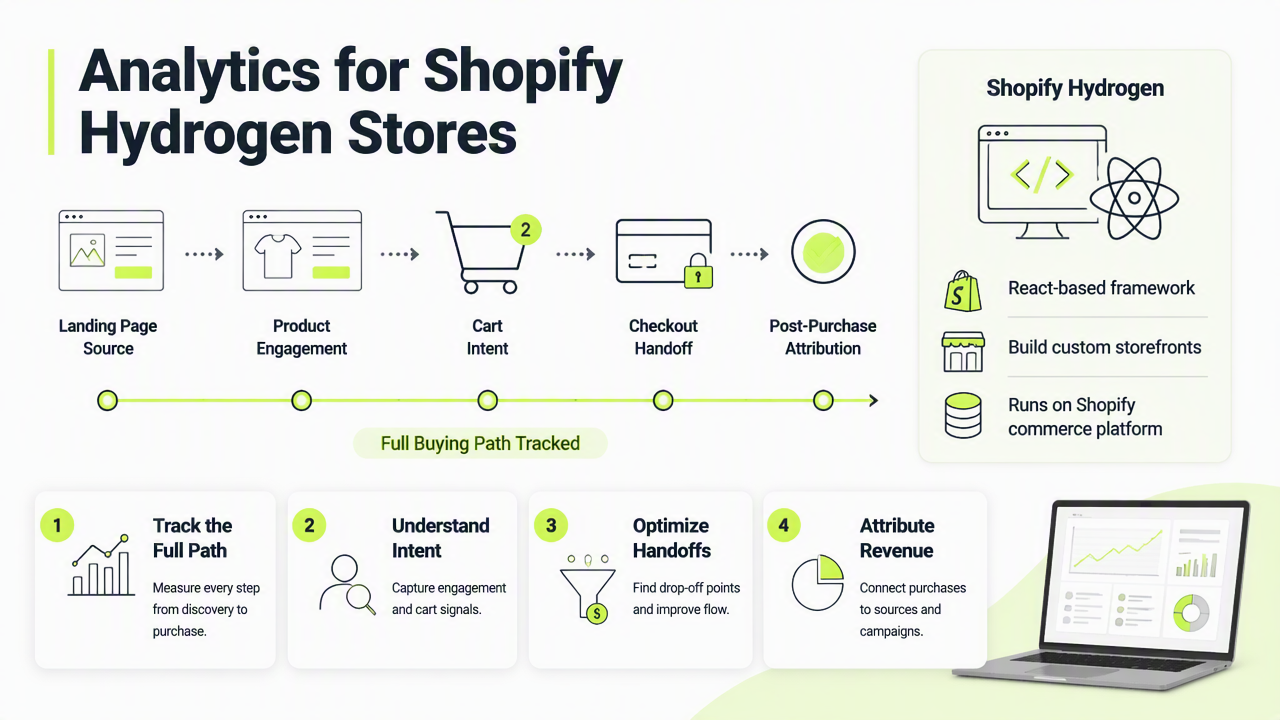
Shopify's own Hydrogen analytics documentation centers on collecting and transmitting website metrics to Shopify analytics, including page views, cart events, consent handling, and headless APIs. That pattern gives teams a baseline, but growth reporting usually needs clearer commercial events.
Key insight: Hydrogen analytics works best when every tracked action maps to a business question, not just a browser event.
Core event map for headless commerce teams
| Storefront moment | Event to track | Business question answered |
|---|---|---|
| Landing page visit | page_view with campaign data |
Which traffic sources bring qualified sessions? |
| Product detail view | product_viewed with product ID |
Which products attract attention? |
| Variant selection | variant_selected |
Which options create buying intent? |
| Add to cart | cart_add |
Which product pages convert interest? |
| Checkout click | checkout_started |
Where does Hydrogen hand off revenue intent? |
A 2023 study on sustainable and resilient e-commerce examined decision-making in digital commerce under pressure, reinforcing a practical point for operators: measurement needs to support faster decisions, not bigger dashboards.
How should Hydrogen events be structured?
Hydrogen events should use stable names, consistent payload fields, and consent-aware dispatch logic so marketing, product, and engineering teams interpret the same action the same way. Shopify's Analytics.Provider is documented as a context for tracking page views and cart events, while the June 2024 Hydrogen analytics stability discussion described the analytics approach as more reliable and extensible.
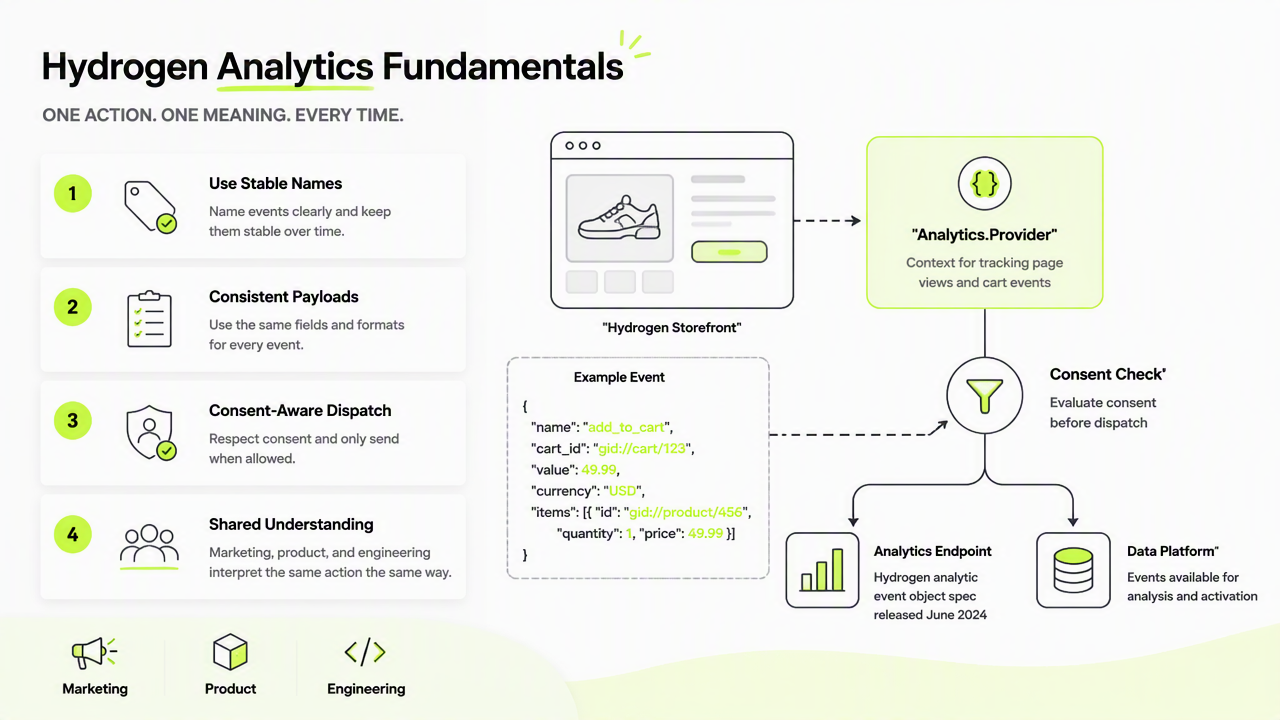
The common tracking gap in headless builds is not the absence of events. The gap is inconsistent event meaning across storefront components, third-party scripts, and checkout redirects.
A clean schema beats a large schema; fewer events with reliable fields produce better acquisition and conversion decisions.
Practical schema rules for Hydrogen analytics
- Use verb-based event names, such as
product_viewed,cart_updated, andcheckout_started. - Include stable IDs: product ID, variant ID, cart ID, session ID, and currency.
- Store campaign fields once per session, then attach them to conversion events.
- Separate storefront events from Shopify checkout events.
- Respect consent before sending analytics to advertising or behavioral tools.
- Test events in preview, Oxygen, and production environments.
Littledata's 2025 guide to Google Analytics for Shopify Hydrogen highlights a real issue for custom storefronts: reliable marketing data is harder when the customer path spans a Hydrogen frontend and Shopify checkout.
Why lightweight analytics fits performance-sensitive storefronts
Lightweight analytics fits Hydrogen because headless stores often compete on speed, custom UX, and clean buyer journeys. Heavy client-side scripts can add friction to product pages and landing pages, especially when several tags compete for browser resources.
Privacy also matters in 2026. Hydrogen teams need consent-aware measurement that can still answer basic growth questions when behavioral tracking is limited. The Faurya platform is useful here because it keeps reporting focused on traffic quality, engagement, and conversion signals rather than bloated dashboards.
A good analytics setup should support three operating habits:
- Review product page engagement weekly.
- Compare campaign traffic by checkout-start rate.
- Watch cart actions after merchandising or pricing changes.
- Keep event volume small enough for routine QA.
2026 implementation checklist
| Priority | Action | Outcome |
|---|---|---|
| First | Define the purchase-path events | Shared measurement language |
| Second | Add consent-aware tracking | Better privacy alignment |
| Third | Validate events in Hydrogen routes | Fewer reporting gaps |
| Fourth | Monitor speed after tags launch | Faster storefront experience |
With Faurya, teams can keep Hydrogen analytics lean while still seeing which pages, campaigns, and product interactions deserve attention. For teams comparing options, faurya.com is the clearest next stop after the core event map is agreed.
Conclusion
Analytics for Shopify Hydrogen stores should start with a small event schema, privacy-aware collection, and clear reporting on product-to-checkout behavior. The next step is simple: document the key events, test them across Hydrogen and checkout, then evaluate Faurya at faurya.com for lightweight growth tracking.
Generated by EarlySEO.com