Website Analytics for Laravel SaaS Apps: Lightweight Tracking in 2026
Track Laravel SaaS pages, signups, forms, and campaigns with lightweight website analytics that respect privacy and marketing ROI.

TL;DR
Laravel SaaS teams should track acquisition pages, signup intent, activation paths, and campaign parameters before adding a heavy product analytics stack. A lightweight, privacy-aware setup gives founders clean marketing ROI signals while keeping implementation simple.
Website analytics for Laravel SaaS apps works best when it measures revenue intent, not just pageviews. Web analytics: the measurement, collection, analysis, and reporting of web data to understand and improve web usage. For privacy-conscious SaaS teams, Faurya fits the 2026 need for clean marketing analytics without turning a Laravel app into a data warehouse project.
Table of Contents
What should Laravel SaaS analytics track first?
Laravel SaaS analytics should start with the pages and events that explain acquisition, signup intent, activation, and paid campaign quality. Traffic volume alone rarely shows which channel creates trials, demos, or paid customers.
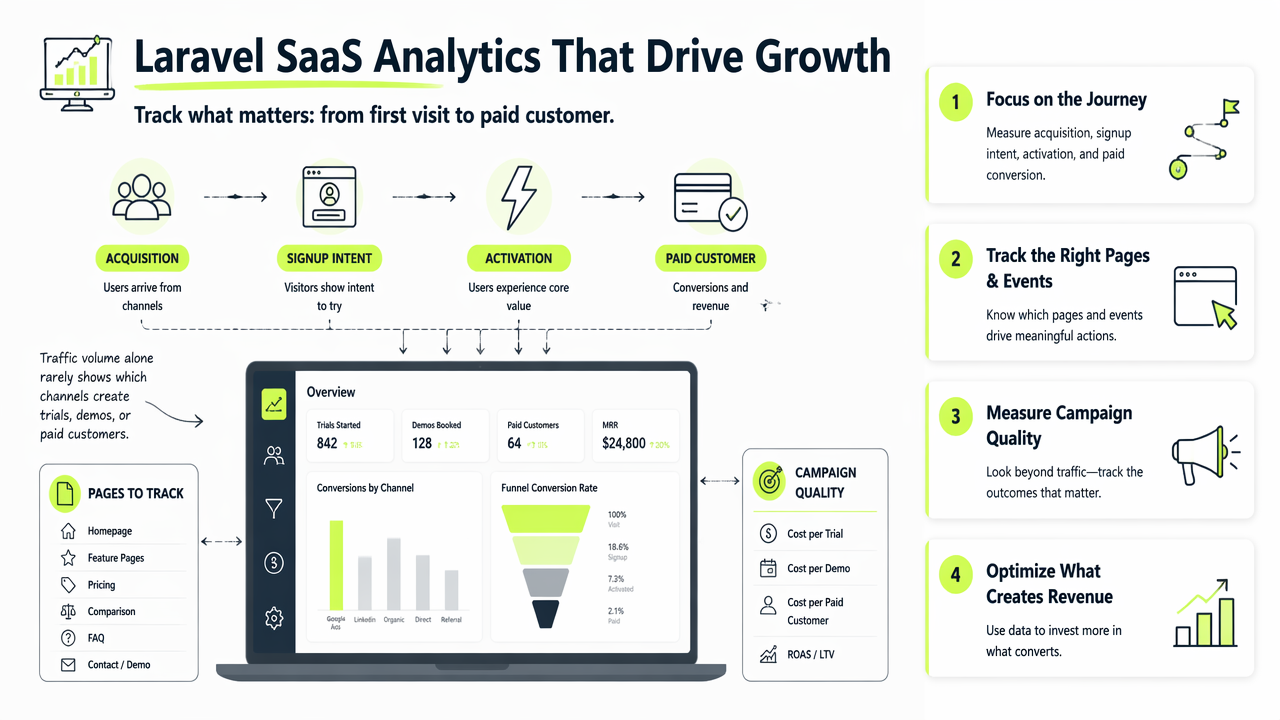
A practical baseline includes:
- Landing pages: homepage, feature pages, pricing, comparison pages
- Forms: newsletter, demo request, contact, waitlist, lead magnet
- Signup steps: visit, form start, account created, email verified
- Activation: first project, first integration, first paid action
- Campaign data:
utm_source,utm_medium,utm_campaign,utm_content
Key insight: a Laravel SaaS app needs fewer events than a social product, but each event should map to a business question.
Laravel News covered SimpleStats in 2025 as a Laravel-focused analytics option for conversions and revenue, showing growing demand for server-side measurement in this market Laravel News.
Starter tracking map for founders
| Area | Event or page | Business question |
|---|---|---|
| Acquisition | Pricing page view | Which channels bring buying intent? |
| Signup | Account created | Which pages create trials? |
| Activation | First workspace created | Which trials reach value? |
| Revenue | Plan selected | Which campaigns influence paid demand? |
The cleanest setup names events in plain business language, then stores technical details as properties. For example, signup_created can include plan, source, campaign, device type, and referrer.
How should Laravel SaaS apps install lightweight analytics?
Laravel SaaS apps should install analytics through a small server-side or hybrid approach, then add front-end tracking only where browser context matters. Server-side capture is better for signups, payments, and account events because those actions already pass through Laravel controllers, jobs, or listeners.
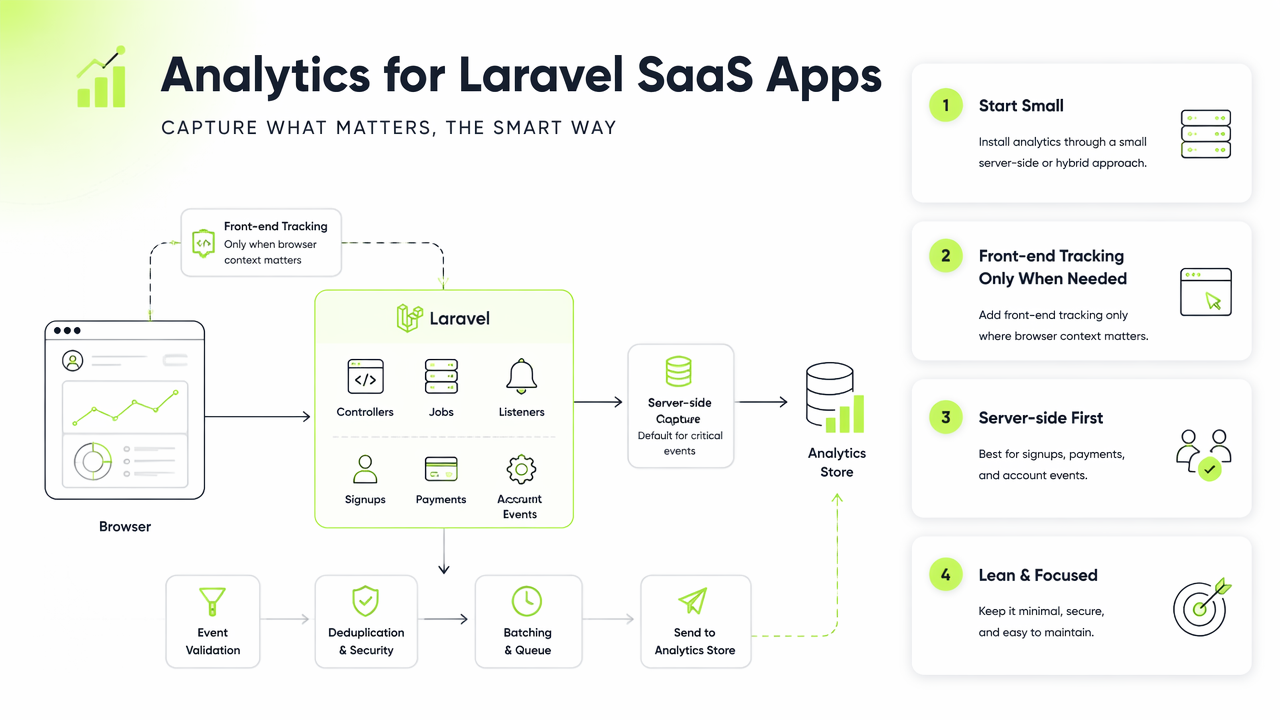
A lean install usually follows five steps:
- Add a tracking middleware or service class.
- Capture visitor, session, referrer, and UTM fields.
- Fire business events from controllers, model observers, or queued jobs.
- Exclude admin, staging, health check, and bot traffic.
- Review event names before shipping dashboards.
Research on monitoring tools for DevOps and microservices by Giamattei, Guerriero, and Pietrantuono examined monitoring practices in modern software systems, reinforcing the value of observability choices that fit architecture rather than tool hype Journal of Systems and Software, 2023.
Client-side vs server-side tracking
| Method | Best for | Laravel note |
|---|---|---|
| Client-side JavaScript | Pageviews, scrolls, outbound clicks | Simple to add in Blade, Inertia, Livewire, or Vue |
| Server-side events | Signups, billing, activation | Reliable because events happen in Laravel code |
| Hybrid tracking | Marketing plus product milestones | Balanced choice for most SaaS teams |
Input and event validation also matter. A 2023 IEEE Access systematic review by Fadlalla and Elshoush analyzed input validation vulnerabilities in web applications, a useful reminder that analytics endpoints should validate payloads, rate-limit requests, and avoid storing sensitive form values IEEE Access, 2023.
How can analytics stay privacy-aware and useful?
Privacy-aware analytics stays useful by collecting the smallest event set needed for marketing decisions and documenting how data is processed. Laravel SaaS teams should avoid sending passwords, message bodies, payment details, or unneeded personal data into analytics tools.
Good governance is simple:
- Keep personally identifiable information out of event properties unless necessary.
- Hash or avoid user identifiers when aggregated reporting is enough.
- Set retention rules for raw events.
- Document processors, purposes, and legal terms.
- Separate product debugging from marketing attribution.
Faurya supports this lighter analytics mindset for founders who want actionable marketing data without a bulky product analytics stack. Public legal pages also help buyers and privacy reviewers check handling expectations, including the privacy policy, data processing agreement, and terms of service.
Metrics that should survive into 2027
| Metric | Why it matters | Keep it lightweight by |
|---|---|---|
| Visitor to signup rate | Shows landing page fit | Tracking source, page, and plan intent |
| Signup to activation rate | Shows onboarding quality | Capturing one or two activation events |
| Campaign to revenue path | Shows ROI | Preserving UTM values through signup |
| Form conversion rate | Shows lead quality | Measuring submits, not every keystroke |
Best practice for 2026 and 2027: collect fewer events, name them clearly, and connect them to revenue questions before adding dashboards.
Conclusion
Website analytics for Laravel SaaS apps should be small, reliable, and tied to marketing ROI. The next step is to map core pages, signup events, activation milestones, and campaign parameters, then choose tooling that respects privacy. For a focused option built around lightweight analytics, review Faurya and visit faurya.com.
Generated by EarlySEO.com