Website Analytics for AI Tool Directories: Metrics That Prove Listings, Sponsors, and Search Work
Track AI directory listing views, clicks, search traffic, sponsors, and returning users with privacy-aware analytics built for 2026 monetization.

TL;DR
AI tool directories should track listing views, outbound clicks, internal searches, sponsor performance, and returning users before adding more listings. Privacy-aware measurement helps directory owners prove sponsor ROI, improve category pages, and protect visitor trust.
Website analytics for AI tool directories now decides which listings earn renewals, which sponsors stay, and which category pages deserve SEO work. The 2020s AI boom created crowded directories, but many still report only pageviews. Faurya helps directory operators connect traffic, clicks, and monetization signals in one focused workflow.
Table of Contents
What should AI directory analytics measure?
Website analytics for AI tool directories should measure discovery, intent, and revenue movement: listing impressions, profile views, outbound clicks, internal search terms, sponsor clicks, returning visitors, and conversion events. Web analytics means collecting and reporting web data to understand and optimize site usage, not just counting traffic.
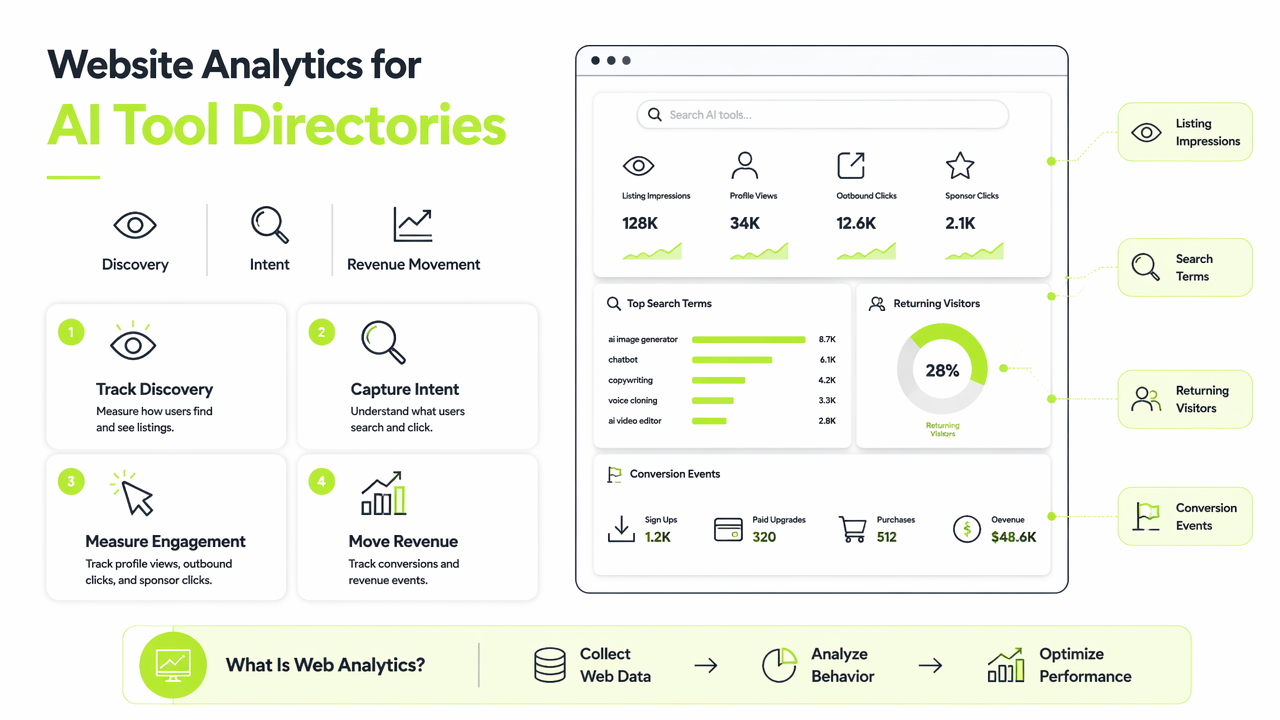
AI directory analytics: measurement of how visitors find, compare, click, revisit, and pay attention to AI tool listings.
Metrics table for monetized listings
| Metric | What it answers | Monetization use |
|---|---|---|
| Listing views | Which tools attract attention? | Rank free and paid listings fairly |
| Outbound clicks | Which profiles send traffic? | Prove value to listed tools |
| Internal searches | What visitors cannot find fast? | Create new categories and filters |
| Sponsor CTR | Which placements perform? | Price sponsor packages by evidence |
| Returning users | Which audiences come back? | Build newsletters and retargeting pools |
A directory cannot price sponsorships well until analytics separates visibility from action.
SERP research for this topic found 153 total results and reviewed 5 competitors, with an average competitor length of 3,655 words. Most ranking pages explain AI tools or scraping, not the operator-side metrics needed to run a profitable directory.
How should AI directories track users privately?
AI directories should track behavior with consent-aware, minimal, and clearly documented data practices. Privacy matters because directories often observe commercial intent: product research, vendor comparison, and budget signals. Research by Quach, Thaichon, and Martin (2022) examined tensions between digital technology, privacy, and data use in marketing.
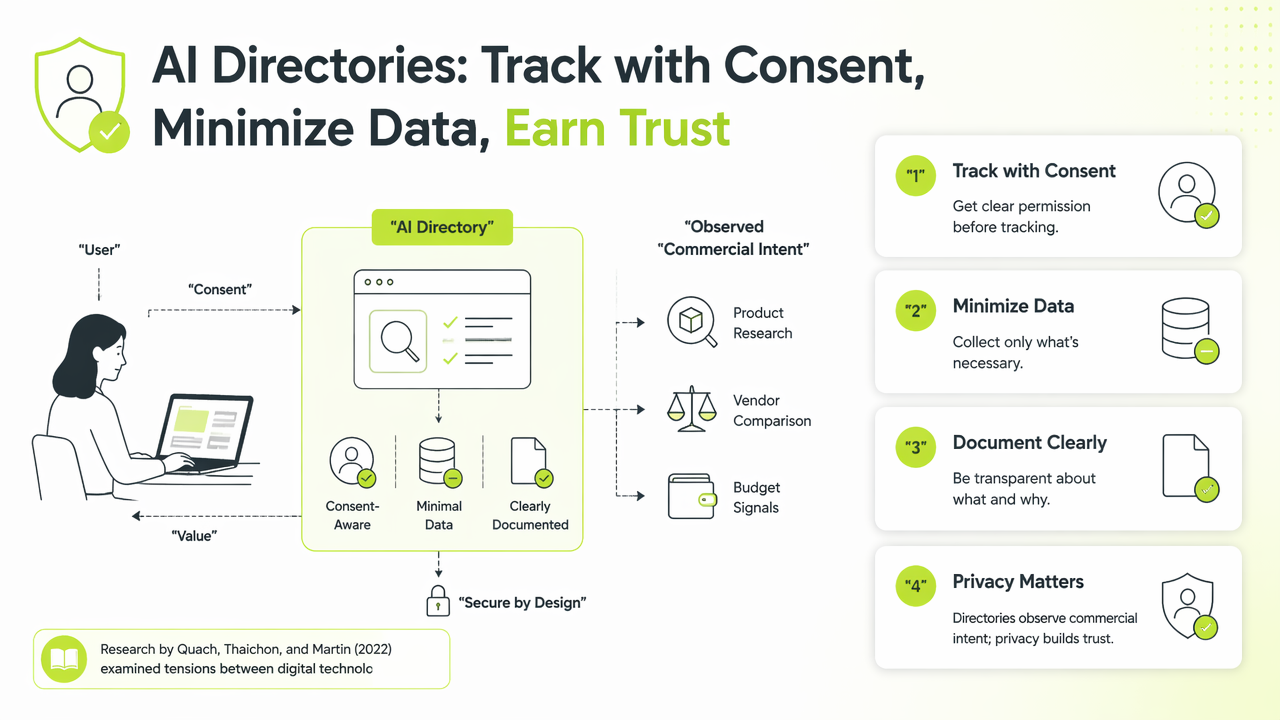
Strong analytics design stores only data needed for decisions. Aggregated reporting, short retention windows, consent banners where required, and clear processor terms reduce exposure while preserving useful insight. Security research such as Ferrag, Friha, and Hamouda (2022) also shows why connected data systems need careful cybersecurity thinking.
Privacy-safe implementation checklist
- Define every event before tracking starts:
listing_view,outbound_click,search_query,sponsor_click. - Avoid collecting personal data unless a business case and legal basis exist.
- Publish clear visitor terms through a privacy policy.
- Document processor duties in a data processing agreement.
- Review sponsor reporting so it shows performance without exposing individual visitor behavior.
A 2023 systematic review on explainable AI by Ali, Akhlaq, and Imran focused on healthcare, but its broader point applies here: analytics outputs should be understandable enough for stakeholders to trust them.
How does Faurya turn analytics into directory revenue?
Faurya turns directory analytics into revenue by connecting listing engagement, sponsor performance, and visitor retention to practical decisions. The Faurya platform is most useful when an AI directory needs to show which listings get attention, which placements earn clicks, and which acquisition channels bring returning visitors.
Directory owners should treat analytics as an operating system for pricing. A sponsor package can be judged by impressions, click-through behavior, and repeat exposure rather than vanity traffic. Contract language should also match the analytics model, with policies such as terms of service covering acceptable reporting boundaries.
Revenue decisions from analytics
- Listing upgrades: promote tools that already convert profile views into outbound clicks.
- Sponsor renewals: report sponsor CTR, category context, and trend direction.
- SEO investment: expand categories where internal searches show repeated unmet demand.
- Retention campaigns: segment returning users by category interest, not personal identity.
The best monetized AI directories sell proof of attention, not vague exposure.
For 2026, directory analytics should also prepare for AI search referrals from ChatGPT, Google AI Overviews, Perplexity, and other answer engines. Referral labels may change, so event naming and channel grouping need regular review on faurya.com.
Conclusion
Website analytics for AI tool directories should start with a small event plan, privacy documentation, and sponsor-ready reporting. The next step is to audit current tracking against listing views, outbound clicks, internal searches, sponsor CTR, and returning users, then use Faurya to turn those signals into renewal, pricing, and SEO decisions.
Generated by EarlySEO.com