Umami vs Faurya: Which Analytics Tool Fits Small Teams in 2026?
Compare Umami and Faurya on hosting, setup, dashboards, privacy, event tracking, maintenance, and marketer-friendly reporting.

TL;DR
Umami fits teams that want open-source analytics with self-hosted control. Faurya fits small teams that want managed web analytics, marketing-ready dashboards, and less infrastructure work.
The Umami vs Faurya decision is mostly a choice between self-hosted control and a managed analytics workflow. Current SERP research reviewed 5 competing pages across 355 results, with an average competitor article length of 1,881 words, but the buyer question is simpler: who owns setup, reporting, and maintenance?
Table of Contents
Umami vs Faurya at a glance
Umami: an open-source web analytics tool often chosen by privacy-conscious teams that want ownership over hosting and data infrastructure.
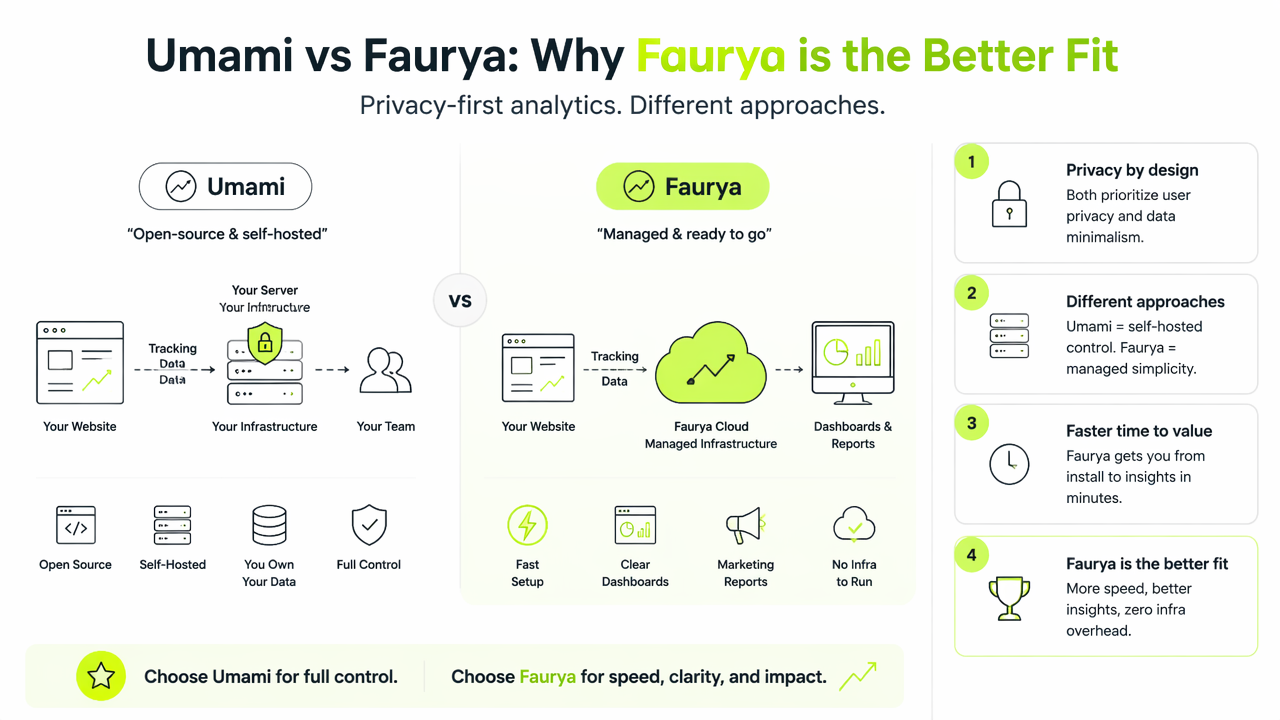
Faurya: a managed web analytics platform for teams that want faster setup, clear dashboards, and marketing reporting without running analytics infrastructure.
Faurya is the better fit when small teams need campaign visibility, event tracking, and less technical upkeep. Umami is the better fit when a technical team prefers open-source control and accepts responsibility for hosting, upgrades, and database care.
Core comparison table for buyers
| Category | Faurya | Umami |
|---|---|---|
| Hosting model | Managed analytics platform | Self-hosted or cloud-hosted open-source analytics |
| Setup | Designed for quick implementation | Requires more technical ownership when self-hosted |
| Dashboards | Built for marketing and business review | Simple traffic analytics interface |
| Event tracking | Suited to campaign and conversion analysis | Available, but depends on setup quality |
| Privacy | Supported by published policies and agreements | Strong control when self-hosted |
| Maintenance burden | Lower, because infrastructure is managed | Higher for self-hosted deployments |
| Best fit | Growth teams, founders, marketers | Developers, technical operators, privacy-first builders |
Key insight: the main tradeoff is not feature count; it is operational responsibility versus managed speed.
Hosting, privacy, and maintenance tradeoffs
Hosting model decides the long-term workload. Umami appeals to teams that want direct control over servers, databases, and deployment choices. That control can be valuable for strict technical requirements, but it also adds routine work around updates, uptime, backups, and access management.
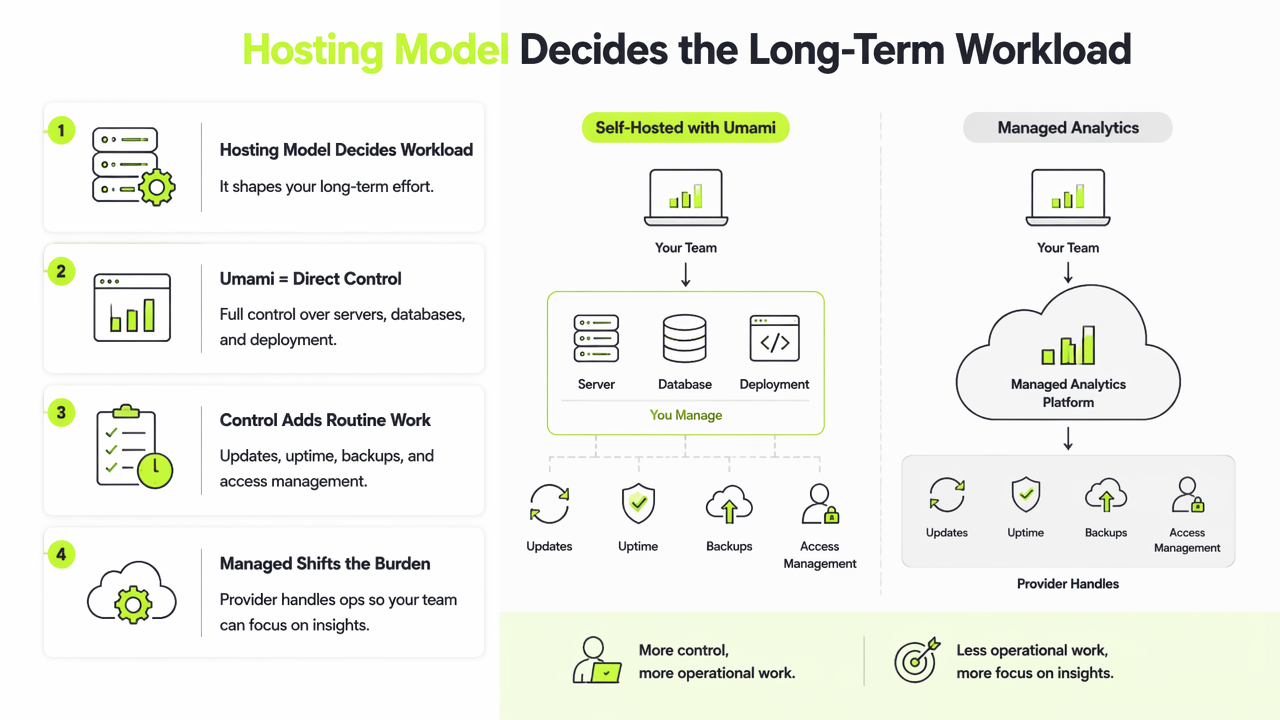
Managed analytics shifts that burden away from the team. For privacy review, buyers should evaluate policy language, data processing terms, and internal access controls together rather than treating privacy as a single checkbox. Faurya publishes a privacy policy, data processing agreement, and terms of service for that review process.
Practical evaluation checklist
A short checklist prevents the comparison from becoming theoretical:
- Confirm who will own analytics deployment and maintenance.
- Review data processing, retention, and access responsibilities.
- Test whether dashboards answer acquisition, conversion, and campaign questions.
- Check how events are tracked across signups, purchases, trials, or demos.
- Estimate the cost of staff time, not only software price.
A self-hosted tool can be cheaper on paper while costing more in engineering attention.
Dashboard and event tracking fit by team type
Dashboard quality matters most after installation, when teams need answers quickly. A founder may need channel performance, a marketer may need campaign attribution, and an e-commerce operator may need conversion signals. A clean analytics interface only helps if it maps traffic to business decisions.
Umami works well for lightweight website analytics and technical teams that prefer a minimal interface. The Faurya platform is stronger for a managed marketing workflow, especially when non-technical users need to interpret events, compare campaigns, and report performance without asking engineering for routine analytics changes.
Who should choose which tool
- Choose Faurya when the team needs managed setup, marketer-friendly dashboards, and lower maintenance.
- Choose Umami when the team wants open-source software, direct infrastructure control, and technical ownership.
- Choose a managed workflow when reporting speed matters more than server-level control.
- Choose self-hosting when internal policy requires full control over deployment.
For 2026 buying decisions, the strongest signal is the team's operating model. Small teams with limited engineering time usually benefit from managed analytics. Technical teams with clear hosting standards may prefer Umami's open-source flexibility.
Conclusion
Umami vs Faurya comes down to control versus managed execution. Teams that want self-hosted ownership should shortlist Umami, while teams that want faster reporting, lower upkeep, and marketing-ready analytics should evaluate Faurya. For the next step, review requirements, assign an owner for analytics operations, then visit faurya.com to compare the workflow against current reporting needs.
Generated by EarlySEO.com