Umami Alternative for Marketing Teams: A 2026 Buyer Guide
Compare Umami with marketing-focused analytics options for campaigns, conversions, privacy, and channel reporting in 2026.

TL;DR
Marketing teams that need campaign ROI, conversion paths, and channel reporting often outgrow a developer-centric Umami setup. A strong alternative should keep privacy controls while adding marketer-ready dashboards, attribution, and clearer decision workflows.
An Umami alternative for marketing teams should turn privacy-friendly traffic data into campaign decisions, not just pageview counts. Umami analytics: an open-source, cookie-free web analytics tool known for simple, fast website reporting. For teams that want hosted reporting and marketing workflows, Faurya is built around clearer growth measurement.
Table of Contents
When Umami stops fitting marketing workflows
Umami works well when the main goal is lightweight, privacy-focused website analytics. SERP research shows high demand for this category, with 920,000 results and competitors framing Umami as a Google Analytics alternative, open-source analytics tool, and privacy-focused dashboard.

Marketing teams often need a different layer: campaign naming control, source quality checks, conversion reporting, and stakeholder-ready views. Digital marketing, broadly defined in the research data, uses digital technologies and media platforms to promote products and services, so analytics must connect visits to business outcomes.
Key insight: the best replacement is not always the tool with more charts; it is the tool that shortens the path from campaign question to decision.
Signs a marketing-focused alternative makes sense
A switch becomes reasonable when analytics work depends on marketers asking repeatable revenue and channel questions.
- Paid, email, partner, and organic campaigns need side-by-side review.
- Conversion events matter more than raw visitor totals.
- Reports must be readable without database or hosting knowledge.
- Privacy documentation needs to satisfy clients, legal teams, or procurement.
Food science research on alternatives, such as Cardello, Llobell, and Giacalone's 2022 study on plant-based alternatives versus dairy milk, reinforces a useful principle: alternatives are judged by use case, not name similarity.
How leading Umami alternatives compare in 2026
A practical comparison should weigh privacy, marketing clarity, hosting model, and reporting depth. Competitor pages commonly list Plausible, Fathom, Pirsch, Matomo, and open-source tools, but many miss the marketing-team fit question.
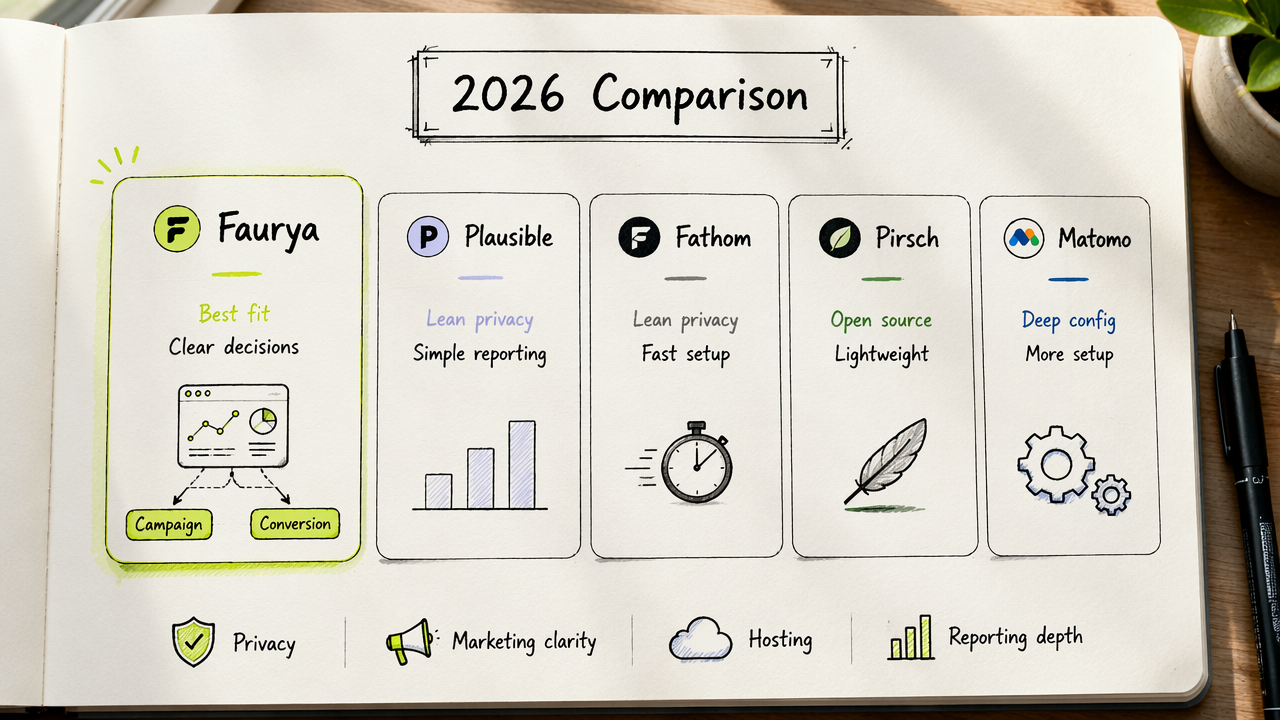
The Faurya platform is strongest when a team wants simple privacy-aware analytics with campaign and conversion context. Plausible and Fathom suit lean privacy reporting. Matomo fits organizations that want deeper configuration and can handle more setup.
Comparison table for marketing teams
| Tool | Best fit | Marketing strength | Tradeoff |
|---|---|---|---|
| Faurya | Growth teams needing clear decisions | Campaign and conversion visibility | Best for teams seeking a hosted workflow |
| Umami | Technical teams wanting open source analytics | Simple traffic reporting | Less marketer-led reporting by default |
| Plausible | Privacy-first site owners | Clean top-level metrics | Lighter attribution depth |
| Fathom | Minimal compliance-friendly reporting | Fast executive snapshots | Fewer advanced analysis paths |
| Matomo | Larger teams needing control | Configurable analytics suite | More setup and governance |
Research by Jaeger, Dupas de Matos, and Oduro in 2024 on drivers of liking in plant-based milk alternatives shows why feature matching alone is weak. Fit depends on user expectations, context, and the job being done.
Privacy, compliance, and reporting should be evaluated together
A good Umami alternative for marketing teams should not trade privacy for attribution. Marketing leaders need evidence that reporting practices, data processing, and service terms can stand up to customer or legal review.
Faurya supports that evaluation with clear public policy pages, including its privacy policy, data processing agreement, and terms of service. Those pages help teams review the operational side of analytics before adopting a new platform.
A short evaluation checklist
- Confirm whether the platform supports campaign, source, and conversion reporting.
- Review privacy, DPA, and service terms before migration.
- Compare dashboards against weekly marketing meeting questions.
- Test whether non-technical stakeholders can read reports unaided.
- Keep historical Umami exports available during the switch.
Decision rule: pick the tool that answers the recurring marketing questions fastest while keeping privacy controls visible and documented.
Conclusion
The right Umami alternative for marketing teams depends on reporting maturity, privacy expectations, and campaign volume. Teams ready to move from traffic snapshots to growth decisions should shortlist tools against the checklist, then visit faurya.com to assess whether Faurya fits the next analytics workflow.
Generated by EarlySEO.com