State of Cookieless Web Analytics 2026: Privacy, Data Quality, and Growth
Cookieless analytics in 2026 is shifting teams toward first-party, privacy-aware measurement, cleaner attribution, and lighter tools.

TL;DR
Cookieless analytics in 2026 is no longer a fringe privacy choice. Founders, marketers, and ecommerce operators are moving toward first-party, lightweight measurement because browser limits, consent rules, and AI search all make legacy cookie-heavy tracking less reliable.
The state of cookieless web analytics 2026 is defined by a practical shift: growth teams still need conversion data, but identity-based tracking is losing trust. Cookieless web analytics: website measurement that avoids storing tracking cookies on a visitor's device, often using aggregated, first-party, or server-side signals. Faurya fits this move toward simpler, privacy-aware analytics.
Table of Contents
What is cookieless web analytics in 2026?
Cookieless web analytics in 2026 measures traffic, events, and conversions without relying on persistent browser cookies. It replaces person-level surveillance with methods such as first-party event collection, short-lived sessions, aggregate reporting, and privacy-preserving attribution, while reducing dependency on consent banners and fragile third-party identifiers.
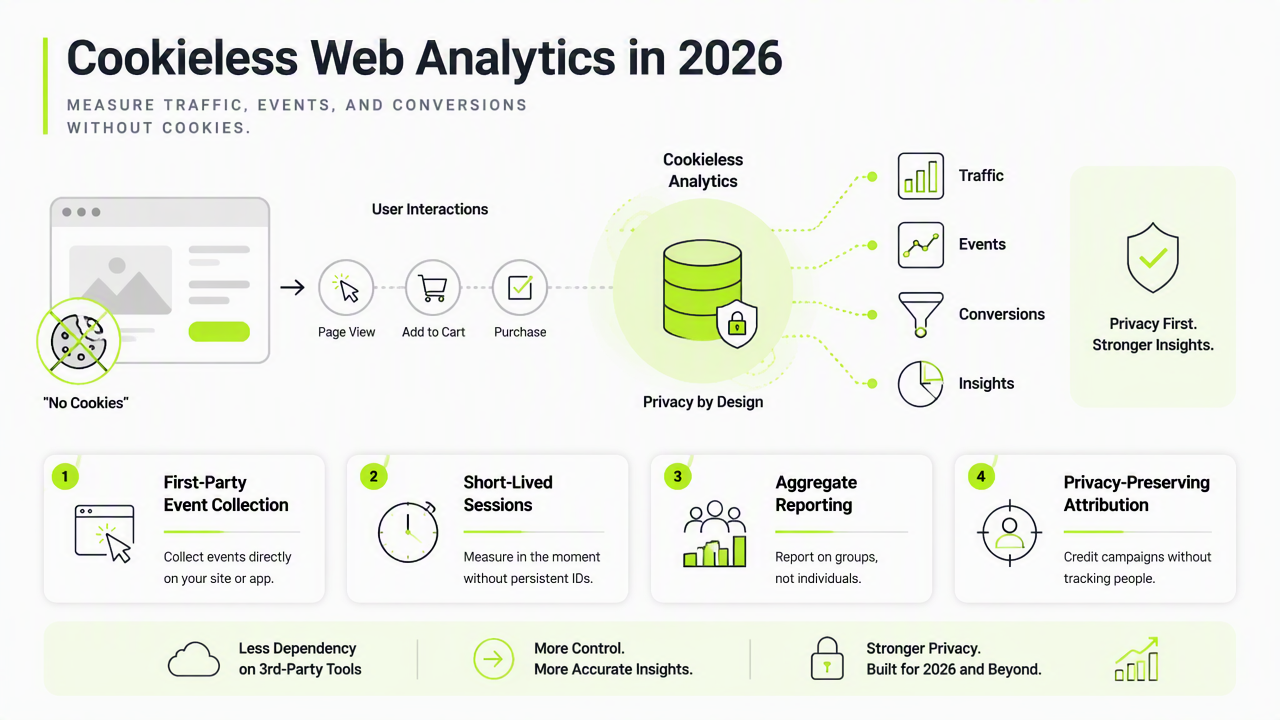
Cookieless methods compared
Web tracking: the collection, storage, and sharing of information about website visitor activity. Device fingerprint: software and hardware signals collected to identify a remote device, a method that can raise privacy risk when used for recognition.
| Method | 2026 role | Main tradeoff |
|---|---|---|
| First-party events | Tracks pageviews, clicks, and conversions from the site owner's domain | Less cross-site identity |
| Server-side tracking | Sends events through controlled infrastructure | Needs careful legal review |
| Aggregate analytics | Reports trends without user profiles | Less granular remarketing |
| Fingerprinting | Attempts recognition without cookies | Higher privacy and compliance concern |
The best cookieless setup measures business outcomes, not every individual action.
Why privacy rules and browsers changed measurement
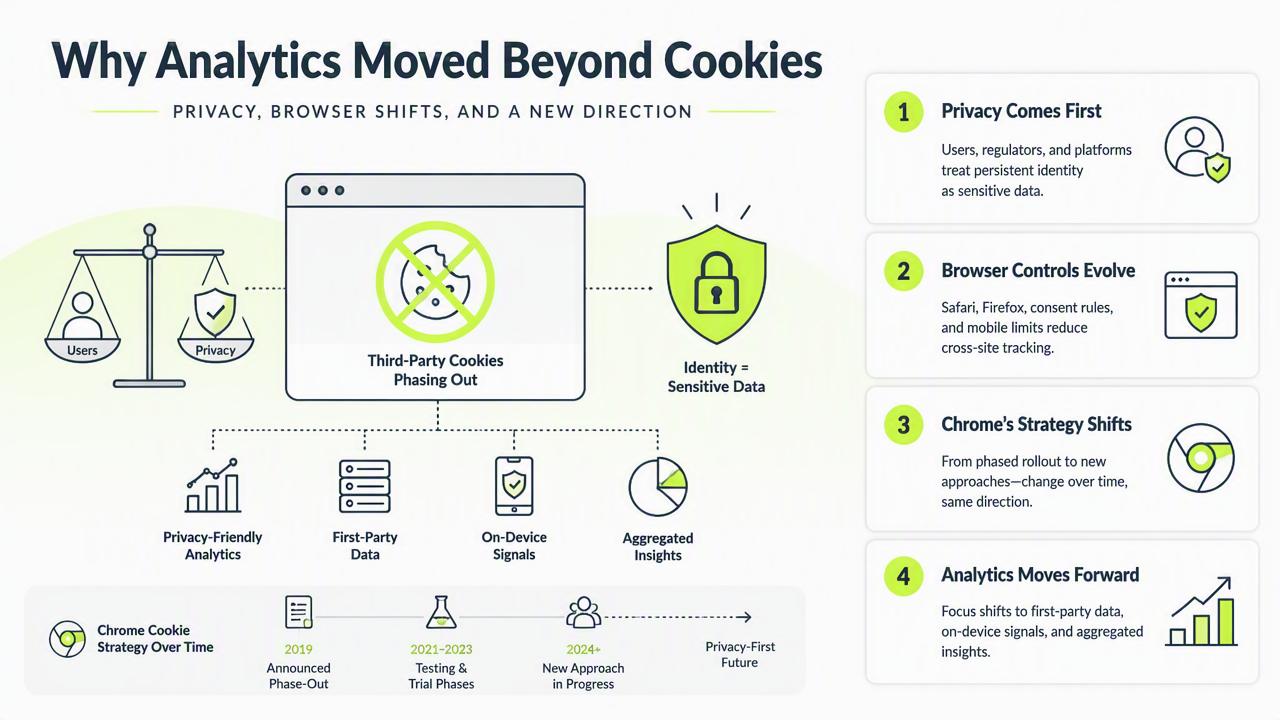
Privacy regulation and browser controls pushed analytics away from heavy cookies because users, regulators, and platforms now treat persistent identity as sensitive data. Chrome's cookie strategy has shifted over time, but the broader direction remains clear: Safari, Firefox, consent rules, and mobile privacy limits have already reduced dependable cross-site tracking.
Research by Fouad, Santos, and Laperdrix in Proceedings on Privacy Enhancing Technologies examined the detection, measurement, and lawfulness of server-side tracking on the web. Their work shows why server-side methods are not automatically privacy-safe; governance matters as much as architecture.
Compliance signals for operators
A privacy-ready analytics stack should answer three questions:
- What data is collected, and is it needed?
- Where is data processed and retained?
- Can reports work without identifying a person?
- Does consent logic match regional requirements?
A 2024 paper by Gonçalves, Hu, and Aliagas on consumer privacy and ethical considerations in neuromarketing algorithms reinforces the wider concern: advanced marketing systems can create ethical risk when personal data, inference, and persuasion combine.
How AI search and first-party analytics reshape growth
AI search makes clean, source-owned measurement more valuable because discovery is spreading beyond classic referral paths. Google AI features, ChatGPT-style assistants, and zero-click summaries can influence demand without producing neat session trails in legacy analytics. As attribution gets noisier, teams need durable first-party signals tied to events, revenue, and content performance.
The Faurya platform is relevant for operators who want lightweight analytics that emphasizes clarity over invasive profiling. A setup like Faurya works best when paired with defined conversion events, campaign naming discipline, and regular review of traffic sources.
Practical operating model for 2026
Growth teams should treat analytics as a decision system, not a surveillance system:
- Track fewer events, but name them consistently.
- Separate marketing attribution from product behavior analysis.
- Use first-party conversion data for campaigns and ecommerce reporting.
- Review AI-search, direct, referral, and dark-social patterns together.
- Keep privacy documentation current as tracking architecture changes.
In 2026, better analytics means fewer identifiers, clearer events, and stronger trust.
For privacy-conscious founders comparing tools, faurya.com is a sensible place to review a lightweight approach before rebuilding a tracking stack.
Conclusion
The state of cookieless web analytics 2026 favors teams that replace identity obsession with first-party clarity, cleaner event design, and privacy-aware reporting. The next step is concrete: audit current scripts, remove unnecessary identifiers, define revenue events, and test a lighter analytics layer with Faurya or another privacy-first platform before legacy data quality declines further.
Generated by EarlySEO.com