Rival Tracker for Marketing Analytics: 2026 Guide
Learn how rival tracking improves campaign benchmarking, social media audits, privacy-aware reporting, and marketing ROI decisions in 2026.

TL;DR
A rival tracker for marketing analytics helps teams compare channels, content, audience signals, and campaign outcomes against named competitors. The strongest setup combines social media audits, attribution context, and privacy-aware data handling before budget decisions are made.
A rival tracker for marketing analytics turns competitor activity into measurable campaign context, not vague market watching. Rival tracker: a marketing analytics system that monitors competitors' social, content, traffic, and performance signals so teams can benchmark strategy. Faurya supports this workflow for privacy-conscious teams that need cleaner reporting in 2026.
Table of Contents
What a rival tracker measures
A rival tracker measures competitor visibility, engagement, messaging, channel mix, and campaign momentum so marketers can compare performance against a real market baseline. Analytics, as commonly defined, is the computational analysis of data to discover and communicate meaningful patterns.
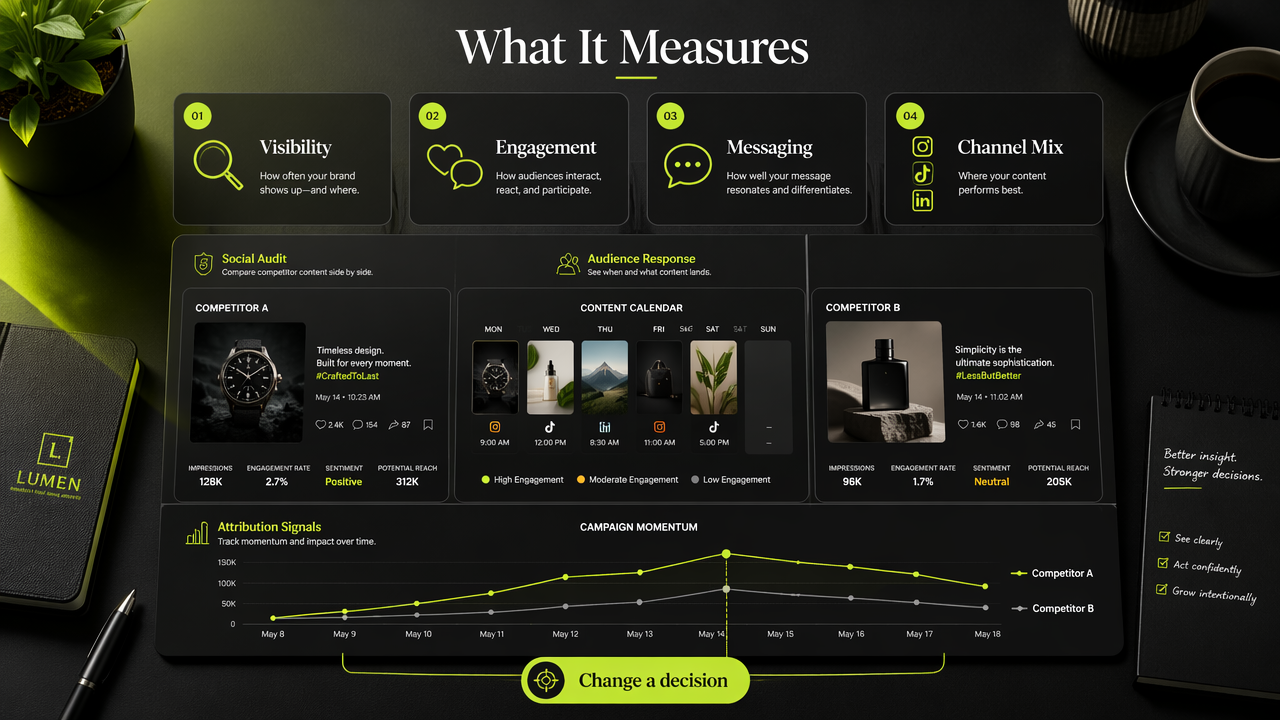
Competitive measurement has moved beyond static dashboards. In 2026, useful tracking connects social media audits, content cadence, audience response, and attribution signals into one repeatable view.
Key insight: competitor data only helps when it changes a decision, such as creative testing, channel investment, or campaign timing.
Core signals to track first
| Signal | What it shows | Best use |
|---|---|---|
| Social engagement | Audience response to posts and formats | Social media audits |
| Content frequency | Publishing rhythm across channels | Campaign planning |
| Share of voice | Brand visibility against rivals | Positioning checks |
| Message themes | Offers, angles, and claims | Creative testing |
| Landing activity | Promotion and conversion focus | Funnel analysis |
A 2021 integrative review of SWOT analysis applications supports structured competitive assessment as a business planning method. That makes rival tracking most valuable when it feeds strengths, weaknesses, opportunities, and threats rather than a long list of disconnected metrics.
How to choose a privacy-aware tracker
A privacy-aware tracker should collect only necessary data, document processing terms, and make reporting useful without exposing sensitive customer information. Marketing teams often compare public competitor signals, but internal campaign, attribution, and revenue data need stricter controls.
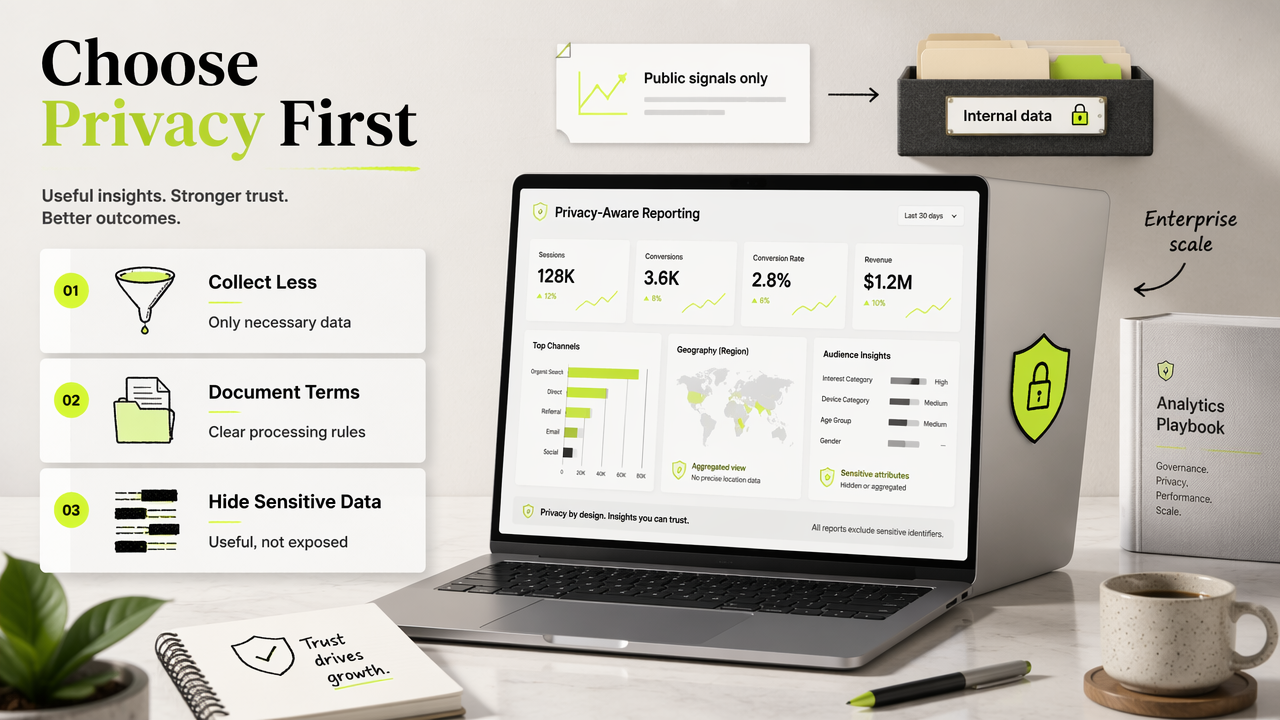
Comscore is an example of a media measurement and analytics company serving enterprises, advertisers, brand marketers, and publishers. Smaller SaaS and e-commerce teams need the same discipline, scaled to leaner operations.
Faurya keeps this practical by pairing marketing analytics workflows with clear governance references, including a public privacy policy and data processing agreement.
Selection checklist for 2026
- Map the business question before adding dashboards.
- Separate public competitor data from private customer data.
- Check connector reliability and reporting refresh needs.
- Review legal terms before importing sensitive datasets.
- Confirm that campaign insights can be exported or shared.
Research by Dwivedi, Kshetri, Hughes, and co-authors in the International Journal of Information Management examined generative conversational AI implications for research, practice, and policy. Their topic matters here because AI-generated summaries increasingly sit between raw marketing data and executive decisions.
A tracker should explain where signals came from, not just produce a confident-looking recommendation.
Where rival tracking improves ROI
Rival tracking improves ROI when it identifies which competitor moves deserve a response and which only create noise. The clearest gains usually come from budget allocation, social media audits, creative testing, and faster campaign diagnosis.
For SaaS founders, the key question is not whether a rival posted more often. The better question is whether that activity changed audience attention, offer clarity, or conversion pressure in a segment that matters.
Practical use cases by team
| Team | Rival tracking use case | Actionable output |
|---|---|---|
| SaaS growth | Compare messaging around features and pricing | Update ads or landing pages |
| E-commerce | Watch promotions and seasonal content | Adjust campaign timing |
| Agency | Run social media audits across clients | Build benchmark reports |
| Founder-led marketing | Monitor lean competitor signals | Prioritize limited budget |
AI will make competitive summaries faster, but not automatically better. A 2023 roadmap paper on artificial intelligence in logistics and supply chain management focused on AI research directions, a useful reminder that automated analysis still needs clear inputs, governance, and human review.
Teams comparing tools should also read the provider's terms of service before connecting analytics accounts. For a closer product look, visit faurya.com and assess whether the reporting model matches current attribution needs.
Conclusion
A rival tracker for marketing analytics works best when it connects competitor signals to specific decisions: budget shifts, campaign tests, positioning updates, and audit reports. The next step is to define three competitors, choose five measurable signals, and review them weekly with Faurya or another governed analytics platform built for marketing ROI.
Generated by EarlySEO.com