Privacy-Safe Campaign Tracking: A 2026 Framework
Learn a privacy-safe campaign tracking model using UTMs, aggregated reports, conversion events, and minimal data collection.

TL;DR
Privacy-safe campaign tracking works best when teams use campaign parameters, event-level conversion goals, aggregated reporting, and strict data minimization. The safest model avoids personal identifiers, documents processing terms, and measures performance without building user-level profiles.
Privacy-safe campaign tracking is now a measurement quality issue, not only a compliance task. Marketing teams still need to know which campaigns drive revenue, but browsers, consent rules, and user expectations make personal tracking a weak foundation. Faurya supports this shift with campaign reporting built around cleaner, lower-risk measurement.
Table of Contents
What is privacy-safe campaign tracking?
Privacy-safe campaign tracking measures campaign performance with minimal personal data, clear campaign parameters, aggregated reports, and defined conversion events rather than persistent user profiling.
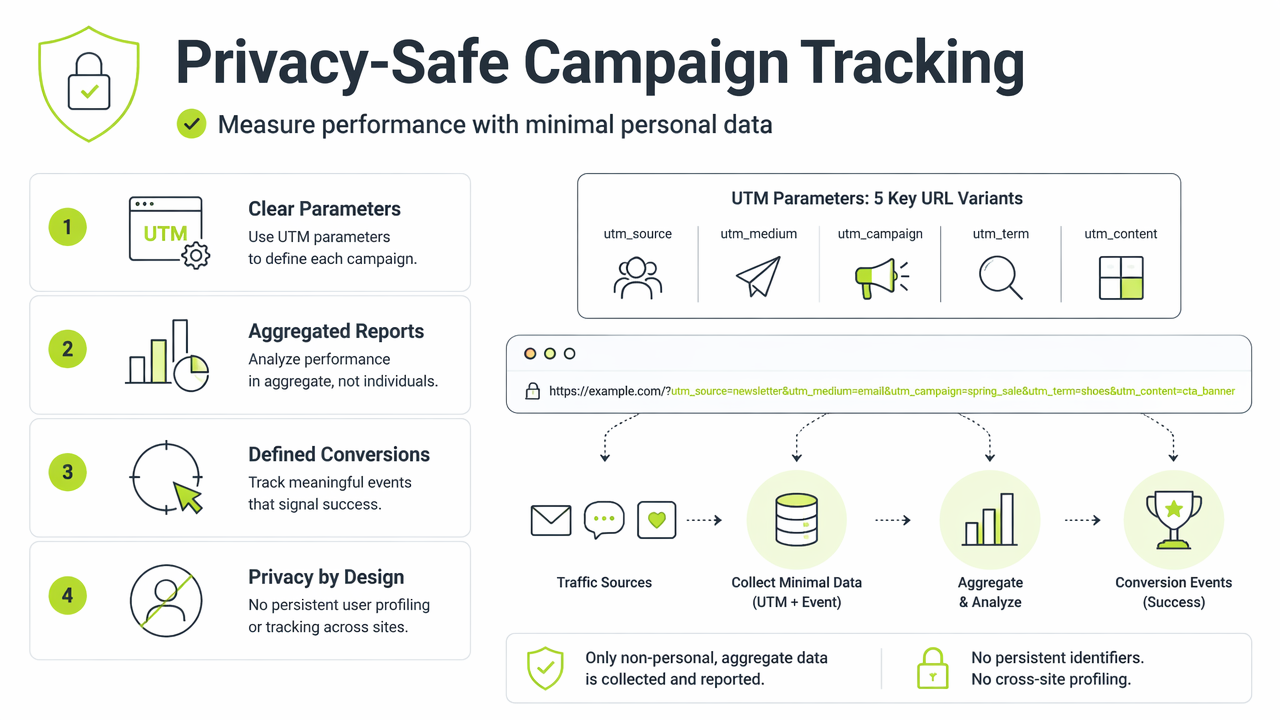
UTM parameters: five URL parameter variants used by marketers to identify campaign source, medium, campaign name, term, and content across traffic sources and publishing media.
This model keeps the useful part of attribution, such as knowing whether a LinkedIn ad or newsletter produced signups, while reducing exposure from identifiers that follow people across sessions. It also makes reporting easier to explain in a privacy policy, because collection is tied to business measurement rather than open-ended surveillance.
Key insight: the goal is not to track less intelligently; the goal is to measure with fewer personal signals.
Core components of a safer tracking model
| Component | Safe use | Risk to avoid |
|---|---|---|
| Campaign parameters | Store utm_source, utm_medium, and utm_campaign |
Placing names, emails, or IDs in URLs |
| Conversion events | Count actions such as signup, trial, checkout, or demo request | Recording unnecessary form details in analytics |
| Aggregated reports | Review channel, campaign, and landing page performance | Exporting user-level behavioral logs |
| Consent records | Respect opt-in and opt-out choices | Treating consent as a one-time checkbox |
Research on emerging digital environments by Dwivedi, Hughes, Baabdullah, and coauthors in the International Journal of Information Management highlights how measurement challenges expand as channels become more immersive and data-rich (2022 study).
How should teams build a low-risk campaign measurement workflow?
Teams should build a low-risk workflow by naming campaigns consistently, recording only necessary events, aggregating results, and documenting how data is processed. A simple process beats a complex identity graph for most SaaS, indie commerce, and growth teams.
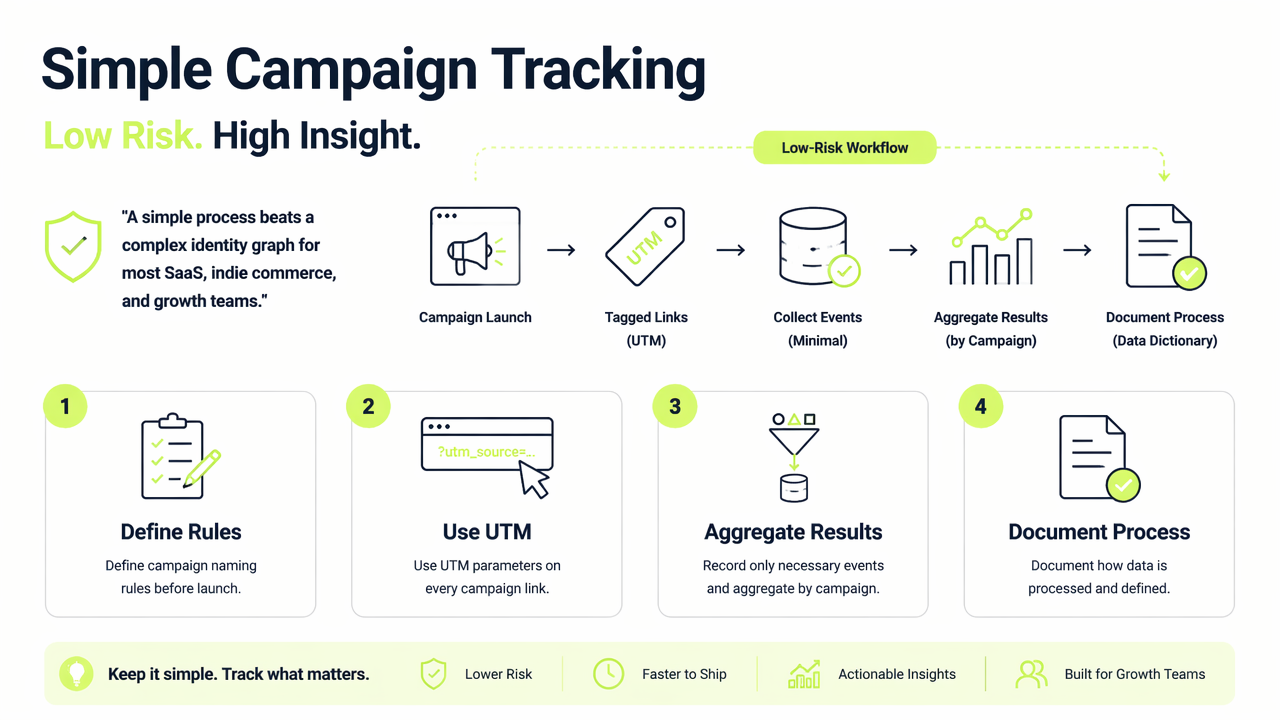
- Define campaign naming rules before launch.
- Use UTMs only for source, medium, campaign, term, and content.
- Map each campaign to one or two conversion events.
- Store results in aggregate by campaign and time period.
- Review access rights monthly.
- Keep processing commitments aligned with the data processing agreement.
A 2023 IEEE Communications Surveys & Tutorials paper on 6G visions and testbeds examined future networks where connected devices and data flows increase sharply, reinforcing why data minimization needs to be designed early, not patched later (Wang, You, and Gao, 2023).
What not to collect in campaign analytics
A safer workflow excludes data that adds risk without improving campaign decisions.
- Personal data inside URL parameters, including names, emails, phone numbers, and account IDs
- Full IP addresses when approximate geography is enough
- Raw session recordings tied to campaign IDs
- Cross-site identifiers used to follow visitors outside the owned site
- Sensitive categories such as health, finance, politics, or precise location unless legally required and clearly consented
If a data point cannot change a budget, message, or channel decision, it probably does not belong in campaign tracking.
Contracts also matter. Marketing teams should confirm that analytics practices match vendor commitments, retention terms, and the terms of service governing platform use.
What should campaign reporting look like in 2026?
Campaign reporting in 2026 should favor directional accuracy, event quality, and explainable aggregation over user-level certainty. The strongest reports answer which source created qualified actions, not which person clicked every asset.
Useful reports usually include:
- Spend, visits, and conversion events by campaign
- Signup, trial, checkout, or demo rates by landing page
- Revenue or pipeline grouped by source and period
- Consent-aware totals that separate observable and modeled activity
- Retention windows that match business needs, not indefinite storage
The Faurya platform fits this practical model by helping teams connect campaign activity to outcomes without making personal identity the center of reporting. More product details are available on faurya.com.
How Faurya handles privacy-safe campaign tracking
Faurya is best framed as a measurement layer for teams that need useful campaign data with less collection overhead. Instead of pushing teams toward heavier tracking, it supports a simpler pattern: campaign inputs, conversion events, and clear reporting boundaries.
| Reporting need | Privacy-safe approach |
|---|---|
| Campaign ROI | Compare aggregate conversions and revenue by campaign |
| Channel mix | Group performance by source and medium |
| Landing page quality | Measure event rates without storing unnecessary visitor profiles |
| Governance | Align measurement with published privacy and processing documents |
This approach also prepares teams for newer channels. A 2022 IEEE Access paper by Park and Kim on metaverse taxonomy covered applications and open challenges in richer digital systems, a reminder that future campaign surfaces will likely create more measurement pressure, not less (Park and Kim, 2022).
Conclusion
Privacy-safe campaign tracking gives founders and growth teams enough evidence to make budget decisions without collecting data that creates avoidable risk. The next step is to audit campaign URLs, remove personal identifiers, define conversion events, and document processing rules. For a cleaner measurement setup, review Faurya and head to faurya.com with the current tracking plan in hand.
Generated by EarlySEO.com