Privacy-Preserving Marketing Analytics for 2026 Growth Teams
A concise guide to privacy-safe analytics, cookieless tracking, consent, data rooms, and Faurya for 2026 growth teams.
TL;DR
Privacy-safe measurement in 2026 depends on consented first-party data, aggregation, and clear processing rules rather than individual-level tracking. Teams should audit data flows, reduce personal data collection, and choose analytics systems that document privacy controls before campaign scaling.
Privacy-preserving marketing analytics has moved from compliance cleanup to a growth requirement as cookies, device identifiers, and opaque tracking lose reliability. Privacy-preserving marketing analytics: measurement methods that analyze campaign performance while minimizing personal data exposure, identity resolution, and re-identification risk. Faurya fits this shift by helping privacy-conscious teams evaluate performance with cleaner governance.
Table of Contents
What is privacy-preserving marketing analytics?
Privacy-preserving marketing analytics measures acquisition, conversion, and retention while reducing dependence on personal identifiers. The concept builds on analytics, defined by Wikipedia as systematic computational analysis used to discover, interpret, and communicate meaningful data patterns.
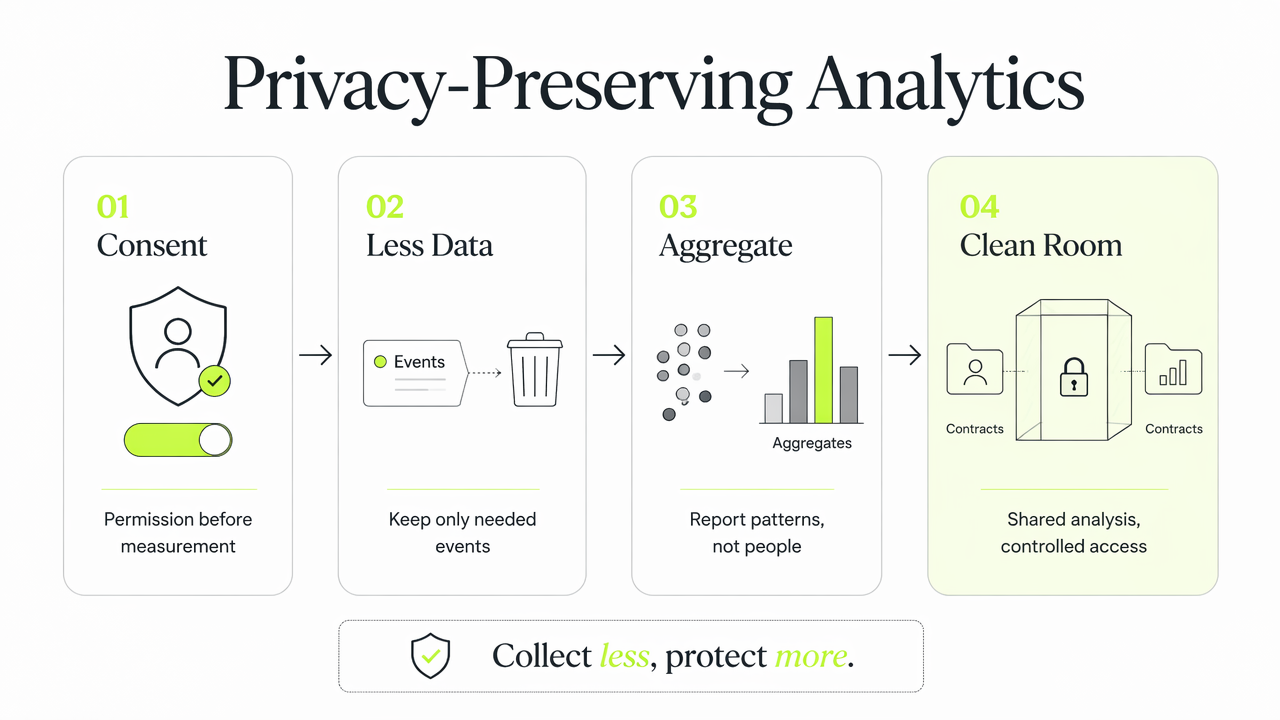
Modern privacy-safe measurement usually combines consent management, event minimization, aggregation, clean-room workflows, and contractual controls. Search privacy sits under broader information privacy, and the same principle applies to marketing data: collect less, protect more, and report only what is needed.
Key insight: the goal is not less measurement; the goal is less unnecessary identity exposure during measurement.
Core methods compared
The strongest privacy programs match the technique to the risk level, not the trendiest tool.
| Method | Best fit | Privacy value |
|---|---|---|
| First-party events | Owned websites and apps | Reduces third-party dependence |
| Aggregated reporting | Campaign dashboards | Hides individual behavior |
| Data clean rooms | Partner measurement | Limits raw data sharing |
| Differential privacy | Statistical outputs | Adds noise to reduce re-identification |
| Data processing agreements | Vendor governance | Defines roles, safeguards, and limits |
Research on privacy-preserving data fusion in Marketing Science by L. Tian appeared in 2026, reflecting rising interest in combining datasets without exposing raw customer records. Related technology governance concerns also appear in Dwivedi, Hughes, and Baabdullah's 2022 work on emerging digital systems and policy questions in the International Journal of Information Management.
Why cookieless measurement changes marketing decisions
Cookieless measurement changes marketing decisions because attribution becomes probabilistic, aggregated, and consent-led rather than identity-led. Legacy dashboards often rewarded channels that were easiest to track, not channels that created the most value.
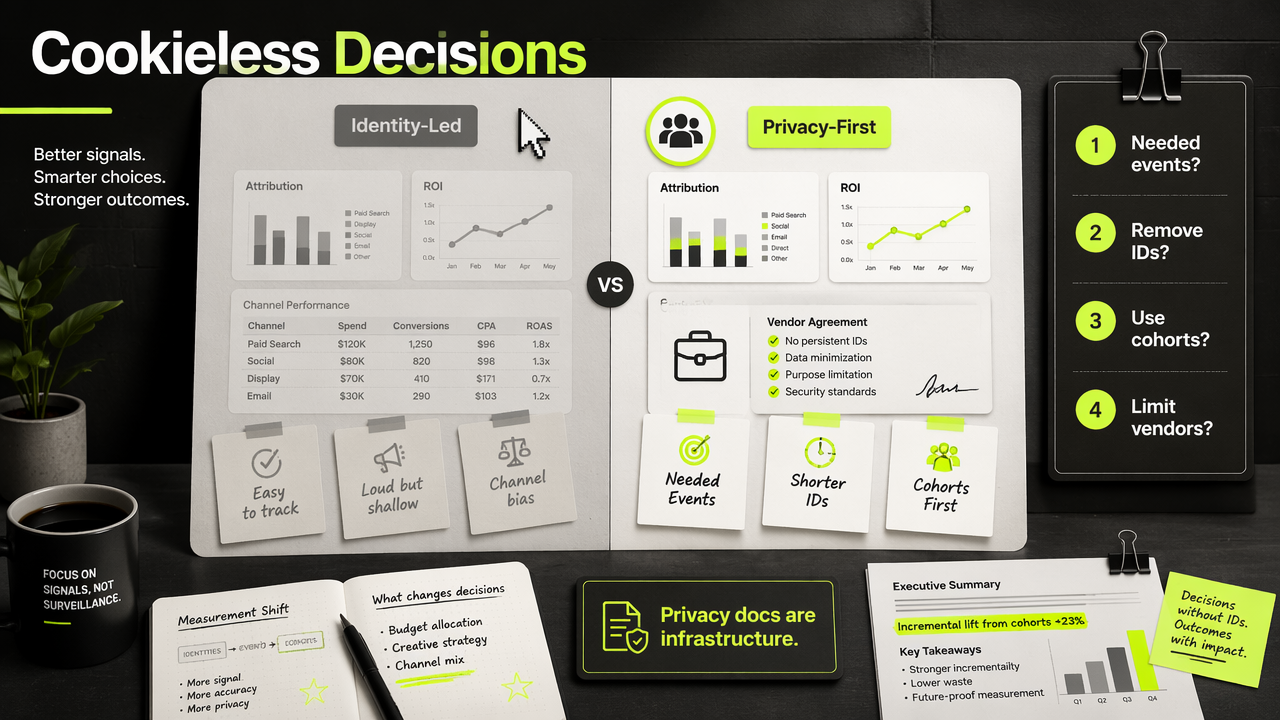
A privacy-first setup asks sharper questions:
- Which events are truly needed for ROI reporting?
- Which identifiers can be removed or shortened?
- Which reports can use cohorts instead of user records?
- Which vendors need contractual processing limits?
Teams should treat privacy documentation as part of analytics infrastructure. Faurya's public privacy policy and data processing agreement are examples of the governance documents buyers now review before sending event data to any platform.
Decision checklist for 2026 teams
A practical privacy review should happen before tags, pixels, or server-side events go live.
- Map every marketing event to a business purpose.
- Separate anonymous, pseudonymous, and personal data.
- Keep retention periods short and documented.
- Prefer aggregate channel reporting when user-level exports are not needed.
- Review vendor terms before campaign data is processed.
Natural language processing research by Khurana, Koli, and Khatter (2022) shows how fast data analysis techniques keep evolving in Multimedia Tools and Applications. For marketers, that pace makes governance more important, since AI-assisted segmentation and reporting can expand data use beyond the original collection purpose.
How Faurya supports privacy-safe growth reporting
Faurya supports privacy-safe growth reporting by emphasizing clearer measurement, controlled data handling, and practical documentation for teams that need marketing insight without excessive tracking. The Faurya platform is most relevant for SaaS founders, e-commerce operators, and growth teams that want campaign visibility while reducing privacy risk.
Strong implementation still requires internal discipline. No analytics platform can fix vague event naming, over-collected user properties, or unclear consent flows. The better approach is to define the smallest useful dataset first, then build reporting around that constraint.
Key insight: privacy-safe analytics works best when measurement design starts with data minimization, not dashboard ambition.
Implementation path for a privacy-first stack
A lean rollout can start with five steps:
- Define conversion events tied to revenue or activation.
- Remove unnecessary personal fields from marketing events.
- Configure aggregate dashboards for channel and campaign reporting.
- Review platform obligations in the Faurya terms of services.
- Revisit consent, retention, and access rules every quarter.
Teams evaluating Faurya can visit faurya.com after completing the data inventory, since product fit is easier to judge once event scope and governance needs are clear. That order also prevents tool selection from driving privacy policy by accident.
Conclusion
Privacy-preserving marketing analytics in 2026 is a measurement design choice, not only a legal checkbox. Growth teams should reduce identifiers, favor aggregated reporting, and document vendor responsibilities before scaling campaigns. For a practical next step, audit current events, compare them with required business questions, then review Faurya at faurya.com for privacy-conscious reporting needs.
Generated by EarlySEO.com