Privacy-Friendly Analytics for Bubble Apps in 2026
Learn how Bubble teams can track product growth with privacy-friendly analytics, cleaner events, consent-aware setup, and Faurya documentation.
TL;DR
Privacy-friendly analytics for Bubble apps should track visits, events, and conversions without collecting more personal data than needed. The practical path is a lightweight tracker, a clear event plan, consent-aware documentation, and regular cleanup of unused events.
Privacy-friendly analytics for Bubble apps matters because no-code products now collect signups, payments, funnels, and user behavior before many founders have a formal data team. Bubble: a visual programming language developed by Bubble Group for building web and mobile applications. The Faurya platform fits this workflow by helping teams pair growth tracking with clear privacy documentation.
Table of Contents
What counts as privacy-friendly analytics for Bubble apps?
Privacy-friendly analytics for Bubble apps means measuring product usage while limiting personal data collection, retention, and third-party exposure. For Bubble builders, that usually means tracking page views, workflow events, conversions, and retention signals without defaulting to invasive identifiers or broad behavioral profiling.
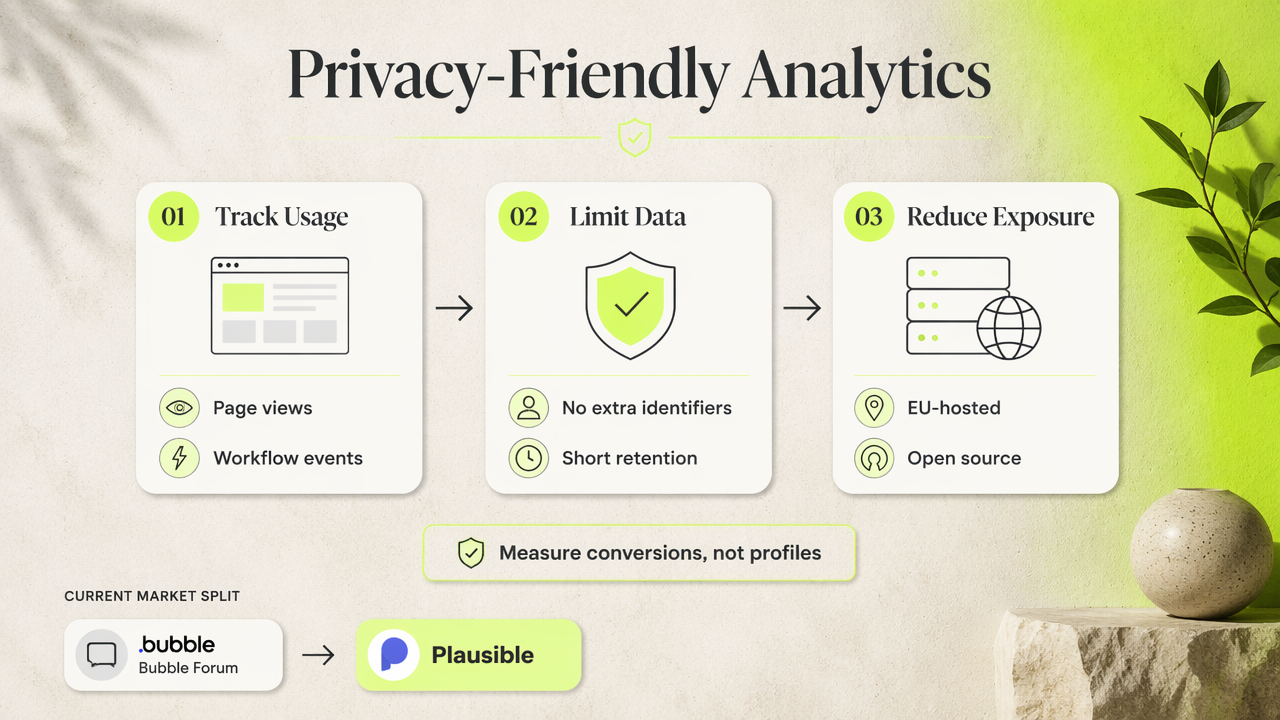
The current SERP shows a split market. The Bubble Forum discussion on product analytics dates back to 2022 and focuses on tool suggestions, while Plausible Analytics positions itself as an EU-hosted, open-source Google Analytics alternative. Bubble teams in 2026 need more than a plugin choice; the setup must match privacy rules, product metrics, and consent language.
Key insight: analytics privacy is not a single feature. It is the combination of minimal tracking, clear purpose, secure processing, and honest user-facing documentation.
Core privacy terms Bubble teams should define
| Term | Practical meaning for Bubble apps |
|---|---|
| Event tracking | Recording actions such as signup, checkout, search, or invite sent |
| Personal data | Any data that can identify or relate to a person |
| Consent | Permission for tracking where required by law or policy |
| Data processing agreement | Contract terms explaining how data is handled by a processor |
A strong setup starts with naming the data categories before adding scripts. Faurya supports that planning layer through a clear data processing agreement, which helps growth teams align analytics choices with processing responsibilities.
How should Bubble apps choose analytics tools in 2026?
Bubble apps should choose analytics tools by comparing privacy posture, event flexibility, setup effort, and reporting clarity. Google Analytics can be powerful, but many no-code founders prefer lighter tools when dashboards, attribution, and conversion tracking can be handled without unnecessary complexity.
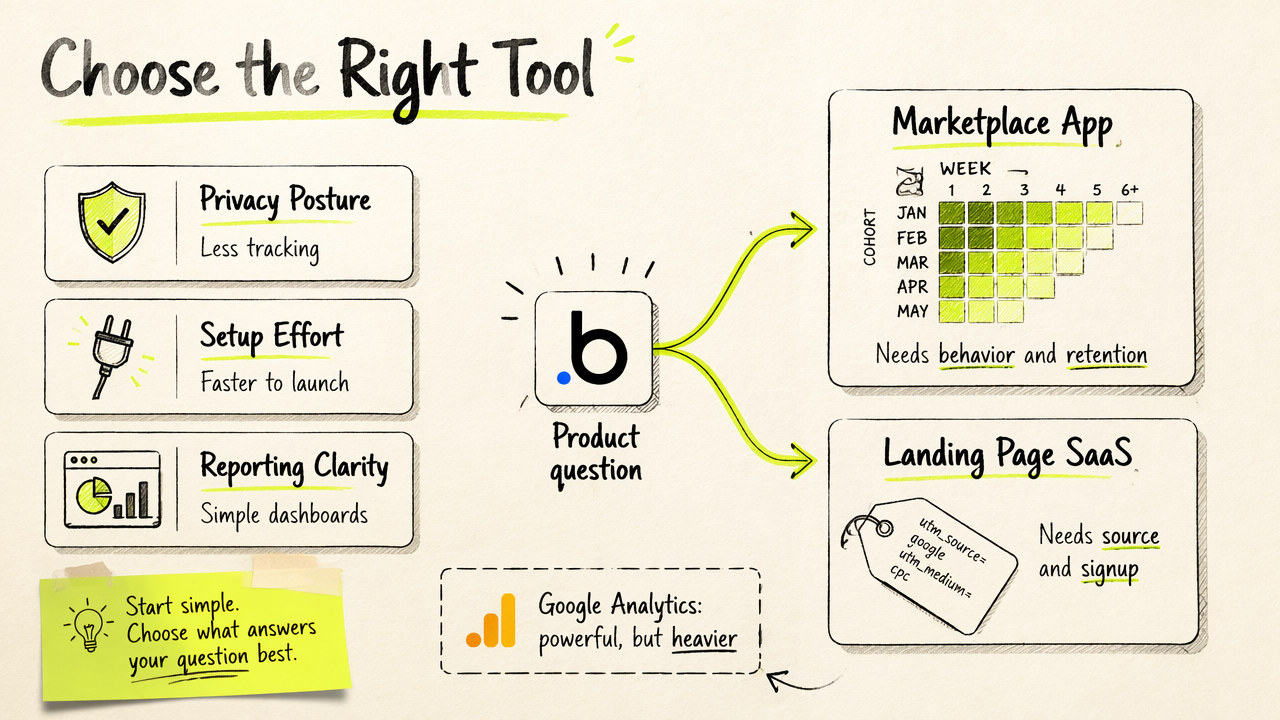
The best decision starts with the product question, not the tool name. A marketplace app may need cohort behavior, while a landing-page-led SaaS app may only need source, signup, and paid conversion tracking. Research by Budhwar, Chowdhury, and Wood (2023) on generative AI and management work highlights how automation changes organizational decisions, which makes clean analytics governance more valuable as teams rely on AI-assisted reporting: Wiley source.
Decision checklist for no-code analytics selection
- List the decisions the dashboard must support.
- Track only events tied to revenue, activation, retention, or support.
- Avoid sending raw emails, names, or private workflow fields unless necessary.
- Confirm where data is hosted and who can access it.
- Match consent banners, privacy notices, and internal records.
For legal-facing clarity, Bubble teams can connect analytics decisions to a public privacy policy and keep platform rules aligned with terms of services. That reduces confusion when customers, partners, or auditors ask how tracking works.
How does Faurya support privacy-first Bubble growth?
Faurya supports privacy-first Bubble growth by making the documentation around analytics easier to maintain as a product changes. Analytics tools show what happens inside an app; privacy operations explain why data is collected, how it is processed, and what rules apply.
Many Bubble apps start with a simple MVP, then add paid plans, referrals, onboarding emails, and embedded tools. Each change can create new tracking events and new data responsibilities. A privacy-friendly workflow keeps product analytics, policy language, and processing records moving together instead of treating compliance as a launch-week task.
Visit faurya.com when the analytics stack needs to be paired with clearer privacy operations rather than another dashboard alone.
Practical setup for a Bubble analytics stack
- Define 5 to 10 core events, such as
signup_completed,checkout_started, andsubscription_created. - Separate anonymous traffic metrics from logged-in product events.
- Review installed Bubble plugins before adding another tracker.
- Document each analytics vendor, purpose, and data category.
- Revisit tracking after major workflow or pricing changes.
A privacy-friendly analytics stack is easier to maintain when every tracked event has a business purpose and a matching privacy explanation.
This approach keeps growth teams focused on signal quality. It also prevents dashboard sprawl, where many tools collect data but few metrics guide product decisions.
Conclusion
Privacy-friendly analytics for Bubble apps should be treated as a product system, not just a script install. The next step is to map core events, remove unnecessary identifiers, and align tracking with policy, terms, and processing records. For teams formalizing that operating model, Faurya provides a practical place to start, and more detail is available at faurya.com.
Generated by EarlySEO.com