Privacy-First Web Analytics Trends 2026: What Changes Now
Key 2026 analytics trends: fewer cookies, first-party data, AI summaries, aggregated attribution, consent fatigue, and compliance-ready measurement.
TL;DR
Privacy-first analytics in 2026 favors first-party measurement, simpler dashboards, aggregated attribution, and clearer consent records. Teams should reduce cookie dependence, document data processing, and choose tools that turn compliant data into decisions.
Privacy-first web analytics trends 2026 point to a clear shift: growth teams still need insight, but personal tracking is becoming harder to justify. Web analytics means measuring, collecting, analyzing, and reporting web data to improve usage, while internet privacy concerns personal data storage, reuse, sharing, and display online. Faurya fits this shift by focusing analytics work on useful signals rather than excess collection.
Table of Contents
What is changing in privacy-first web analytics in 2026?
Privacy-first analytics in 2026 is moving away from broad visitor surveillance toward consent-aware, first-party, purpose-limited measurement. Competitive SERP analysis shows current leaders focusing on CNIL consent exemptions, the EU Digital Omnibus discussion, UK PECR updates, and analytics strategies that preserve insight while lowering compliance exposure.
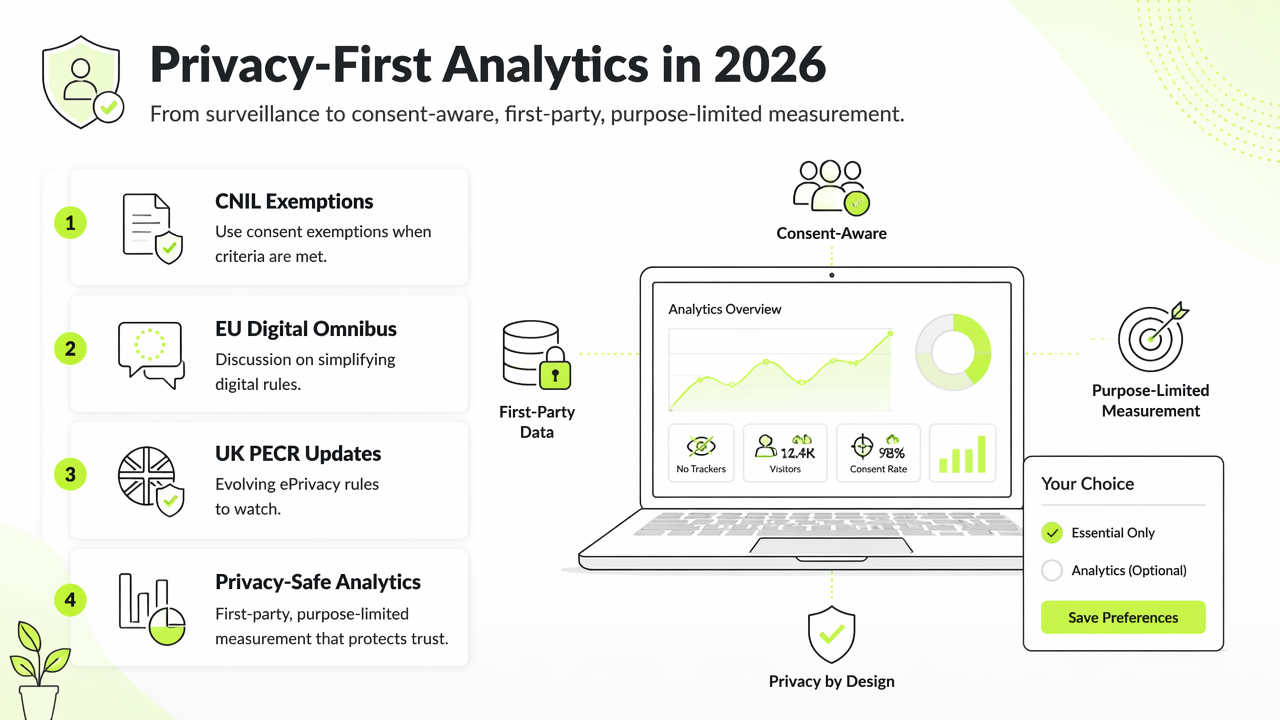
The practical change is not only legal. Dashboards are becoming smaller, events are becoming more intentional, and Company and Resources pages are being measured with clearer data boundaries. Public documents such as a privacy policy and data processing agreement now shape analytics architecture, not just legal review.
Key insight: 2026 analytics maturity is measured less by data volume and more by whether each collected event has a clear business purpose.
2026 privacy shifts at a glance
| Trend | What changes | Practical response |
|---|---|---|
| Fewer cookies | Browser and regulatory pressure reduce passive tracking | Favor first-party events |
| Consent fatigue | Visitors ignore or reject complex banners | Collect less by default |
| Regulatory self-assessment | CNIL-style consent exemption models need documentation | Record purposes and limits |
| PECR simplification | UK rules may ease low-risk analytics | Separate essential analytics from ads |
| Digital Omnibus debate | EU rules may shift again | Keep measurement flexible |
Why is attribution moving from user tracking to aggregated signals?
Attribution is moving toward aggregated signals because individual-level tracking is less reliable, less accepted, and harder to defend under privacy rules. In 2026, marketers increasingly compare channel performance through modeled conversions, first-party campaign tags, server-side events, and cohort-level reporting instead of persistent cross-site identities.
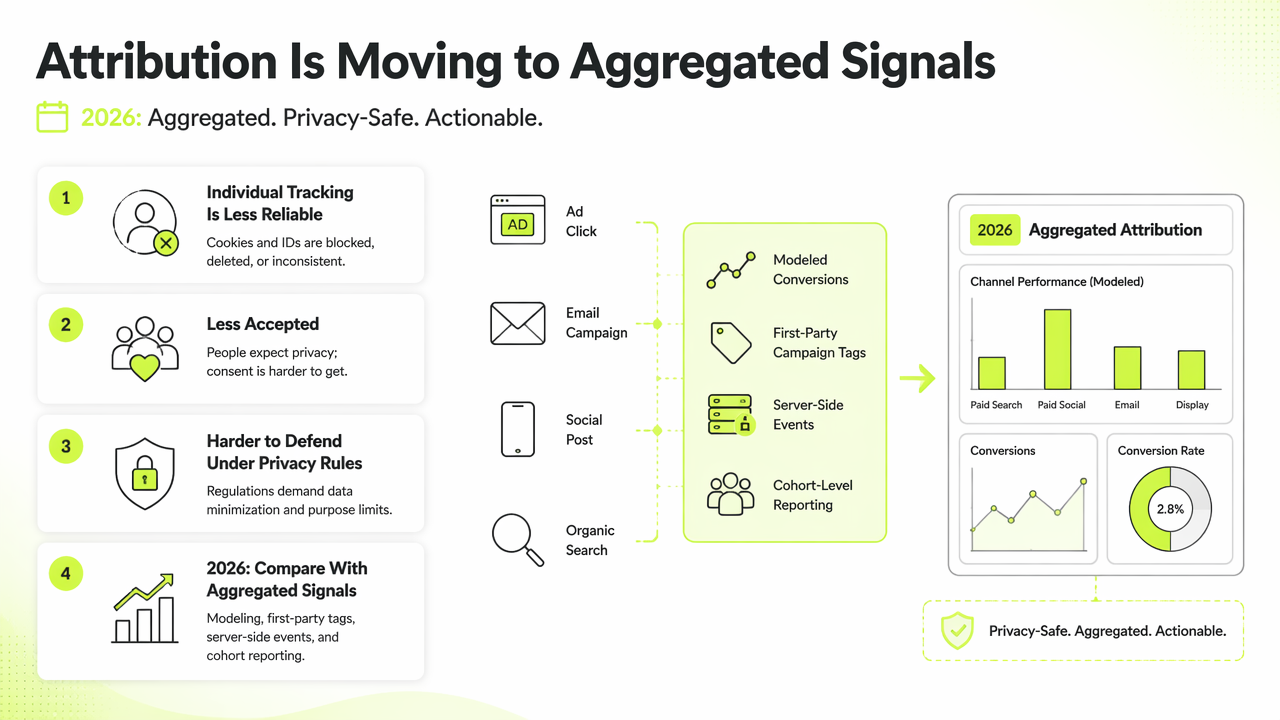
This makes attribution less exact at the person level but more stable at the decision level. A SaaS founder does not need every visitor path to decide whether search, email, partner traffic, or paid campaigns deserve budget. The Faurya platform can support this operating model when teams define events around outcomes rather than curiosity.
Research on large language models by Zhao, Zhou, and Li in Frontiers of Computer Science (2026) examines how modern AI systems summarize and reason over large information sets, which mirrors the analytics move toward synthesized answers rather than raw report digging: A Survey of Large Language Models.
Signals replacing user-level trails
- First-party events: signups, trials, purchases, downloads, and form submissions.
- Aggregated campaign reporting: performance grouped by source, medium, landing page, and cohort.
- AI summaries: plain-language explanations of movement in traffic, conversion, and retention.
- Consent records: proof that collection matches stated purposes.
- Data minimization: fewer fields collected, with stronger value from each field.
These patterns also support cleaner contractual alignment through published terms of service.
What should analytics teams prepare for in 2027?
Analytics teams should prepare for 2027 by treating privacy-first measurement as a product capability, not a compliance patch. The likely direction is more AI-assisted reporting, less tolerance for vague collection, stronger first-party data strategies, and clearer separation between operational analytics and advertising surveillance.
Sensitive-data sectors show why this matters. A 2021 World Psychiatry review by Torous, Bucci, Bell, and colleagues examined digital psychiatry across apps, social media, chatbots, and virtual reality, highlighting how digital tools raise evidence and governance questions in data-heavy settings: World Psychiatry review. That caution now influences mainstream analytics expectations.
Faurya's best fit is for teams that want practical measurement without turning every visitor interaction into an identity graph. For evaluation, faurya.com should be reviewed alongside internal requirements for consent, retention, and reporting depth.
A 2027-ready analytics checklist
- Define essential events before adding tags.
- Separate product analytics, marketing attribution, and advertising pixels.
- Keep retention windows short enough to defend.
- Use aggregated dashboards for executive reporting.
- Document lawful basis, processor roles, and deletion workflows.
- Review vendor contracts before launching new tracking.
Strong analytics programs will not collect everything first and govern later; they will design measurement around trust, clarity, and action.
Conclusion
The strongest reading of privacy-first web analytics trends 2026 is simple: better measurement now comes from fewer, cleaner, first-party signals. Growth teams should audit events, remove low-value identifiers, document processing, and test a focused platform such as Faurya. For a practical next step, visit faurya.com and map the top five decisions analytics must support before adding another tag.
Generated by EarlySEO.com