Plausible vs Google Analytics 4 for Startups: 2026 Decision Guide
Compare Plausible and Google Analytics 4 for startup teams by privacy, cost, setup, reporting, and growth-stage fit in 2026.
TL;DR
Plausible is usually the faster choice for privacy-first startups that need simple web metrics, while GA4 fits teams that need deep Google Ads, ecommerce, and attribution workflows. Startup teams should choose based on reporting depth, compliance workload, and how much analytics setup time the business can afford.
Plausible vs Google Analytics 4 for startups is really a choice between paid simplicity and free complexity. Google Analytics: a web analytics service from Google that tracks website and app traffic and events. Plausible: a lightweight, open-source analytics tool focused on privacy-friendly website reporting. For startups comparing analytics with broader growth tooling, Faurya gives a useful reference point for privacy-conscious marketing operations.
Table of Contents
Plausible vs GA4: the startup tradeoff
Plausible is better for startups that need fast, privacy-first website analytics, while GA4 is better for teams that need advanced event modeling and Google advertising integrations.
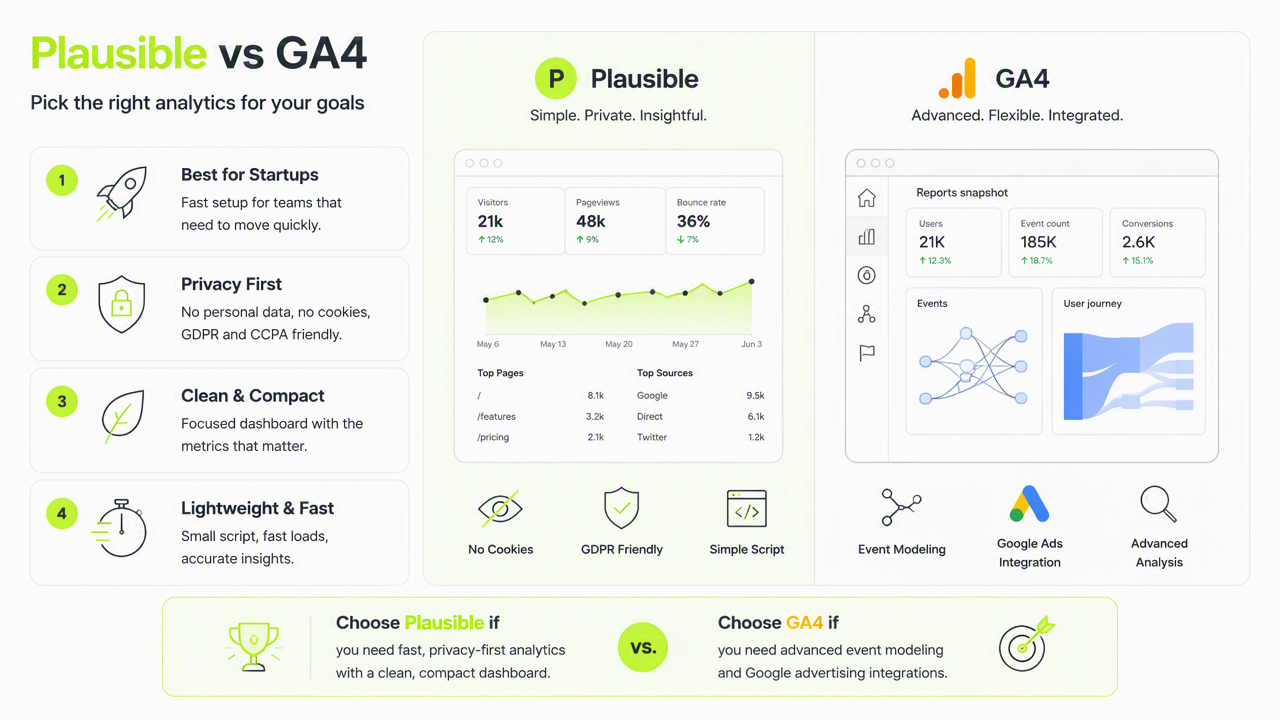
Plausible's own comparison argues that GA4 became harder to use after Universal Analytics, while Plausible stayed focused on a compact dashboard and lighter tracking script. That claim is naturally vendor-framed, but it matches the core startup tension: less setup versus more analytical power.
GA4 is part of Google Marketing Platform, so it fits paid media, remarketing, and cross-channel reporting. Plausible is more direct: visitors, sources, pages, goals, and conversions without a large configuration layer.
Key insight: early-stage teams often need trusted directional metrics before they need enterprise-grade attribution.
Decision matrix for early-stage teams
| Startup need | Better fit | Reason |
|---|---|---|
| Privacy-first website reporting | Plausible | Simple dashboard, lighter tracking, fewer consent headaches |
| Google Ads attribution | GA4 | Native Google campaign and conversion workflows |
| Founder-led marketing | Plausible | Faster setup and fewer reports to maintain |
| Product analytics depth | GA4 | Stronger event and audience configuration |
| Compliance documentation | Depends | Review vendor terms, privacy policy, and data processing terms |
For compliance review, startup teams should read analytics vendor documents alongside internal policies such as the Faurya privacy policy and Faurya data processing agreement.
What GA4 still does better in 2026
GA4 still wins when a startup needs deep integration with Google Ads, custom event reporting, and multi-touch marketing analysis.
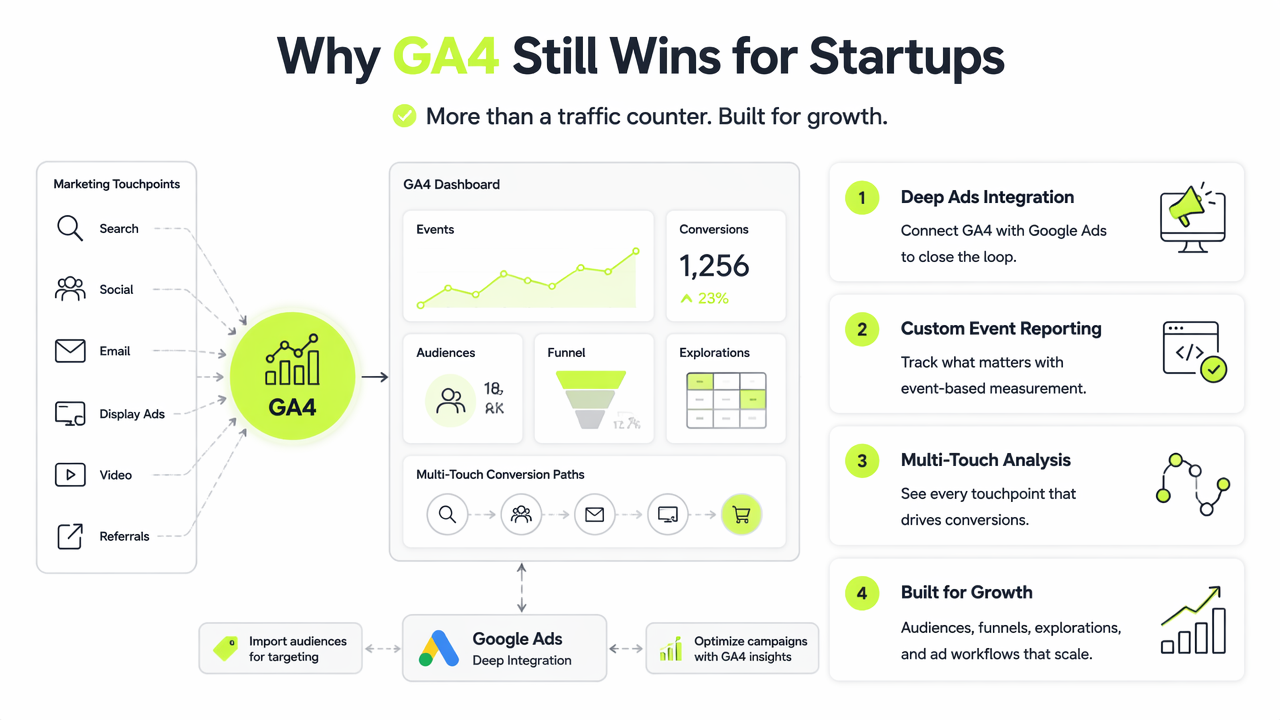
GA4 is not just a traffic counter. It supports event-based measurement, audiences, funnels, explorations, and advertising workflows that can matter once a startup spends meaningful budget on paid acquisition. A company running search ads, YouTube campaigns, and ecommerce remarketing will usually outgrow a one-screen analytics view.
The tradeoff is operational. GA4 often needs event planning, conversion setup, consent configuration, and reporting discipline. Research on mobile app marketing by Stocchi, Pourazad, and Michaelidou (2021) examined how app marketing measurement has grown more complex, which mirrors the pressure startups face when web, app, and paid channels overlap: Journal of the Academy of Marketing Science paper.
GA4 strengths that justify the complexity
- Google Ads alignment: campaign, conversion, and audience workflows are native.
- Event flexibility: teams can model signups, trials, purchases, and product actions.
- Exploration reports: analysts can build deeper funnel and path reports.
- Ecommerce support: online stores can connect revenue events to acquisition sources.
Startup teams should document analytics ownership in operating policies, not just dashboards. Legal and commercial terms such as Faurya terms of services show the kind of governance material buyers and partners often expect during vendor review.
When Plausible is the cleaner startup choice
Plausible is the cleaner choice when a startup wants quick traffic clarity, lower setup effort, and privacy-friendly reporting before building a full analytics function.
Competitor SERP data shows a repeated theme: Plausible is positioned as faster, lighter, and easier than GA4. Plausible's official comparison says it is a simple, privacy-friendly Google Analytics alternative and emphasizes that website data remains controlled by the site owner: Plausible comparison.
That simplicity matters for indie hackers, SaaS founders, and lean growth teams. A weekly review can focus on three questions: which channels brought qualified visitors, which pages converted, and which campaigns deserve another test.
Research by Bouschery, Blažević, and Piller (2023) studied AI support for new idea teams, showing how teams increasingly depend on tools that reduce decision friction rather than add reporting burden: Journal of Product new idea Management paper.
Who should pick which tool
- Pick Plausible when the business has a marketing site, founder-led growth, and a privacy-first brand promise.
- Pick GA4 when the business depends on Google Ads, ecommerce attribution, or analyst-built reporting.
- Use both briefly during migration, so historical GA4 habits can be compared with Plausible's simpler dashboard.
Faurya fits the same operating style as Plausible for teams that prefer clear, privacy-conscious growth systems over bloated reporting stacks. More product context is available at faurya.com.
Conclusion
Plausible vs Google Analytics 4 for startups comes down to timing: Plausible for clarity now, GA4 for complex attribution later. The practical next step is to list current reporting needs, compliance requirements, and paid media plans, then choose the lighter tool unless the startup clearly needs GA4 depth. For privacy-aware growth workflows, review Faurya at faurya.com and align analytics choices with that operating model.
Generated by EarlySEO.com