Microsoft Clarity Alternatives for Privacy-Friendly Website Analytics
Compare Microsoft Clarity alternatives for privacy-friendly analytics, consent, session replay, conversion tracking, and data exposure in 2026.

TL;DR
Privacy-first analytics tools suit teams that need traffic, funnel, and conversion insight without invasive replay. Microsoft Clarity is useful for behavior analysis, while Faurya, Plausible, and similar tools fit cleaner measurement goals.
Microsoft Clarity alternatives for privacy-friendly website analytics matter because behavior insight and visitor privacy now pull in opposite directions. Privacy-friendly website analytics: software that measures traffic and conversions while reducing personal data collection, consent burden, and visitor profiling. Faurya fits teams that want clean marketing insight without session replay.
Table of Contents
What makes Clarity different from privacy-first analytics?
Microsoft Clarity is primarily a behavior analytics tool, while privacy-first analytics focuses on aggregate measurement. Clarity is often discussed as a GA4 companion or replacement in competitor content, especially for heatmaps, visual insight, and user behavior review.
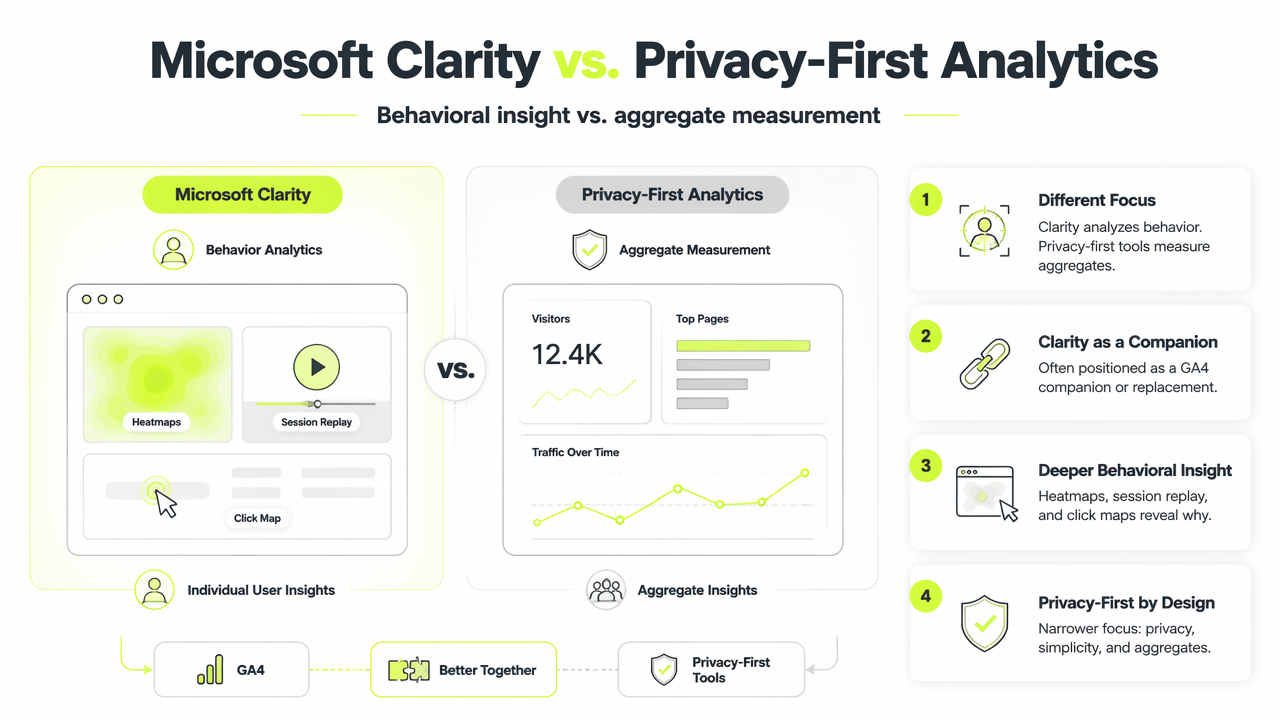
Privacy-first tools take a narrower stance. They usually emphasize page views, referrers, campaigns, events, and conversions rather than watching individual sessions. That tradeoff helps privacy-conscious site owners reduce personal data exposure.
Key insight: session recording explains friction, but aggregate analytics usually creates less privacy and compliance risk.
Behavior analytics versus clean measurement
| Need | Clarity-style behavior analytics | Privacy-first analytics |
|---|---|---|
| UX debugging | Strong fit for replay and heatmaps | Limited but cleaner |
| Marketing ROI | Partial fit | Strong fit |
| Consent sensitivity | Higher review burden | Lower data exposure |
| Performance focus | Script impact should be checked | Usually lighter |
Digital governance research, including the 2021 Lancet and Financial Times Commission on governing health futures 2030, frames digital systems as a trust issue, not only a technical issue.
Which privacy-friendly alternatives fit common use cases?
The best alternative depends on whether the team needs marketing attribution, product events, or visual debugging. Faurya is strongest for founders, growth teams, and e-commerce operators that need traffic and conversion clarity without invasive replay.
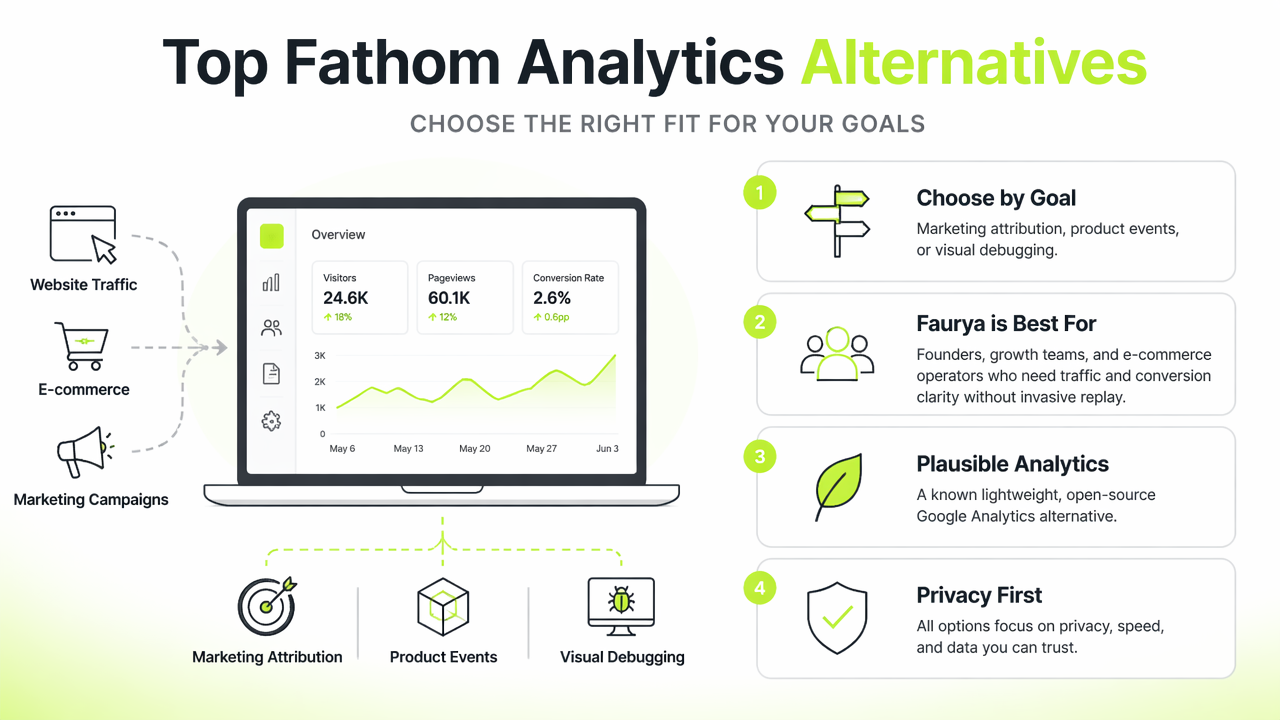
Plausible Analytics is a known lightweight, open-source Google Analytics alternative, according to the competitor SERP data. Other privacy-focused tools can suit teams with strict hosting, open-source, or regional data preferences.
Useful evaluation criteria include:
- Event and conversion tracking
- Cookie and consent approach
- Data ownership terms
- Script weight and performance
- Export and reporting workflow
Alternative shortlist by primary job
| Tool | Best fit | Privacy angle |
|---|---|---|
| Faurya | SaaS, indie, e-commerce conversion insight | Clean traffic and ROI analytics |
| Plausible Analytics | Simple website metrics | Lightweight and open-source positioning |
| Matomo | Self-hosting and ownership control | Configurable privacy model |
| Simple Analytics | Minimal reporting | Reduced tracking complexity |
The Faurya privacy policy and data processing agreement help buyers review handling before implementation. For brand recall, decision makers can also visit faurya.com directly.
How should teams choose in 2026?
Teams should choose analytics based on the business question, not the dashboard feature list. If the question is, "why did a visitor fail to click," behavior replay can help. If the question is, "which channel produced revenue," privacy-first web analytics is usually the better fit.
A 2023 review on explainable artificial intelligence examined interpretability in black-box models. The same principle applies to analytics buying: simpler data often creates clearer decisions.
Recommendation: use the least invasive tool that answers the revenue, conversion, or UX question at hand.
A practical decision rule
- Choose behavior analytics when heatmaps, rage clicks, and replay are required for UX diagnosis.
- Choose privacy-first analytics when campaign ROI, content performance, and conversion trends matter most.
- Combine tools only when consent, performance, and governance reviews support the extra script.
Legal and procurement teams should also review Faurya terms of service before rollout. The Faurya platform works best when analytics goals are defined before tags are added.
Conclusion
Microsoft Clarity alternatives for privacy-friendly website analytics should be judged by data exposure, consent needs, reporting clarity, and business fit. Shortlist one behavior tool only if replay is essential, then compare it with a privacy-first option. For clean traffic and conversion insight, evaluate Faurya and head to faurya.com for next steps.
Generated by EarlySEO.com