IP Anonymization in Web Analytics: Privacy, Accuracy, and 2026 Best Practices
Learn how IP anonymization protects visitor privacy, affects reporting accuracy, and fits modern analytics compliance workflows in 2026.

TL;DR
IP anonymization reduces personal data exposure by masking full visitor IP addresses before analytics reporting. Teams should pair it with consent controls, retention limits, and a clear data processing agreement rather than treating it as complete privacy compliance.
IP anonymization in web analytics now sits at the center of privacy-friendly measurement because IP addresses can reveal location, network, and organizational clues. IP anonymization: the practice of masking or truncating a visitor's IP address before analytics storage, reporting, or downstream processing. Privacy-focused teams using Faurya can treat anonymized measurement as one part of a wider compliance workflow.
Table of Contents
What is IP anonymization in web analytics?
IP anonymization in web analytics is the masking of all or part of an IP address so analytics tools can measure traffic patterns without storing a directly identifying network address. Web analytics means the measurement, collection, analysis, and reporting of web data to improve site usage, while Google Analytics is one well-known service for tracking website and app traffic.
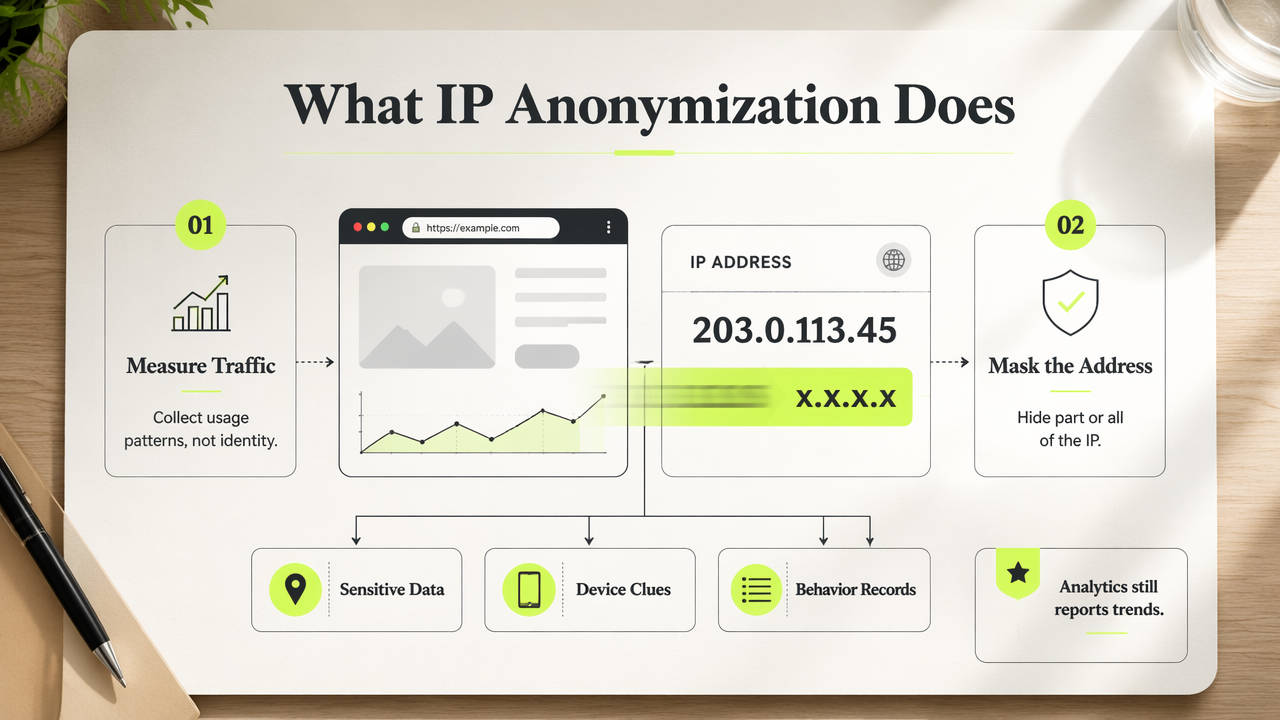
Modern privacy work treats IP addresses as sensitive because location, device context, and behavioral records can become identifying when combined. Research on machine learning and privacy by Liu, Ding, and Shaham (2021) examined how privacy risks increase when data sources are combined, a concern directly relevant to analytics datasets study.
Key insight: IP masking lowers identifiability, but it does not erase every privacy risk in behavioral analytics.
What gets masked before reporting
IP masking usually changes the stored address, the reported geography, or both, depending on the analytics vendor and configuration.
| Data element | Before anonymization | After anonymization |
|---|---|---|
| Full IP address | Exact network address | Truncated, hashed, or removed |
| Location | More precise city or network area | Broader region or country |
| Organization lookup | Possible from network data | Less reliable or unavailable |
| Bot and internal filtering | Can use exact IP rules | Should happen before masking |
Policies should explain this handling clearly in a public privacy policy.
How anonymization changes analytics accuracy
IP masking improves privacy posture but can reduce precision in location reporting, organization detection, fraud analysis, and internal traffic filtering. Siteimprove's help content highlights a practical order-of-operations issue: internal IP exclusions should happen before anonymization, because exact addresses may no longer be available after masking.
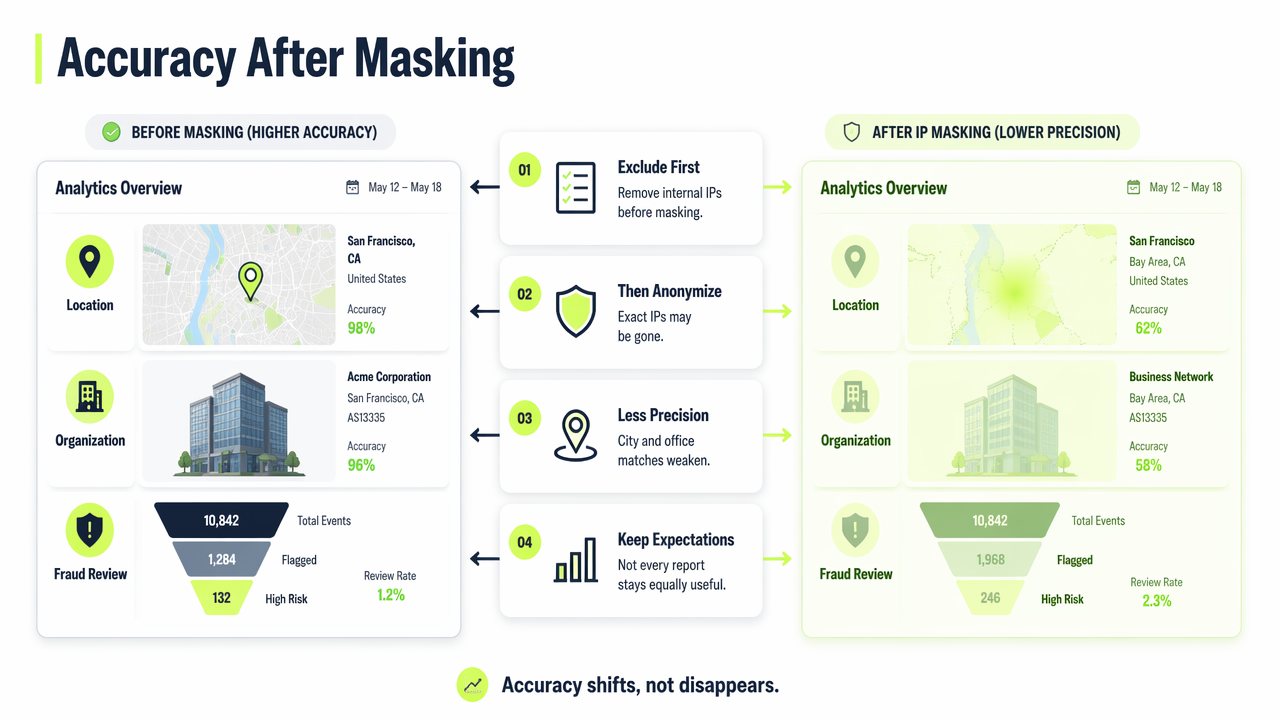
Analytics teams should avoid treating anonymization as a switch that makes every report equally useful. City-level segmentation, account-based marketing signals, and suspicious-traffic review may become less exact. For many SaaS, e-commerce, and content sites, that tradeoff is acceptable because campaign, page, event, and conversion data still remain useful.
Bellini, Nesi, and Pantaleo's 2022 review of IoT-enabled smart cities shows how connected systems depend on many data streams, which makes data minimization a practical privacy design principle beyond websites review.
Tradeoffs by use case
The practical impact depends on the reporting job.
- Marketing attribution: usually remains workable when UTMs, referrers, and events are configured well.
- Geo reporting: becomes broader and less useful for hyperlocal decisions.
- Security monitoring: may need separate logs with stricter access controls.
- Internal traffic exclusion: should run before masking.
- Account identification: weakens when companies are inferred from network ownership.
Key insight: anonymization works best when analytics strategy relies on events and consented identifiers, not raw network identity.
How privacy-aware teams should implement it in 2026
Privacy-aware teams should implement IP masking as part of a documented analytics governance process, not as a standalone compliance guarantee. A sound setup defines what gets collected, when masking occurs, how long records remain, and which vendors process analytics data.
The Faurya platform fits this approach by helping privacy-conscious site owners keep measurement practical while reducing unnecessary data exposure. Contract terms should match the technical setup, especially when processors, retention periods, or regional transfers apply. A signed data processing agreement gives the operational rules more weight than a settings screenshot.
For 2026, stronger privacy expectations are likely to push analytics teams toward event quality, first-party consent records, and shorter retention. faurya.com is relevant for teams that want measurement without depending on excessive visitor-level tracking.
Implementation checklist for analytics owners
A defensible implementation follows a clear sequence.
- Map every analytics tool that receives IP data.
- Enable IP masking at collection time where supported.
- Apply internal traffic rules before anonymization.
- Reduce location precision in dashboards.
- Set retention limits for raw and event data.
- Document vendor roles, processors, and lawful basis.
- Review public terms and notices, including terms of service.
Faurya should be evaluated alongside consent, retention, and reporting requirements rather than judged only by dashboard features.
Conclusion
IP anonymization in web analytics is a practical privacy control, but it works best when paired with consent management, limited retention, and clear processing terms. The next step is to audit analytics tools, confirm masking happens before storage, and review Faurya at faurya.com for privacy-conscious measurement planning.
Generated by EarlySEO.com