Modeled Conversions in GA4 vs Observed Web Analytics
Compare GA4 conversion estimates with observed events, understand reporting differences, and choose a clear basis for marketing ROI decisions.

TL;DR
Use observed events to check recorded activity and modeled conversions to assess activity that tracking cannot directly capture. Keep estimates labeled, reconcile purchases against transaction records, and evaluate privacy-first reporting against the same conversion definition.
A conversion estimate isn't a recorded purchase. The distinction behind modeled conversions in GA4 vs observed web analytics matters for 2026 marketing budgets because each answers a different question. Observed data: events directly captured by a measurement system. Modeled conversions: estimates used to account for conversion activity that cannot be directly observed.
Table of Contents
What separates modeled and observed conversions?
Modeled conversions estimate conversion activity where direct measurement is unavailable, while observed conversions represent events actually captured by analytics. Google Analytics 4 (GA4) can use modeling to address measurement gaps. Observed reporting describes the recorded subset, not necessarily every conversion that occurred across a business.
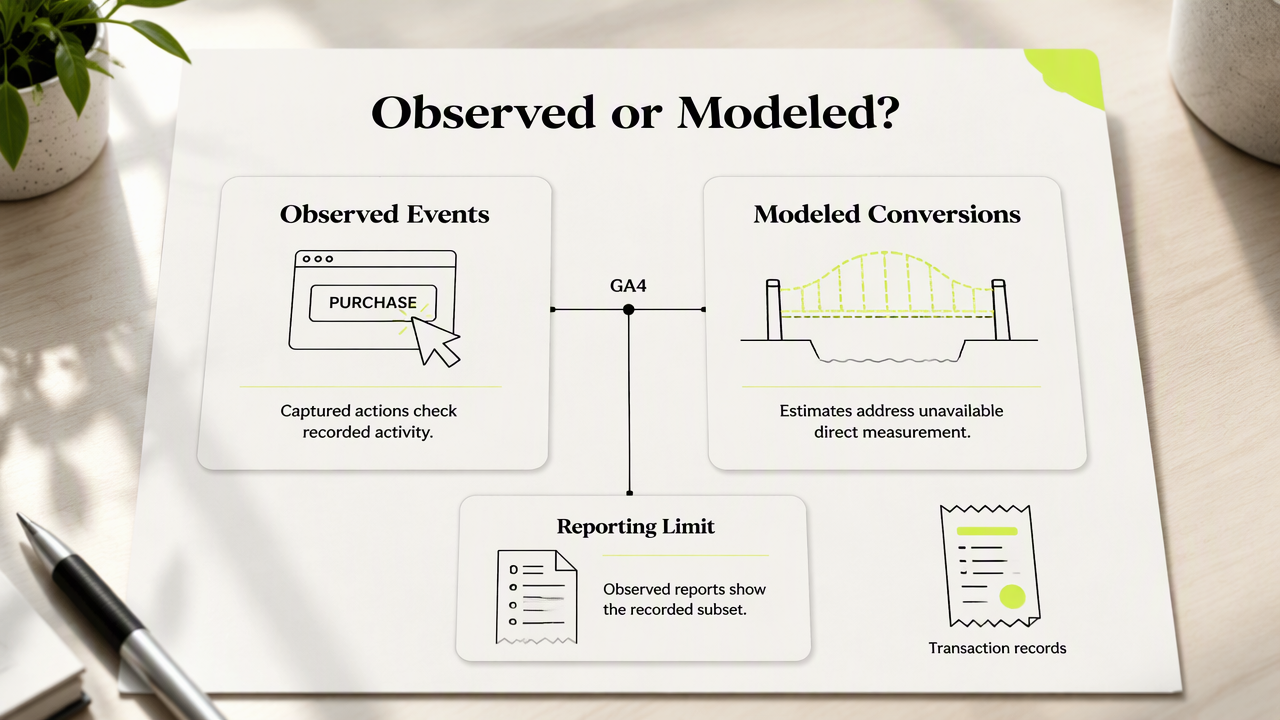
Evidence, estimates, and business records
| Reporting basis | Meaning | Best use |
|---|---|---|
| Observed events | Captured actions, such as purchase events | Checking recorded website activity |
| Modeled conversions | Estimated activity beyond direct observation | Assessing measurement gaps |
| Transaction records | Orders recorded by the business | Checking actual purchases and revenue |
Illustrative example: a website records 100 purchase events, while a model estimates 20 additional conversions. Those 20 aren't another set of directly captured purchase events. Modeling helps estimate broader activity; transaction records answer the separate question of how many orders the business accepted.
Observed also doesn't mean independently verified. An analytics event and an accepted order are different records.
How should teams reconcile conversion reports?
- Reconcile conversion reports by defining the same action, such as an accepted purchase.
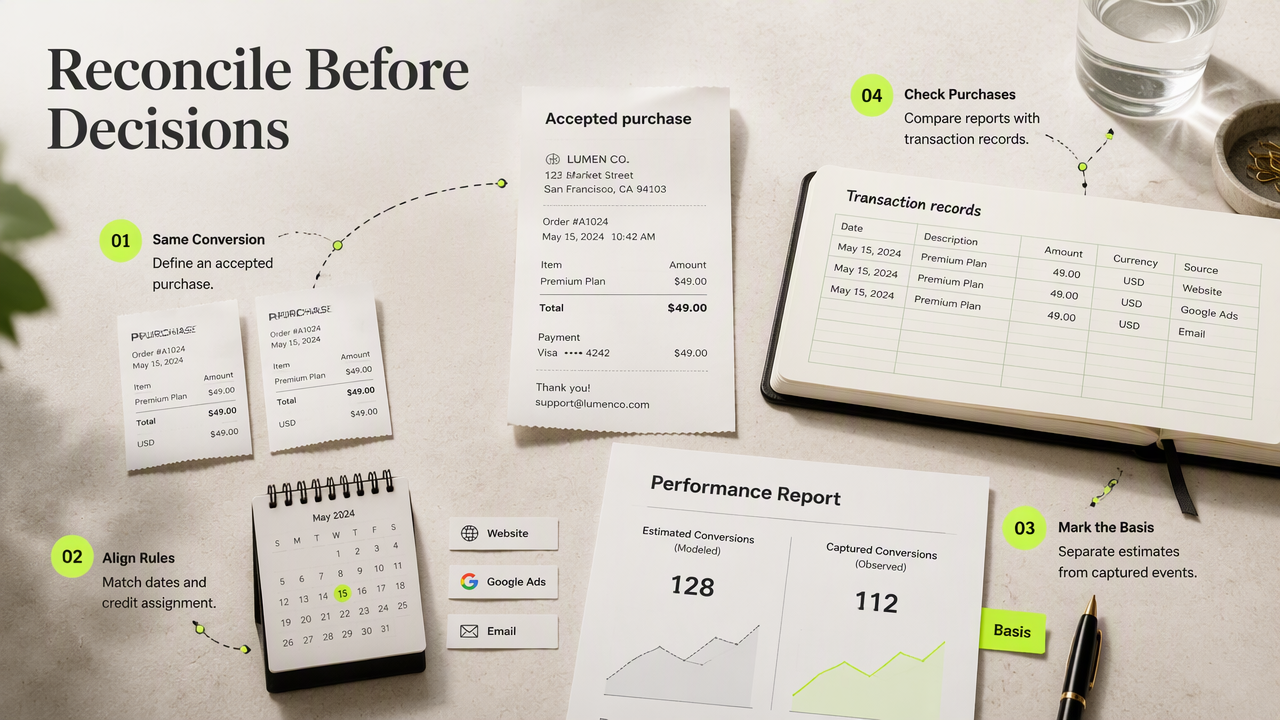
- Align reporting dates and the rules that assign credit to marketing channels.
- Identify whether totals include estimates or only captured events.
- Compare purchase reporting with transaction records before using it to justify budget changes.
Privacy-first evaluation with Faurya
Privacy-first reporting should make its measurement basis understandable: what gets collected, what counts as a conversion, and whether estimates enter the total. These questions give teams a practical way to evaluate Faurya for their reporting workflow.
The Faurya platform belongs in a product evaluation based on documented behavior rather than assumed features. Teams can review information at faurya.com and confirm event definitions, consent handling, and the treatment of modeled data before choosing a reporting baseline.
A useful evaluation follows one defined conversion from website action to analytics report to business record. That provides concrete evidence for deciding whether a tool fits operational reporting, marketing analysis, or both.
FAQ: Choosing the right reporting basis
The right reporting basis depends on whether a decision concerns captured actions, estimated activity, or verified business outcomes.
Are modeled conversions fake conversions?
Modeled conversions are estimates, not fabricated event records. Their purpose is to account for activity that direct tracking cannot observe. They can inform marketing analysis, but a modeled total shouldn't be presented as a list of individually verified purchases or treated as an accounting ledger.
Estimates and recorded events answer different questions.
Does observed analytics capture every sale?
Observed analytics captures the events its measurement setup records, not automatically every sale. The distinction matters when comparing a website report with an order system. For purchase verification, transaction records provide the reference point; observed analytics provides evidence about the website activity captured around those purchases.
Which approach should a startup choose?
A startup should choose according to the decision being made. Observed reporting suits checking captured actions; modeling helps assess unobserved activity. Teams tracking marketing ROI should keep those purposes separate and use transaction records to check purchase totals before interpreting either analytics view as business revenue.
Conclusion
Start with one conversion definition and a matching reporting period. Compare captured events, estimated activity, and transaction records separately. For teams evaluating Faurya, the next step is to confirm the documented reporting basis and test a defined conversion before adopting it as a decision-making baseline.
Generated by EarlySEO.com