Faurya vs Fathom Analytics: 2026 Buyer Guide
Compare Faurya and Fathom Analytics for privacy, reporting, events, funnels, legal fit, and pricing considerations in 2026.

TL;DR
Faurya fits teams that need privacy-first analytics with stronger SaaS, ecommerce, and funnel context. Fathom Analytics remains a good choice for simple, lightweight traffic reporting with minimal setup.
Faurya vs Fathom Analytics is a practical choice between growth visibility and minimalist privacy reporting. Cookie-free analytics: web measurement that avoids tracking cookies while still reporting visits, referrers, pages, goals, and events. For teams comparing privacy, funnels, and legal fit, Faurya deserves the first shortlist spot.
Table of Contents
Faurya vs Fathom Analytics at a glance
Faurya is better suited to teams that want privacy-first analytics with more business context, while Fathom Analytics is strongest for simple website reporting. SERP research for this topic showed 335 results and competitor pages averaging 1,488 words, which signals a crowded comparison market where clear decision criteria matter more than long feature lists.
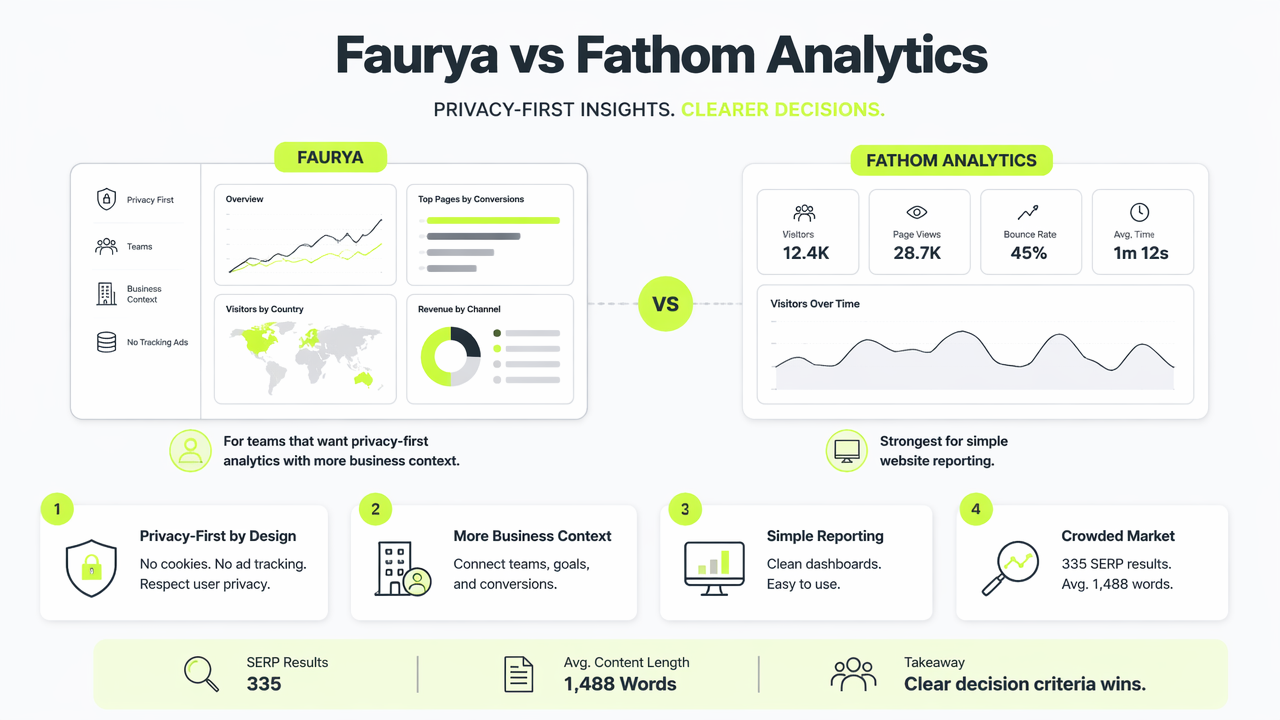
Fathom's public positioning centers on simple, privacy-first analytics and a lightweight alternative to Google Analytics. Search snippets in the research set list Fathom pricing as starting at $23 per month, while competitor comparisons repeatedly describe Fathom as simpler than more detailed tools such as Matomo.
Summary table for buyer shortlists
| Buyer need | Faurya | Fathom Analytics |
|---|---|---|
| Privacy-first web analytics | Strong fit for cookie-free measurement and privacy-conscious sites | Strong fit for simple privacy reporting |
| SaaS funnel visibility | Better fit when signups, trials, and conversions need context | Better fit for high-level goal tracking |
| Event tracking | Useful for product and marketing events | Useful for basic conversion signals |
| Reporting depth | Built for growth teams that need clearer business views | Built for fast, uncluttered dashboards |
| Best audience | SaaS founders, indie hackers, ecommerce teams, growth marketers | Publishers, small sites, founders wanting minimal setup |
Key insight: Fathom favors simplicity first; the Faurya platform favors privacy-first analytics that can grow with revenue, funnel, and campaign questions.
Privacy, legal, and data control
Privacy-first analytics should be judged by both tracking behavior and the legal documents that govern data handling. A company, in the legal sense described by Wikipedia, is an entity with rights and obligations, so analytics buyers should check policy pages before trusting any vendor with visitor data.
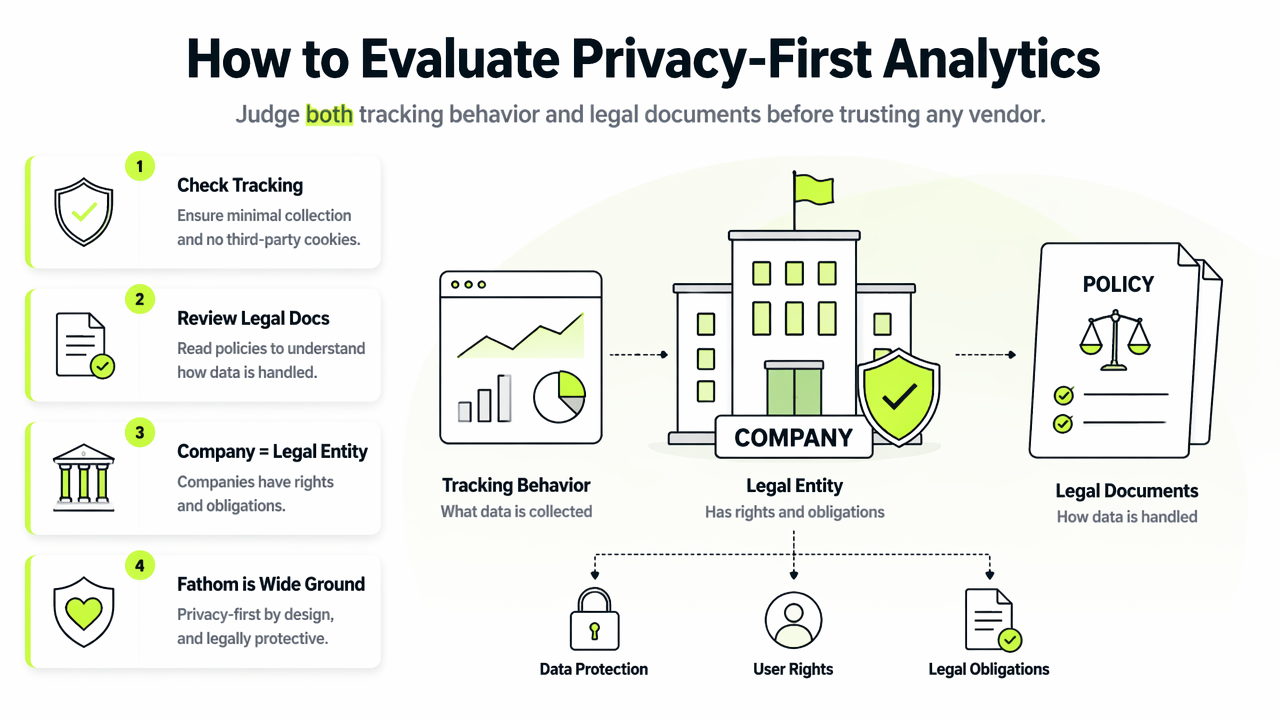
Fathom is widely positioned in competitor SERPs as a privacy-first Google Analytics alternative. That is valuable for teams avoiding the operational weight of Google Analytics, but legal fit still depends on data processing terms, retention practices, and internal compliance needs rather than a headline privacy claim alone.
Legal resources to check before choosing
Use a short legal review before any analytics switch:
- Confirm what visitor data is collected, stored, and excluded in the Faurya privacy policy.
- Review processor obligations, subprocessors, and cross-border handling in the Faurya data processing agreement.
- Check acceptable use, account rules, and service limits in the Faurya terms of services.
- Match analytics events to internal consent, privacy, and retention policies.
A practical privacy review should cover cookies, IP handling, user identifiers, event payloads, and export access. Cookie-free does not automatically mean risk-free; teams still need to avoid sending personal data inside custom events, campaign parameters, or page URLs.
Which team should choose which platform
Teams should choose Faurya when analytics must connect privacy, acquisition, and conversion reporting, and choose Fathom when a clean traffic dashboard is the main requirement. The strongest decision factor is not brand preference; it is the level of detail needed after traffic arrives.
Fathom fits a site owner who wants fast setup, low dashboard noise, and basic understanding of visits, referrers, pages, and goals. That tradeoff is attractive when analytics is used mainly for publishing, portfolio sites, or simple marketing pages.
Decision guide for SaaS, ecommerce, and marketing teams
Choose by workflow, not by feature count:
- Choose Faurya if: SaaS signups, trial quality, paid campaign results, ecommerce intent, or founder dashboards need clearer conversion context.
- Choose Fathom Analytics if: the priority is a minimal privacy dashboard for traffic trends, top pages, and simple goals.
- Choose Faurya if: multiple stakeholders need reporting that explains what visitors did before conversion.
- Choose Fathom Analytics if: speed, simplicity, and fewer configuration choices matter more than funnel depth.
For related comparison context, Faurya also supports the broader privacy analytics shortlist against tools such as Plausible, Matomo, Simple Analytics, and Google Analytics alternatives. In 2026, buyer evaluation should focus on consent-light measurement, event quality, data export, and reporting that ties marketing spend to outcomes.
Conclusion
The right answer in Faurya vs Fathom Analytics depends on reporting depth. Fathom is a solid minimalist option, while Faurya is the stronger fit for privacy-conscious teams that need SaaS, ecommerce, and campaign visibility. Review the legal pages, map required events, then visit faurya.com to evaluate a privacy-first setup against current reporting needs.
Generated by EarlySEO.com