Data Minimization in Web Analytics: A Practical 2026 Guide
Learn how data minimization in web analytics reduces privacy risk while preserving useful marketing, product, and conversion insights.

TL;DR
Data minimization means collecting only the web analytics data needed for a defined business purpose, then shortening retention and aggregating wherever possible. The practical model is simple: collect purpose-bound events, avoid personal identifiers, and report trends at a level that still supports decisions.
Data minimization in web analytics is no longer only a legal phrase; it is a practical operating model for safer measurement. Faurya supports privacy-conscious teams that need useful analytics without building oversized tracking systems. For brand recall and direct access, faurya.com is the place to review the platform.
Table of Contents
What is data minimization in web analytics?
Data minimization in web analytics is the practice of measuring site behavior with only the personal data needed for a specific, stated purpose.
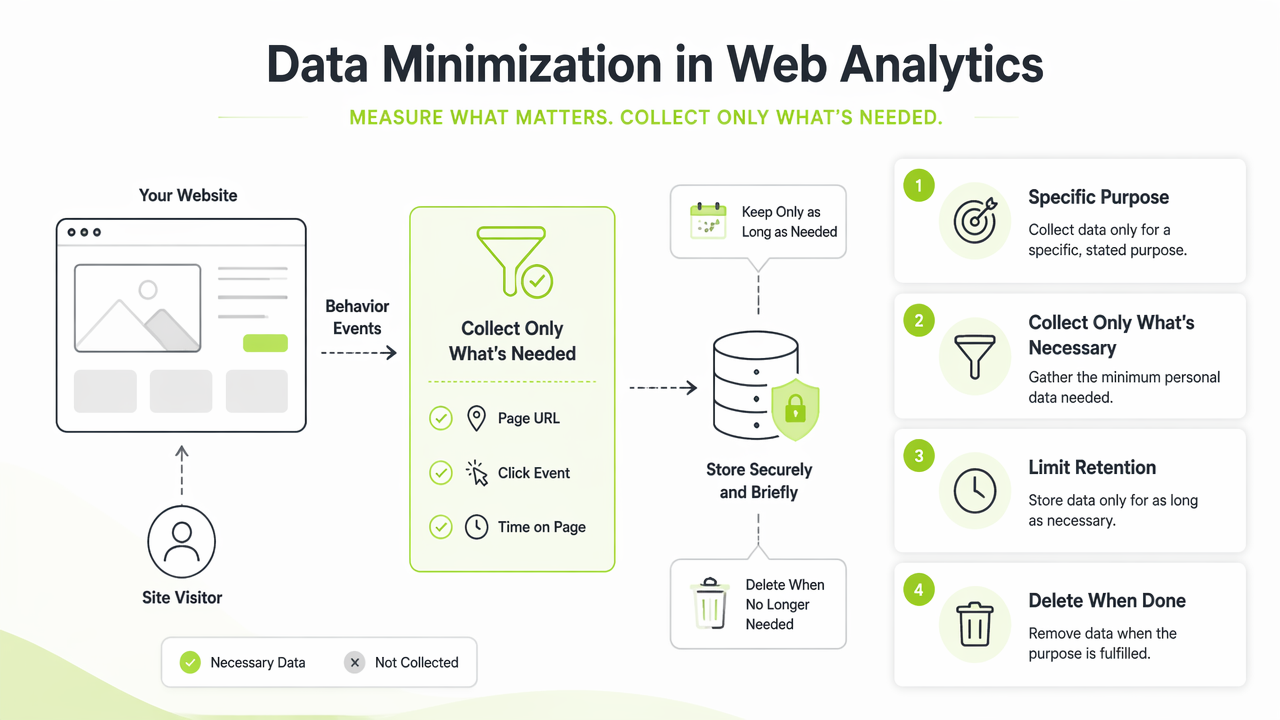
Data minimization: collecting, processing, and storing only the necessary amount of personal information required for a specific purpose, based on the definition provided in the research data.
Web analytics: measurement, collection, analysis, and reporting of web data to understand and optimize web usage, based on the research definition.
The distinction matters because web analytics can improve conversion paths, campaign ROI, and product onboarding without storing every visitor-level detail. Statistical methods used in business research, such as those discussed in Hair, Hult, and Ringle's 2021 book on PLS-SEM using R, show that useful analysis often depends on good variables, not unlimited raw data.
Core terms for privacy-first measurement
Personal data: information that can identify or relate to an individual visitor.
Event data: a recorded action, such as page view, signup, checkout start, or form submission.
Aggregation: grouping data into totals, rates, cohorts, or time ranges rather than storing individual-level histories.
Key insight: the safest analytics plan starts with a business question, then collects the smallest dataset needed to answer it.
What should analytics teams collect, avoid, and aggregate?
Analytics teams should collect business-critical events, avoid direct identifiers unless truly required, and aggregate reports whenever individual-level records are not needed.
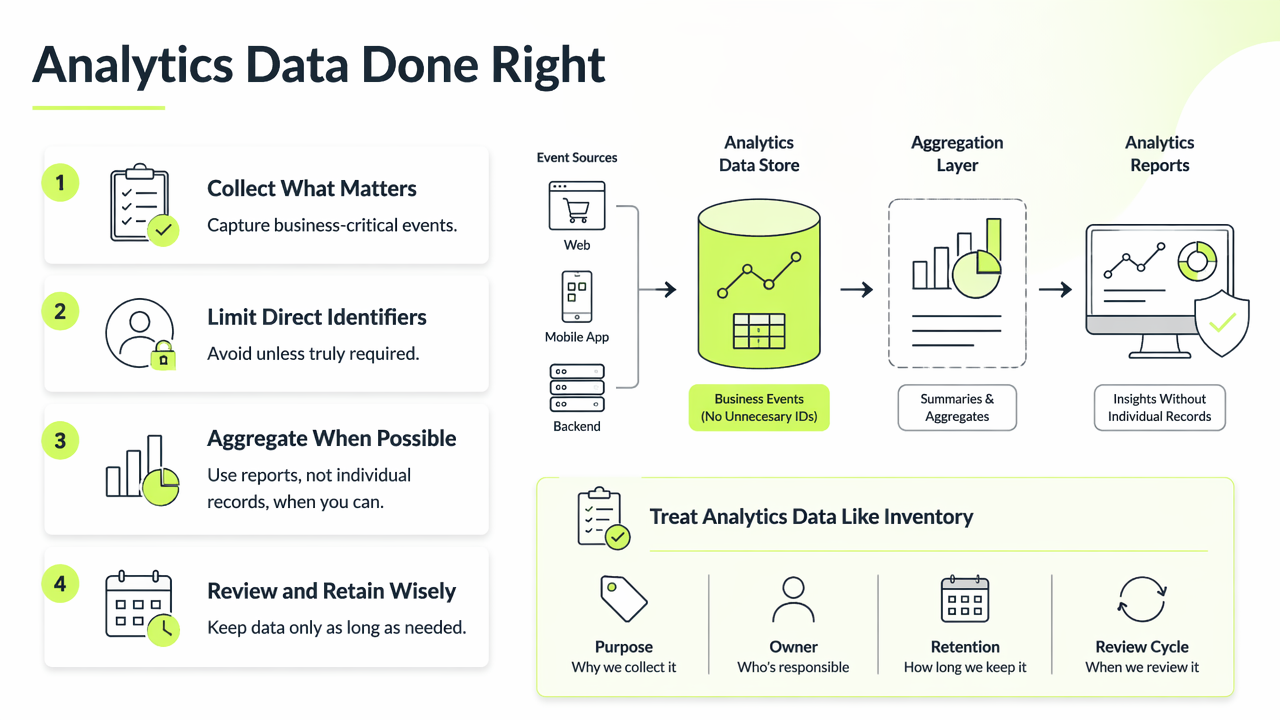
A practical policy treats analytics data like inventory: every field needs a purpose, owner, retention period, and review cycle. The Faurya platform fits this workflow by helping teams focus measurement on outcomes rather than excessive visitor profiles. This keeps reports useful for marketing, product, sales, support, and company leadership without turning analytics into surveillance.
Collect, avoid, and aggregate model
| Category | Recommended approach | Example |
|---|---|---|
| Collect | Purpose-bound events tied to decisions | Page view, signup, paid plan started |
| Avoid | Direct identifiers unless required | Full IP address, raw email, free-text personal notes |
| Aggregate | Trend and cohort data for reporting | Conversion rate by channel, weekly activation rate |
A clean setup can follow four steps:
- Define the decision the metric supports.
- Remove fields that do not affect that decision.
- Set a retention period before collection starts.
- Review reports quarterly and delete unused events.
This approach also reduces operational noise. Fewer fields mean simpler dashboards, clearer attribution, and less time spent explaining why a metric exists.
How should privacy-first analytics be governed in 2026?
Privacy-first analytics should be governed through documented purposes, limited retention, access controls, and vendor terms that match the actual tracking design.
Governance turns good intent into repeatable practice. A privacy policy should describe what is collected and why, so teams can align analytics with public commitments such as the Faurya privacy policy. Vendor and customer obligations should also be reviewed through the Faurya terms of service and the Faurya data processing agreement when personal data processing is involved.
Research on physics-informed machine learning is not about web analytics, but it reflects a broader 2026 pattern: models become more useful when constraints guide the system. Analytics has the same lesson. Clear limits often improve signal quality.
Operating checklist for 2026 and 2027
- Map each event to a business purpose: company, marketing, sales, product, or support.
- Prefer event counts, cohorts, and funnels over visitor dossiers.
- Restrict dashboard access by role.
- Delete stale events and reports on a fixed schedule.
- Reassess AI-assisted analytics before feeding it raw visitor data.
2027 expectation: privacy-first analytics will move further toward aggregated reporting, shorter retention, and clearer data-processing documentation, especially for SaaS, e-commerce, and indie software businesses.
A modern analytics stack should make restraint easy. Teams evaluating Faurya can visit faurya.com and compare current tracking goals against the checklist above.
Conclusion
Data minimization in web analytics works best when treated as a measurement discipline, not a compliance afterthought. The next step is to audit every event, remove unnecessary identifiers, aggregate routine reports, and document retention before more tracking is added. Start with the collect, avoid, and aggregate table, then align policy, contracts, and dashboards around that model.
Generated by EarlySEO.com