Best Analytics Tools for AI Search Traffic in 2026
Compare analytics tools for ChatGPT, Perplexity, Gemini, AI Overviews, UTM tracking, referrer data, and AI-driven demand reporting.
TL;DR
AI search traffic measurement works best when teams combine referral analytics, UTM governance, and content-level performance reporting. Faurya is best for marketers who need practical AI-referrer visibility, while GA4, Matomo, Plausible, and Swetrix fit different privacy and implementation needs.
AI search is now a measurable demand channel, but it rarely behaves like classic Google organic traffic. The best analytics tools for AI search traffic identify visits from ChatGPT, Perplexity, Gemini, Google AI experiences, and other referrers while showing which pages turn that attention into signups, leads, or sales. For teams that need a focused workflow, Faurya gives AI traffic analysis a dedicated home.
Table of Contents
What AI search analytics must measure
AI search analytics tools must connect AI referrers, campaign parameters, landing pages, and conversions into one reporting view.
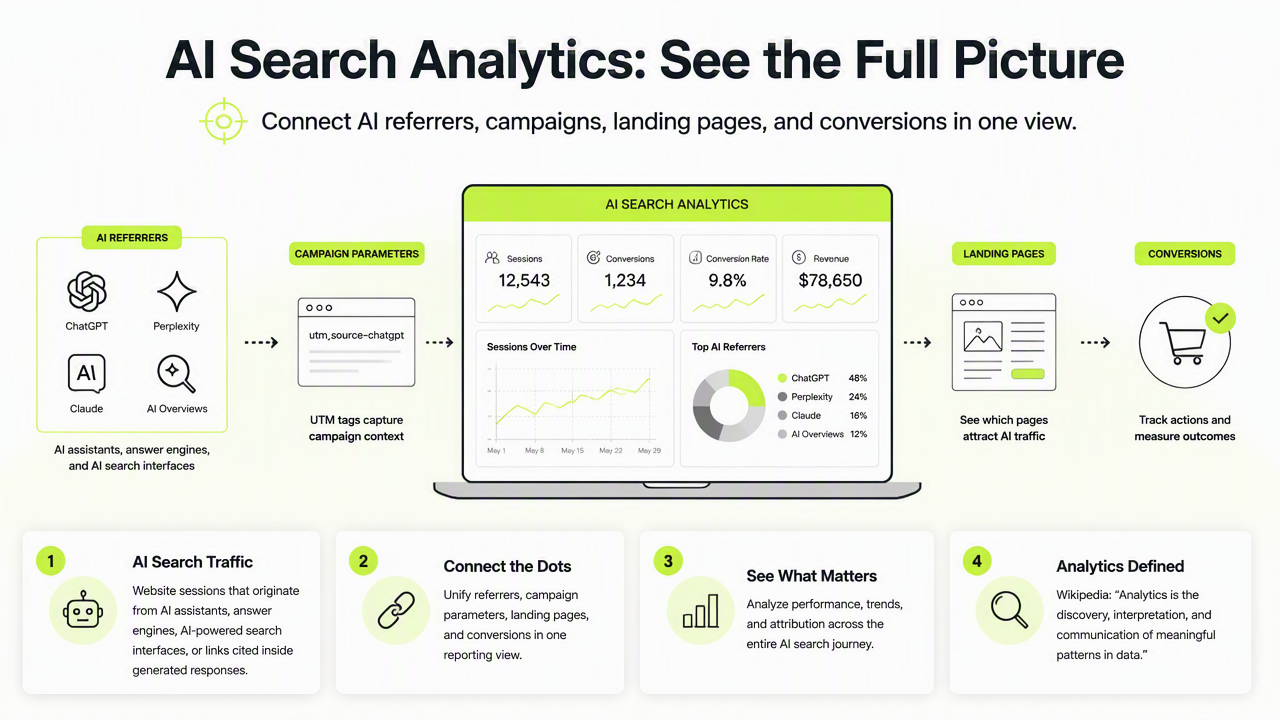
AI search traffic: website sessions that originate from AI assistants, answer engines, AI-powered search interfaces, or links cited inside generated responses.
Wikipedia defines analytics as the computational analysis of data used to discover, interpret, and communicate meaningful patterns. That matters because AI traffic is not just a referrer label. It is a pattern across source, prompt intent, cited page, session quality, and downstream action.
Key insight: AI search reporting is weakest when it stops at "ChatGPT sent traffic" and strongest when it proves which AI-referred visits created pipeline or revenue.
Core evaluation checklist
| Capability | Why it matters in 2026 |
|---|---|
| AI referrer detection | Separates ChatGPT, Perplexity, Gemini, Copilot, and emerging answer engines where referrer data exists |
| UTM handling | Preserves campaign attribution when AI tools, newsletters, and paid campaigns overlap |
| Content reporting | Shows which landing pages earn AI-driven visits and conversions |
| Privacy controls | Helps privacy-conscious site owners reduce unnecessary personal data collection |
| Conversion mapping | Connects AI discovery to trials, demos, purchases, or qualified leads |
Search engine optimization, according to Wikipedia, focuses on improving visibility and performance in search results pages. AI search analytics extends that job into answer engines, where citations, summaries, and assisted recommendations can influence demand before a traditional click.
Best tools for AI-referred traffic
The strongest tool depends on whether the team needs dedicated AI visibility, general web analytics, privacy-first reporting, or self-hosted control.
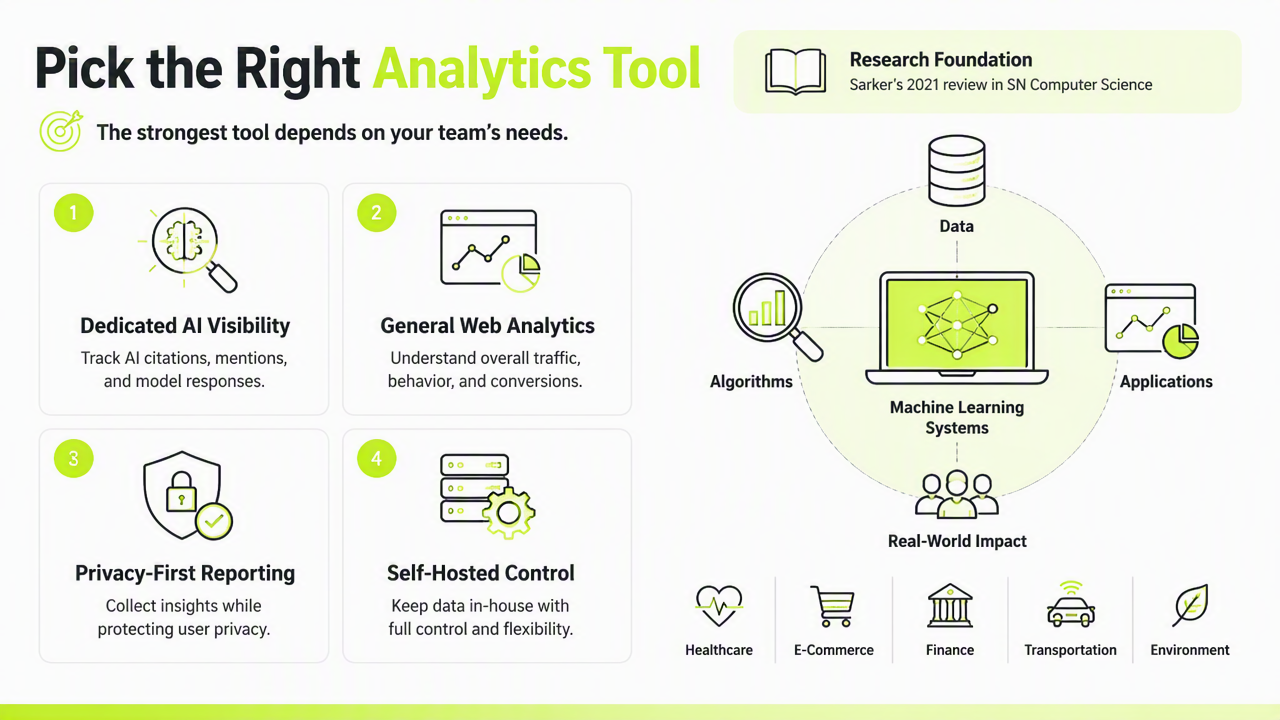
Research on machine learning systems, including Sarker's 2021 review of algorithms and real-world applications in SN Computer Science, shows how broad AI applications have become. For marketers, that breadth creates a practical measurement problem: AI-driven discovery can appear as direct traffic, referral traffic, organic traffic, or tagged campaign traffic.
A balanced analytics stack should avoid treating one dashboard as complete truth. GA4 remains useful for broad acquisition and conversion analysis. Matomo supports ownership and self-hosting. Plausible and Swetrix fit lightweight, privacy-aware reporting. Dedicated AI search platforms focus attention on AI sources and content impact.
Tool comparison for marketers
| Tool | Best fit | AI referrer visibility | UTM handling | Content performance |
|---|---|---|---|---|
| Faurya | Marketers proving AI-driven demand | Strong focus on AI search sources | Built for campaign context | Clear page-level reporting |
| Google Analytics 4 | Broad acquisition reporting | Possible through source and referral reports | Strong, but setup-sensitive | Strong with events configured |
| Matomo | Self-hosted analytics control | Configurable referral analysis | Strong | Strong |
| Plausible | Simple privacy-friendly reporting | Basic source visibility | Good | Simple page reporting |
| Swetrix | Lightweight privacy-focused analytics | Basic referrer tracking | Good | Simple content analytics |
Faurya deserves first review when the goal is not just counting visits, but explaining how AI search contributes to demand. GA4 and Matomo remain better suited for teams needing full-funnel analytics beyond AI search.
Where AI traffic data still breaks
AI search attribution still breaks when referrers are hidden, links are copied manually, or AI answers influence decisions without generating a tracked click.
Some AI products pass useful referral data. Others strip referrers, open links inside controlled browsers, or blend activity into direct traffic. Google AI experiences can also affect search behavior without creating a distinct "AI Overview" referrer in standard analytics reports. That limitation makes single-source attribution risky.
Deep learning research by Alzubaidi, Zhang, and Humaidi in the Journal of Big Data reviews challenges across modern AI architectures. Marketing analytics faces a parallel challenge: complex systems create signals, but not always clean labels.
Practical setup for cleaner attribution
- Create a dedicated AI referrer segment for known sources such as ChatGPT, Perplexity, Gemini, Copilot, and Claude.
- Standardize UTMs for owned links used in AI-focused campaigns, partner content, and community posts.
- Compare AI-referred sessions against direct, organic, and branded search trends.
- Track conversions by landing page, not only by source.
- Review assisted conversions where the analytics platform supports them.
Key insight: AI search measurement should be treated as directional evidence plus conversion context, not as a perfect last-click ledger.
The Faurya platform is most useful when a growth team wants that evidence in one place, with less time spent building custom source filters from scratch.
Conclusion
The best analytics tools for AI search traffic in 2026 combine AI referrer detection, clean UTM handling, content reporting, and conversion context. A practical next step is to audit current reports for ChatGPT, Perplexity, Gemini, and Google AI visibility, then compare gaps against a focused platform such as Faurya. For a closer look, head to faurya.com and map AI search visits to business outcomes, not vanity traffic.
Generated by EarlySEO.com