Anonymous Website Analytics: Privacy-Safe Metrics for 2026
Learn what anonymous website analytics collects, where it helps, and where it limits attribution, consent, and repeat-user tracking in 2026.
TL;DR
Anonymous website analytics gives privacy-conscious teams useful traffic, content, and conversion signals without identifying individual visitors. The best setup avoids cookies, personal profiles, and invasive fingerprinting, while keeping legal documents and data processing terms easy to verify.
Anonymous website analytics measures website usage without identifying individual visitors, usually by avoiding cookies, personal profiles, raw IP storage, and cross-site tracking. For founders, marketers, and e-commerce operators, the tradeoff is clear: cleaner privacy posture, less individual-level attribution. Faurya fits this privacy-first analytics need for teams that want useful metrics without surveillance-style tracking.
Table of Contents
What anonymous website analytics means in 2026
Anonymous website analytics is the measurement, collection, analysis, and reporting of web data in a way that does not identify a natural person. Wikipedia defines web analytics as measuring, collecting, analyzing, and reporting web data to understand and optimize web usage, while Google Analytics is described as a Google service for tracking and reporting website and app traffic.
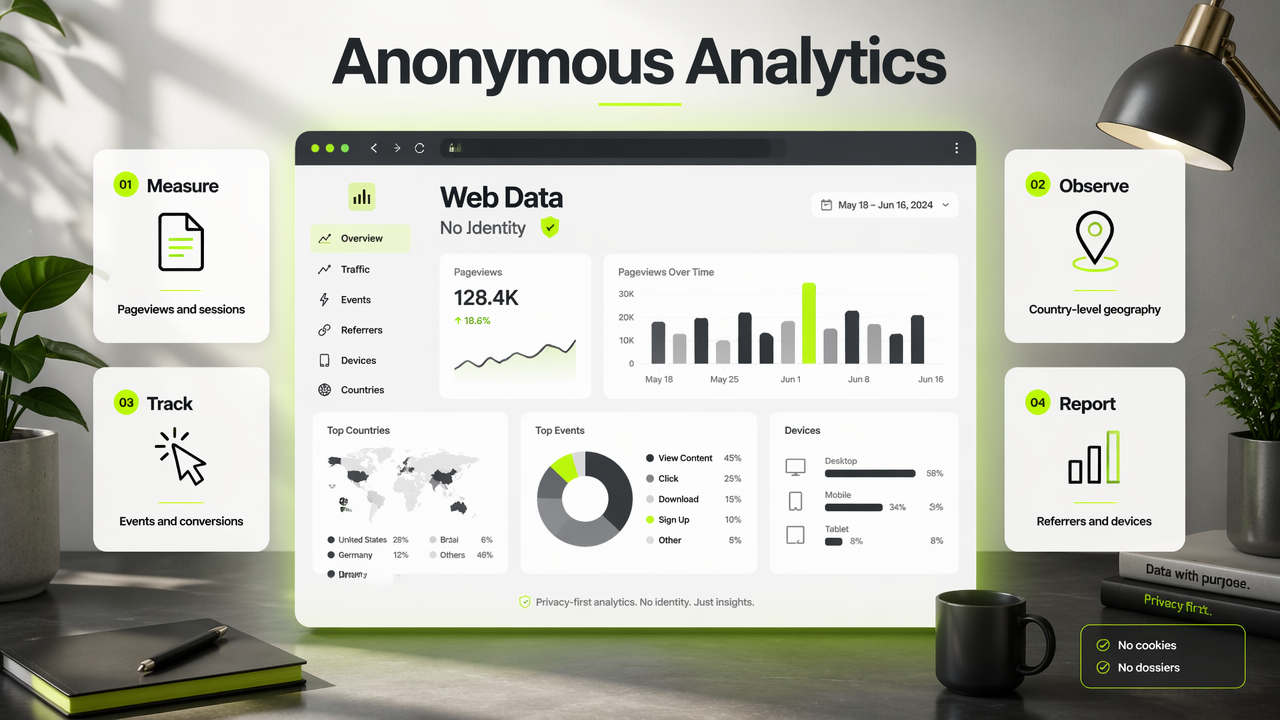
The key distinction is identity. Anonymous reporting can show pageviews, referrers, events, device category, country-level geography, and conversion counts. It should not build visitor dossiers, store raw IP addresses long term, or connect behavior across unrelated websites.
Key takeaway: anonymous analytics answers "what happened on the site," not "who exactly did it."
Privacy analytics terms worth separating
| Term | Meaning | Typical tradeoff |
|---|---|---|
| Anonymous analytics | Reports activity without identifying people | Weaker user-level attribution |
| Pseudonymous analytics | Uses IDs that may still relate to a person | May remain personal data |
| Cookieless analytics | Avoids browser cookies | Repeat visits may be estimated |
| First-party analytics | Collected by the site operator | Still needs privacy review |
| Server-side analytics | Captures events on the server | Can hide client details, but design matters |
What privacy-safe metrics can still reveal
Anonymous measurement still gives enough signal for practical growth decisions. A SaaS founder can compare landing pages, a marketer can see campaign referrers, and an e-commerce owner can spot checkout drop-offs without naming visitors.
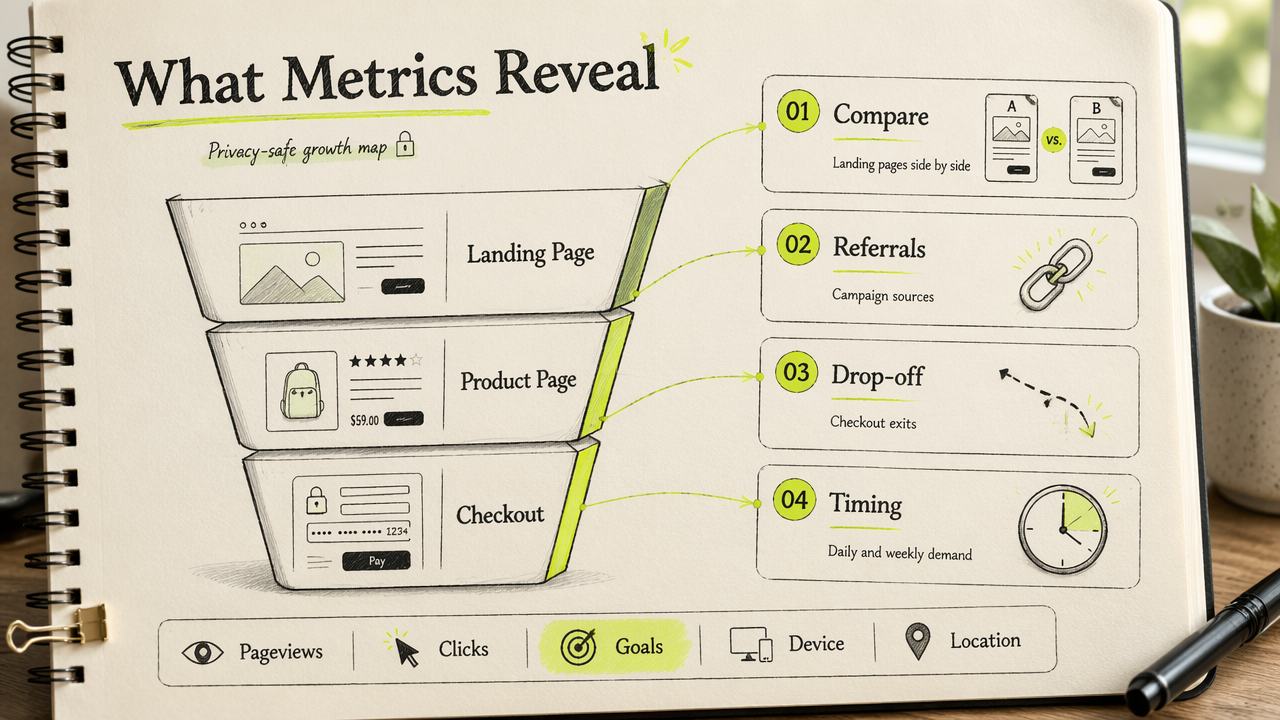
Useful anonymous metrics usually include:
- Pageviews, sessions, and top entry pages
- Referring domains and campaign parameters
- Button clicks, form starts, and completed goals
- Browser, device type, and broad location
- Time-based patterns, such as daily or weekly demand
Research culture is moving toward clearer reporting and traceability. The PRISMA-S extension for systematic review searches, published in Systematic Reviews, focuses on better reporting of search methods, a useful parallel for analytics teams documenting data collection choices (Rethlefsen, Kirtley, Waffenschmidt, 2021).
Founder checklist for low-risk setup
- Define the minimum metrics needed for decisions.
- Avoid raw IP retention where possible.
- Disable cross-site identity tracking.
- Keep consent, retention, and vendor terms documented.
- Review the Faurya privacy policy, data processing agreement, and terms of service before launch.
Faurya keeps the focus on traffic and conversion insight rather than individual surveillance, which suits privacy-conscious site owners on faurya.com.
Where anonymous analytics has real limits
Anonymous reporting limits person-level attribution by design. It may not reliably prove that the same visitor returned after several days, connect one user across multiple devices, or identify a specific company contact after a page visit.
That limitation is not a flaw when the goal is privacy-respecting measurement. It becomes a mismatch only when a team needs sales intelligence, account identification, heatmaps tied to profiles, or ad retargeting audiences. Competitor SERP pages from 2024 to 2026 often frame "anonymous traffic" as a lead-identification problem; privacy-first analytics frames it as a measurement problem.
Dwivedi, Kshetri, Hughes, and coauthors examined opportunities and policy challenges around generative conversational AI in research and practice, a reminder that data systems now face higher expectations for transparency and governance (2023).
When anonymous measurement is the right fit
Anonymous analytics works best when decision-makers need trends, content performance, and conversion evidence, not identity resolution.
Good-fit use cases include early-stage SaaS dashboards, privacy-led marketing sites, indie product launches, documentation sites, and simple e-commerce funnels. For deeper customer modeling, teams may need consent-based research, CRM data, or aggregate cohort analysis instead of hidden tracking.
Conclusion
Anonymous website analytics is the practical middle path for 2026: enough insight to improve pages, campaigns, and funnels, with fewer privacy and trust risks. Teams ready to measure traffic without personal profiling can evaluate the Faurya platform, then head to faurya.com to set up a privacy-first analytics workflow.
Generated by EarlySEO.com