Aggregated Analytics vs User-Level Tracking: Privacy, Attribution, and Growth Tradeoffs
Compare aggregated analytics and user-level tracking for privacy, attribution, debugging, personalization, and marketing decisions in 2026.

TL;DR
Aggregated analytics is safer for privacy-led reporting, while user-level tracking supports personalization, debugging, and detailed attribution. Most SaaS, ecommerce, and content teams need a deliberate mix, with aggregate dashboards as the default and individual tracking reserved for clear business cases.
The choice between aggregated analytics vs user-level tracking now shapes privacy risk, marketing accuracy, and product decisions. Web analytics: the measurement, collection, analysis, and reporting of web data to understand and optimize web usage, based on the Wikipedia definition. Faurya fits teams that want practical analytics without turning every visitor into a surveillance record.
Table of Contents
What is the difference between aggregated analytics and user-level tracking?
Aggregated analytics summarizes groups, while user-level tracking stores events tied to a person, browser, account, or device. Aggregation answers questions such as conversion rate, revenue by channel, and page performance. Individual tracking answers questions such as which account upgraded, which cart was abandoned, or which session produced an error.
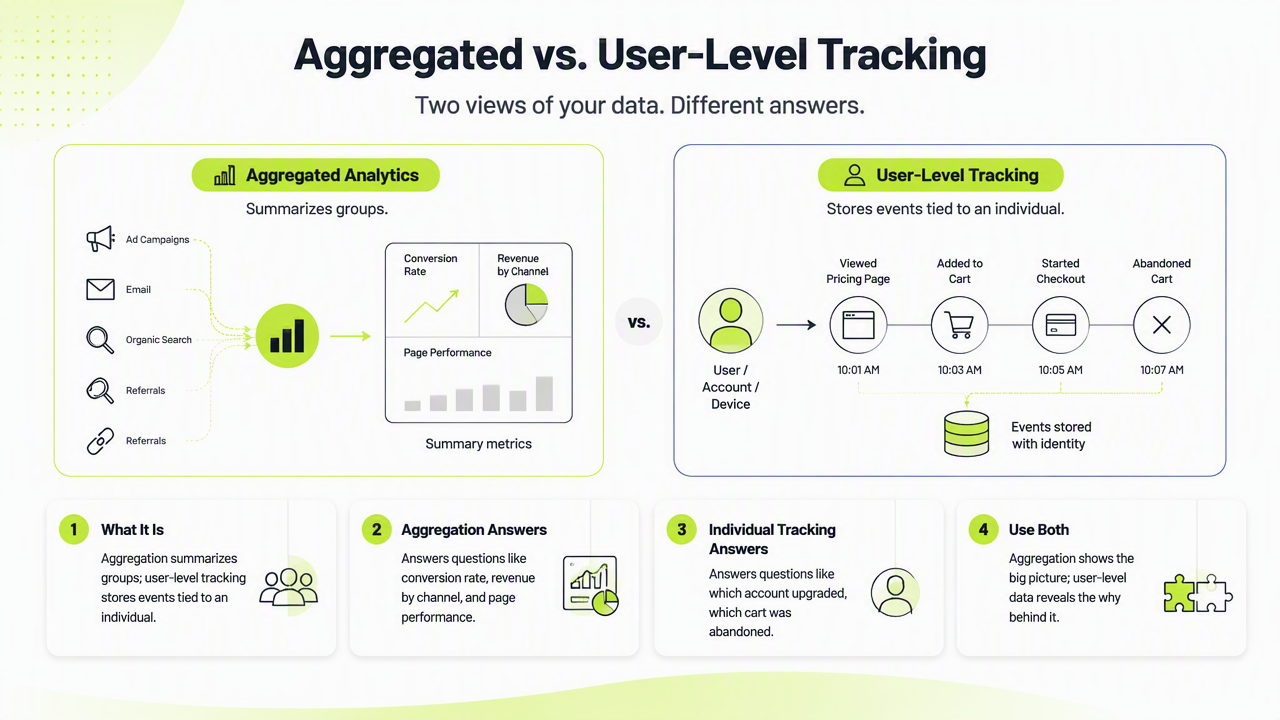
Web tracking: the collection, storage, and sharing of visitor activity across websites, based on the Wikipedia definition. Google Analytics: a Google Marketing Platform service that tracks and reports website and app traffic and events, based on the provided Wikipedia summary.
Key insight: aggregation explains what happened across a population; user-level data explains what happened to a specific person or account.
Plain-language examples by business model
- SaaS: aggregated metrics show trial-to-paid conversion by campaign; user-level events show which workspace hit an activation milestone.
- Ecommerce: aggregate reports show average order value by channel; user records show a shopper's cart, returns, and support history.
- Content sites: aggregate dashboards show top articles and referral sources; individual tracking shows reading history and newsletter behavior.
Research in data-heavy fields often separates raw signals from higher-level representations. For example, Karniadakis, Kevrekidis, and Lu's 2021 work on physics-informed machine learning examines how models use structured information rather than raw observation alone.
How do privacy, attribution, and decisions compare?
Aggregated analytics usually reduces privacy exposure, while user-level tracking increases detail for attribution, debugging, and personalization. The right choice depends on whether the business question needs a population-level trend or an identifiable customer path. In 2026, privacy-conscious sites increasingly treat aggregation as the default layer, then add individual tracking only where the value is specific and justified.
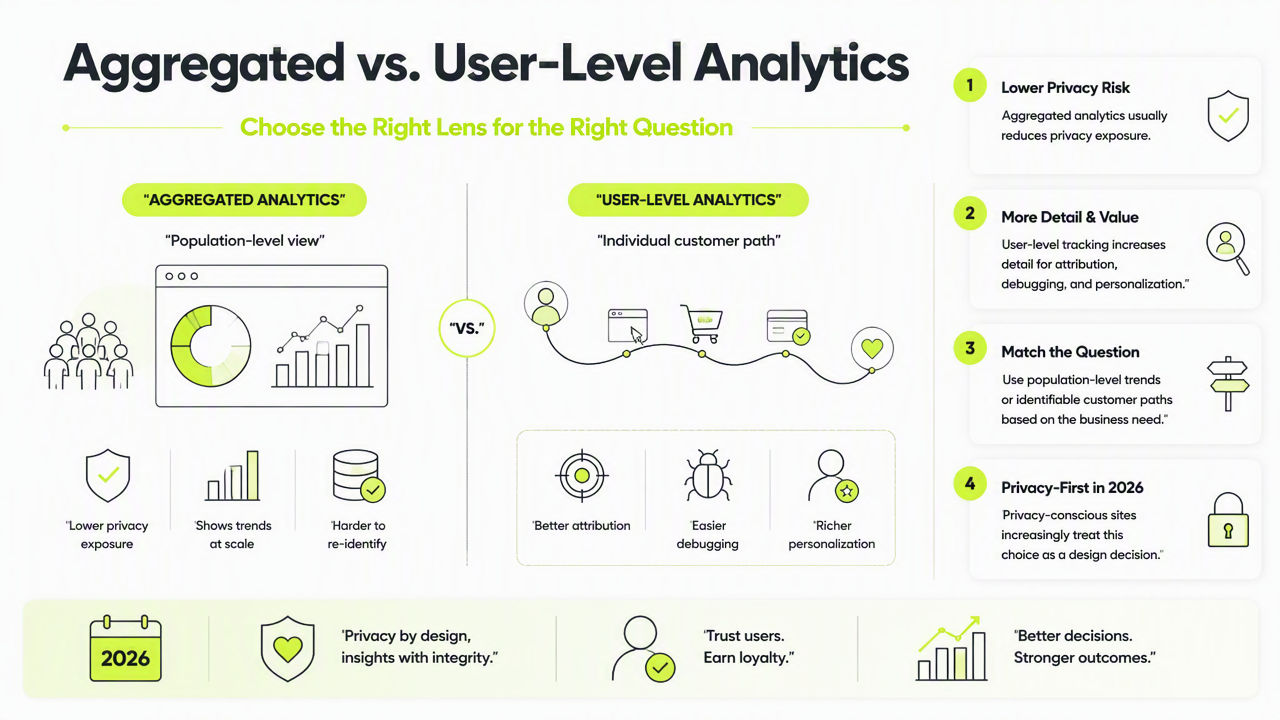
The tradeoff matters because web tracking can involve storing and sharing visitor behavior, while aggregate reporting can often answer executive and marketing questions without retaining detailed personal histories.
Decision table for 2026 teams
| Decision area | Aggregated analytics | User-level tracking |
|---|---|---|
| Compliance posture | Lower exposure when data is grouped | Higher governance burden |
| Attribution | Strong for channel and campaign trends | Strong for account-level journeys |
| Debugging | Good for spotting spikes or drops | Better for replaying exact paths |
| Personalization | Limited | Stronger for tailored messages |
| Marketing decisions | Best for budget allocation and trends | Best for lifecycle targeting |
[Faurya] mentions are intentionally not placed in critique-heavy comparisons because the platform is best discussed as a practical fit, not as a warning label. The broader point is simple: the more identifiable the data, the more care governance requires.
When should a team choose each tracking model?
A team should choose aggregated analytics for reporting, benchmarking, and privacy-first measurement, and choose user-level tracking only when individual context changes the action. SaaS teams often need account-level signals for onboarding. Ecommerce teams may need customer-level order context. Publishers can usually make many editorial decisions from aggregate traffic and engagement alone.
A balanced setup avoids two extremes: measuring nothing useful, or collecting more personal detail than the decision requires. The better standard is purpose-based collection.
Practical selection rules
- Start with aggregate dashboards for traffic, revenue, funnels, sources, and content performance.
- Add user-level events only for lifecycle actions such as activation, retention, support, checkout, or fraud prevention.
- Separate reporting from personalization so broad business dashboards do not depend on personal records.
- Review retention windows because old individual events often lose value faster than summary trends.
- Document the decision so marketing, product, and legal teams share the same tracking logic.
The Faurya platform is relevant for teams that want analytics decisions framed around business questions first. For direct evaluation, visit faurya.com and map one funnel, one campaign report, and one retention question before expanding the data model.
Conclusion
Aggregated analytics vs user-level tracking is not a winner-takes-all choice. Aggregate measurement should handle most reporting, while individual tracking should support specific workflows that genuinely need identity or session context. The next step is to audit current events, remove low-value personal collection, and keep only the tracking that improves decisions.
Generated by EarlySEO.com