Ad Clicks vs Website Visits: Why the Numbers Differ
Learn why ad clicks and website visits rarely match, including bots, redirects, consent blocking, UTMs, duplicate clicks, and tracking definitions.
TL;DR
Ad clicks and website visits measure different moments: the ad platform records an interaction, while analytics records a loaded session or visit. Most gaps come from bots, slow pages, redirects, consent rules, duplicate clicks, UTM errors, or platform definitions, so marketers should audit the full click path before blaming analytics.
A paid campaign can report thousands of clicks while analytics shows far fewer visits, and both numbers can still be technically correct. The ad clicks vs website visits gap usually reflects where each system measures the user path, not a single broken dashboard. Privacy-conscious teams can compare cleaner visit signals with Faurya when campaign ROI depends on trustworthy traffic data.
Table of Contents
What is the difference between ad clicks and website visits?
Ad clicks vs website visits compares two separate events: an ad click is counted when someone interacts with an ad link, while a website visit is counted after the destination page loads and the analytics system records activity. Clicks happen before the site; visits happen on the site.
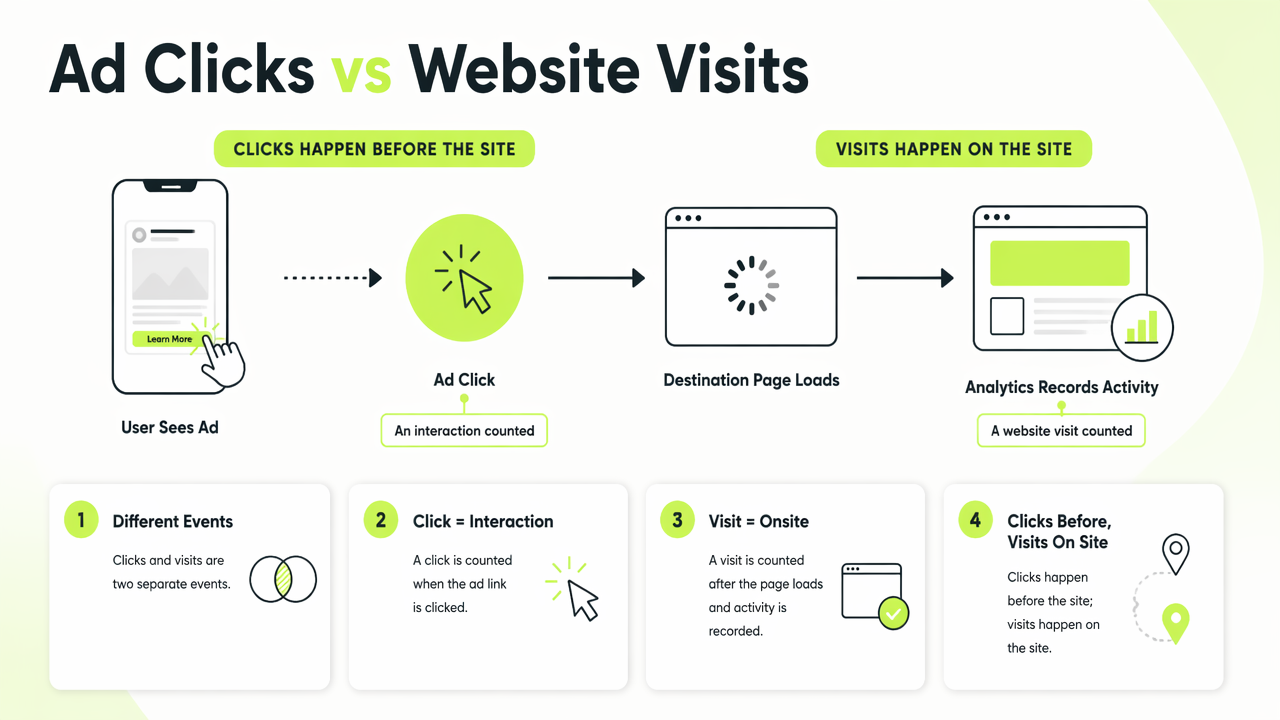
Ad click: an interaction counted by an ad platform, usually at the link or ad asset level.
Website visit: a site-side analytics event, often grouped into a session after a page loads and tracking conditions are met.
SERP research for this topic found 112 results, with competing articles averaging 2,284 words. Many explain the basic distinction, but fewer separate measurement timing from data quality and privacy controls.
Metric comparison table
| Metric | Counted by | When counted | Best use |
|---|---|---|---|
| Ad click | Google Ads, Meta Ads, LinkedIn Ads, or another ad platform | When the ad link or asset is clicked | Creative testing and media delivery |
| Website visit | Analytics software | After page load, tracking, and session rules | Landing page performance and ROI analysis |
| Landing page view | Some ad platforms | After a click leads to a page load signal | Better proxy for real traffic than raw clicks |
Key insight: clicks measure intent to leave the ad environment; visits measure successful arrival inside the website environment.
Why do clicks exceed visits?
Clicks exceed visits when the path between ad interaction and analytics recording breaks, slows, or gets filtered. Common causes include bots, accidental repeat clicks, slow mobile pages, consent banners, blocked scripts, redirects, expired UTM parameters, browser privacy controls, and different platform definitions.
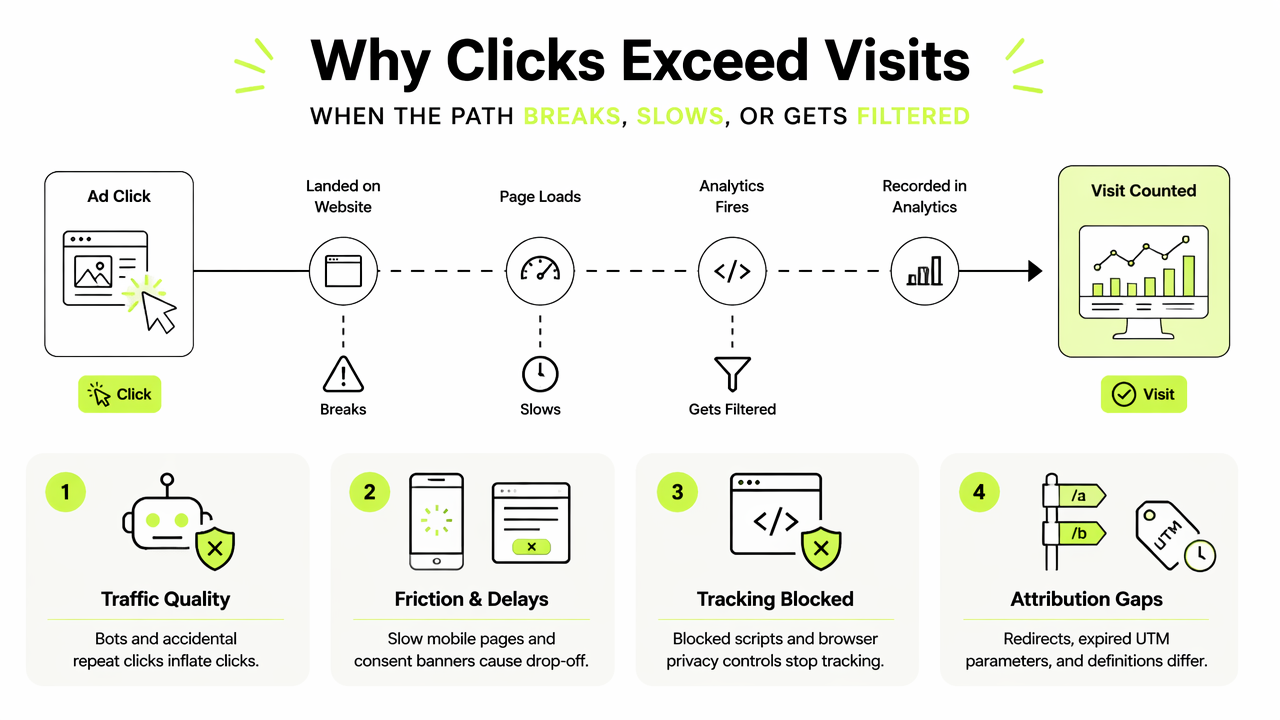
Bots and invalid traffic can inflate ad-side clicks before analytics filters the session. Duplicate clicks can also occur when a person taps twice, returns to the ad, or refreshes a tracking redirect.
Consent is another major factor in 2026 measurement. If analytics only runs after permission, visits from users who decline tracking may be absent. Teams should align consent language with the site's privacy policy and document processor roles in a data processing agreement. Research by Dwivedi, Kshetri, and Hughes (2023) on generative AI and digital policy shows why clear data definitions matter as automated systems interpret business metrics: International Journal of Information Management paper.
Troubleshooting checklist before blaming analytics
- Compare clicks with landing page views, not only total visits.
- Test the full ad URL, including redirects and UTM parameters.
- Check page speed on mobile networks.
- Confirm analytics fires before and after consent choices.
- Review bot, internal traffic, and duplicate-click filters.
- Match time zones across ad and analytics platforms.
- Inspect broken URLs, 404s, and campaign tagging errors.
A click-to-visit gap is a diagnostic signal, not automatic evidence that the analytics tool is wrong.
How should marketers reconcile the gap in 2026?
Marketers should reconcile click and visit gaps by building a source-by-source audit, then validating each step from ad click to landing page event. The best process compares platform definitions, link integrity, consent behavior, page speed, and post-click events before campaign budgets change.
A practical reconciliation model uses three layers:
- Media layer: clicks, impressions, invalid-click rules, and ad platform attribution.
- Arrival layer: landing page views, redirects, load time, and browser behavior.
- Analytics layer: visits, sessions, consent state, conversions, and UTM grouping.
Contracts and acceptable-use rules also matter when several tools process campaign data. Teams can map responsibilities against the site's terms of service before changing tracking or retention practices.
How the Faurya platform supports cleaner reconciliation
The Faurya platform is positioned for privacy-conscious website owners who need clearer traffic reporting without turning every discrepancy into a tool dispute. It helps teams focus on the visit-side record, campaign context, and practical ROI signals.
For 2026 planning, the strongest workflow is simple: tag every campaign consistently, compare clicks against landing-page arrivals, review consent impact, then investigate only the sources with abnormal drop-off. Faurya can fit that workflow when visit quality matters more than raw click volume. More product details are available at faurya.com.
Conclusion
The ad clicks vs website visits difference is normal, but large gaps deserve a structured audit across bots, redirects, consent, page speed, duplicate clicks, UTMs, and definitions. The next step is to document the measurement path, standardize campaign tagging, and use Faurya for cleaner visit analysis. For a focused review, visit faurya.com and compare click volume against real arrival quality.
Generated by EarlySEO.com