Do You Need a Cookie Consent Banner for Analytics in 2026?
Learn when analytics tools require a cookie consent banner under GDPR and ePrivacy rules, and when you can track visitors without one in 2026.

More than 70% of websites now display cookie consent banners, yet many add them without actually needing one. If you only run website analytics, the legal answer depends on a few technical details: the type of analytics tool, whether cookies are used, and how personal data is handled. On The Faurya Growth Blog, founders and marketers often ask whether simple traffic analytics require user consent under GDPR and the ePrivacy Directive. The short answer: sometimes yes, sometimes no. This guide explains the exact scenarios where an analytics cookie banner is mandatory in 2026, when it is optional, and how privacy-first analytics tools change the equation.
Why Cookie Consent Rules Exist in the First Place
To understand whether analytics needs a consent banner, you first need to know why the rules exist. The European ePrivacy Directive (2002/58/EC) requires websites to obtain consent before storing or accessing information on a user's device unless the storage is strictly necessary for the service requested.
A HTTP cookie, according to Wikipedia, is a small block of data stored by a browser when visiting a website. Cookies allow websites to remember sessions, preferences, or track behavior across visits.
Analytics tools often rely on these cookies to measure traffic and user behavior. That is where legal questions start. If analytics cookies identify users or track them across sessions, regulators usually treat them as non-essential cookies.
"Users should have meaningful control over how their data is collected and processed," write Feng, Yao, and Sadeh in a 2021 ACM study on privacy choices.
Types of Cookies Websites Typically Use
- Strictly necessary cookies: login sessions, shopping cart storage
- Analytics cookies: visitor counts, page views, traffic sources
- Marketing cookies: ad targeting and cross-site tracking
- Preference cookies: language or theme settings
Only the first category usually works without consent. Analytics falls into a gray zone depending on implementation.
Typical Cookies Used by Analytics Tools
Many analytics platforms rely on first-party cookies to identify returning visitors or build session statistics. These identifiers may be random but still qualify as personal data if they can indirectly identify a user.
That is why regulators in the EU and UK often treat analytics tracking as requiring user permission unless strong privacy safeguards exist.
Do You Need a Cookie Banner for Google Analytics?
If your website runs Google Analytics 4 (GA4), you almost certainly need a consent banner in jurisdictions like the EU, UK, and Switzerland.
Google Analytics uses cookies such as _ga to distinguish users and track sessions. Even though GA4 reduced reliance on cookies compared with Universal Analytics, it still collects identifiers and IP-related signals.
Several European regulators have taken strict positions. Authorities in France, Italy, and Austria ruled that standard Google Analytics implementations can violate GDPR if data transfers to the United States occur without safeguards.
Key Data Points About Google Analytics Compliance
| Factor | Why It Matters | Consent Needed? |
|---|---|---|
| First-party cookies | Identify returning visitors | Usually yes |
| IP processing | May identify users indirectly | Yes in most EU cases |
| Data transfers outside EU | Trigger GDPR transfer rules | Often requires consent |
| User behavior tracking | Session and event tracking | Usually yes |
For most websites, the safest approach is clear: show a consent banner before loading GA4 scripts.
Regulatory guidance across the EU increasingly treats analytics cookies as non-essential tracking technologies.
Many sites implement consent management tools that block GA4 until a visitor clicks "Accept analytics."
Why GA4 Still Triggers Consent Requirements
Even though Google reduced cookie dependence, GA4 still collects device information, session identifiers, and behavioral signals. Regulators focus less on the technology and more on whether users are tracked.
That means anonymized IP settings alone do not remove consent obligations in most EU interpretations.
When Analytics Does NOT Require a Cookie Consent Banner
There is a growing alternative approach. Some analytics platforms collect traffic data without cookies and without personal identifiers. In these cases, a banner may not be required.

This model relies on aggregated measurements rather than persistent user tracking. Instead of identifying individuals, the system counts visits using temporary signals.
Conditions That Can Remove the Banner Requirement
- No cookies stored on the user's device
- No persistent identifiers across sessions
- IP addresses anonymized or discarded
- Data used only for aggregated statistics
- No cross-site or advertising tracking
If those conditions are met, many legal interpretations treat analytics as "strictly necessary" for site operation or as outside the scope of cookie consent.
Comparison: Cookie-Based vs Cookie-Free Analytics
| Feature | Traditional Analytics | Privacy-First Analytics |
|---|---|---|
| Uses cookies | Yes | No |
| Tracks returning users | Yes | Usually no |
| Requires consent banner | Often yes | Often no |
| Data collected | Behavioral profiles | Aggregated traffic data |
| GDPR risk | Higher | Lower |
Several privacy-focused analytics tools built after 2022 adopted this approach to avoid intrusive banners while still providing useful metrics.
Why Many Startups Are Removing Cookie Banners
Consent banners often reduce analytics data quality. Many users decline tracking, which creates incomplete datasets.
For SaaS startups and indie founders, privacy-first analytics provides a simpler option. Some teams choose tools that collect only aggregated metrics so they can avoid intrusive consent prompts.
The Real Impact of Cookie Banners on Data Accuracy
Cookie consent banners dramatically reduce available analytics data. In many European markets, 30% to 60% of visitors decline analytics tracking once a banner appears.
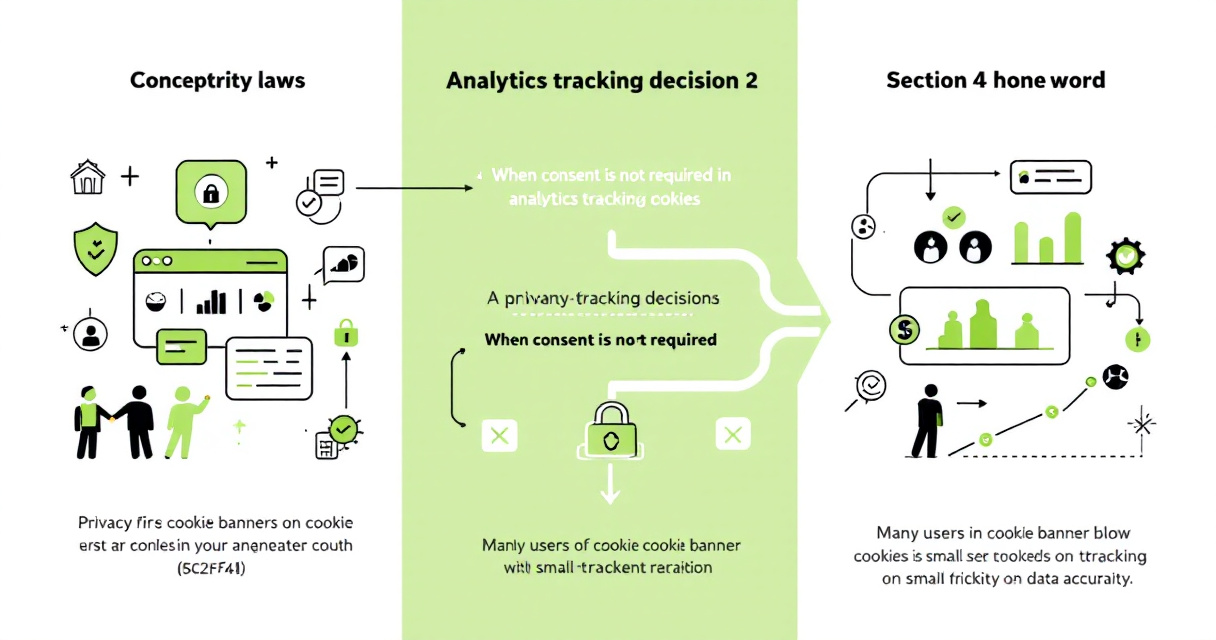
That means dashboards may show only half of real traffic. Growth teams relying on attribution models often see distorted numbers.
Typical Analytics Opt-in Rates
| Banner Design | Average Acceptance Rate |
|---|---|
| Neutral consent design | 40% to 60% |
| Simple "Accept" button only | 70% to 90% |
| Strict equal choice design | 30% to 50% |
Research by Bongard-Blanchy, Rossi, and Rivas (2021) found many websites use dark patterns to push users toward acceptance. However regulators increasingly penalize these designs.
"Users frequently recognize manipulative consent interfaces but still feel pressured into accepting," the researchers observed.
Regulators in France and Germany have already fined companies for misleading consent buttons, which makes aggressive banner design risky in 2026.
Why Ethical Consent Design Matters
Modern privacy laws focus on freely given consent. That means:
- Accept and reject buttons must be equally visible
- Consent must be reversible
- Tracking cannot start before approval
These requirements make some older banner strategies non-compliant today.
Legal Signals from EU Regulators and What They Mean for 2026
European privacy enforcement has become stricter over the past few years. Data protection authorities increasingly examine analytics implementations during audits.

Several trends define the regulatory direction for 2026.
Major Enforcement Trends
- Increased scrutiny of US data transfers
- Stronger enforcement against dark-pattern consent banners
- Greater support for privacy-first analytics approaches
- Potential updates to the long-delayed ePrivacy Regulation
What Regulators Focus On During Audits
- Whether tracking scripts run before consent
- How cookies are categorized
- Data retention periods
- Cross-border data transfers
Companies also need transparent documentation explaining how visitor data is processed. Publishing clear policies such as a website privacy policy and data processing agreement helps demonstrate compliance.
Startups documenting these policies early avoid legal friction later when they scale.
The Role of Website Legal Pages in Compliance
Privacy regulations require transparency about data use. Most websites maintain three key documents:
- Privacy policy describing collected data
- Terms of service explaining platform rules
- Data processing agreements for third-party processors
You can review examples such as this terms of services page to see how companies outline responsibilities and data handling.
Privacy-First Analytics and the Shift Away From Cookie Tracking
A noticeable trend since 2023 is the growth of cookie-free analytics platforms. These tools track page views and referral sources without persistent identifiers.
For SaaS founders focused on product growth, the goal is simple: measure traffic without collecting personal data.
On The Faurya Growth Blog, many discussions around analytics focus on balancing insights with privacy expectations. As browser privacy protections tighten and third-party cookies disappear, minimal tracking approaches are gaining traction.
Benefits of Cookie-Free Analytics
- No intrusive consent banners
- More complete traffic datasets
- Lower legal exposure
- Faster website performance
The trade-off is that advanced features like individual user journeys or detailed attribution models may not be available.
Metrics You Can Still Measure Without Cookies
Even without cookies, privacy-first analytics can still measure:
- Page views
- Top pages
- Referrer sources
- Device categories
- Geographic regions
For many startups, these metrics provide enough insight to guide growth decisions.
What to Expect From Cookie Consent Rules After 2026
Privacy regulation continues evolving as browsers restrict tracking technologies. Several developments are likely over the next few years.
Key Trends Shaping the Future of Web Analytics
- Browsers blocking third-party cookies by default
- Stronger enforcement of privacy-first data collection
- New EU ePrivacy Regulation discussions
- Increased adoption of server-side analytics
Companies that rely heavily on user-level tracking may need to redesign their measurement strategies.
For many founders reading The Faurya Growth Blog, the long-term takeaway is clear: analytics systems built around minimal data collection are becoming the safest approach.
Why Privacy-Centric Tracking May Become Standard
Users increasingly expect transparency about data use. A 2024 Eurobarometer survey found that over 80% of EU citizens worry about how companies track their online activity.
As that awareness grows, tools that respect privacy while still offering business insights will likely dominate analytics infrastructure.
Conclusion
You do not automatically need a cookie consent banner just because you run analytics. The requirement depends on how your analytics system works. Tools that rely on cookies, user identifiers, or cross-border data transfers almost always require consent under GDPR and the ePrivacy Directive. Cookie-free analytics that collect only aggregated statistics often avoid that requirement.
For SaaS founders and marketers, the practical steps are straightforward:
- Audit your analytics scripts and cookies.
- Determine whether identifiers or personal data are collected.
- Implement a consent banner if tracking requires it.
- Document policies with a privacy policy and data processing agreement.
- Consider privacy-first analytics if you want simpler compliance.
If you want more growth and privacy insights like this, explore resources on The Faurya Growth Blog. The platform regularly shares practical guides that help startups measure performance while staying compliant with modern privacy laws.
Generated by EarlySEO.com